
Best Bed for Elderly With Mobility Issues: 5 Safe Options


Adjustable Bed Frame

Gardening Kneeler Bench

Adult Coloring Book
Getting in and out of bed can become difficult when mobility is limited. A bed that is too high, too low, or hard to adjust can make transfers harder for both the older adult and the caregiver.
The best bed for elderly with mobility issues should do more than provide a comfortable place to sleep. Height adjustment, easy positioning, low-height settings, support features, and caregiver access can make a real difference. We compared five current options with these needs in mind.
Best Beds for Elderly With Mobility Issues
The strongest choices are beds that can adjust to the user’s needs instead of forcing the user to adapt to a fixed height.
Best Overall: SonderCare Aura Premium
The SonderCare Aura Premium is our best overall choice for seniors who need substantial mobility support. Its full-electric hi-low design lets the entire bed move up and down, which is more useful for transfers than a standard adjustable mattress base.
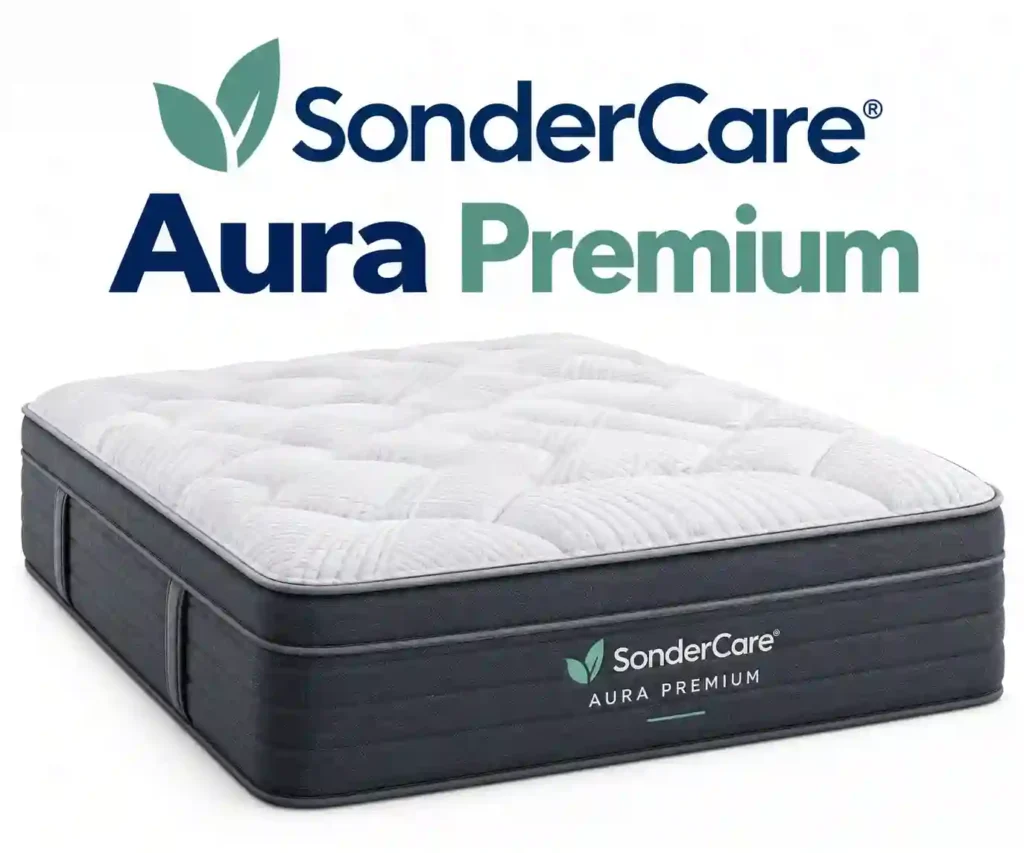
The bed can lower to a 10-inch platform height and rise to a 39-inch working height. It also includes head and knee positioning, multi-height assist rails, and a pre-programmed transfer position. The 500-pound capacity gives it a wide range of use.
Its biggest drawback is price. At around $6,999, it is far more expensive than basic home hospital beds. It also takes more planning to fit into a bedroom.
| Specification | Details | Why It Matters |
|---|---|---|
| Bed type | Full-electric home hospital bed | Adjusts for transfers and care |
| Platform range | 10–32 inches | Allows low and caregiver-friendly positions |
| Mattress-top height | Up to about 39 inches | Easier caregiver access |
| Weight capacity | 500 lb | Suitable for many users |
| Assist rails | Multi-height rails | Helps with positioning and transfers |
The Aura is designed to combine hospital-bed functions with a more residential appearance. That can be useful for families who need medical functionality without a strongly clinical-looking bedroom.
Pros And Cons
The Aura has an unusually wide range of adjustments, but its premium design comes with a premium price.
| Feature | Pro | Con |
|---|---|---|
| Height adjustment | Very wide range | Expensive system |
| Low position | Useful for fall-risk users | Requires careful setup |
| Caregiver height | Reduces awkward bending | More expensive than basic beds |
| Positioning | Head and knee adjustments | More controls to learn |
| Rails | Adjustable assist rails included | Rails still require proper assessment |
Who Should Consider This Product
This bed makes the most sense for an older adult who has significant difficulty getting into or out of bed, needs regular caregiver assistance, or benefits from frequent bed repositioning.
Someone who is still independently mobile and only wants a more comfortable sleeping position may not need such an advanced medical bed.
Best For: Seniors needing extensive mobility and caregiver support
Not Ideal For: Shoppers looking for a low-cost standard adjustable bed
Best Value: CostCare B337 Hi-Low Hospital Bed
The CostCare B337 is a better fit for shoppers who need the core benefits of a hi-low hospital bed without moving into the luxury price range. Its low position reaches about 7 inches, while the bed can rise to about 30 inches for care.
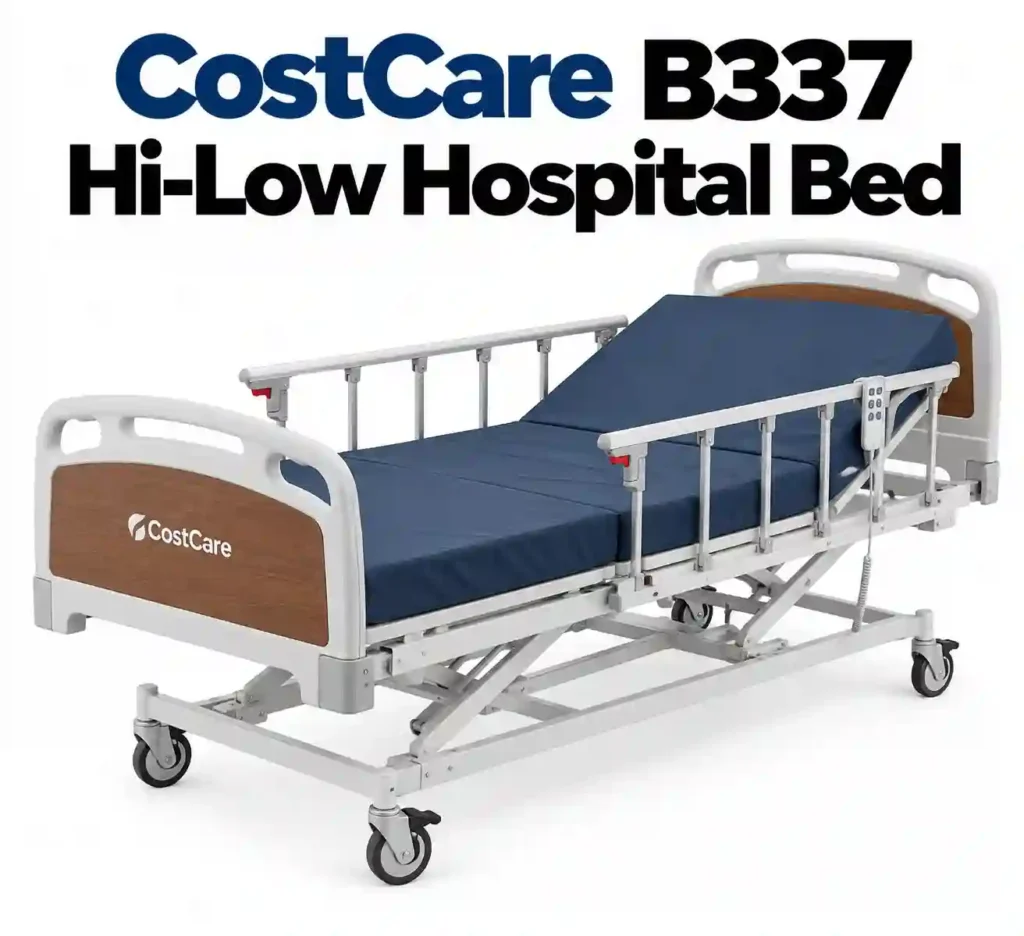
It also has a central locking system and under-bed lighting. The built-in lighting is a practical touch for older adults who need to get out of bed at night.
| Specification | Details | Why It Matters |
|---|---|---|
| Bed type | Full-electric hi-low bed | Easy height adjustment |
| Low height | About 7 inches | Helps reduce fall height |
| High height | About 30 inches | Better caregiver access |
| Locking | Central locking system | Keeps the bed stable |
| Lighting | Built-in under-bed light | Improves nighttime visibility |
The B337 is especially appealing when safety and caregiver access matter more than having a furniture-style appearance.
Pros And Cons
The B337 focuses on practical home-care functions rather than luxury finishes.
| Feature | Pro | Con |
|---|---|---|
| Low height | Very low sleeping position | More clinical appearance |
| Hi-low adjustment | Useful for transfers | Takes floor space |
| Central locking | Helps stabilize the bed | Requires correct setup |
| Under-bed light | Useful at night | Adds another powered feature |
| Expandability | Flexible bed configuration | Can increase overall cost |
Who Should Consider This Product
Consider the B337 if the main concern is safe bed entry and exit, caregiver access, and long-term home care.
It may not be the right choice for someone who wants the appearance of normal bedroom furniture or does not need a medical-style bed.
Best For: Value-focused home care
Not Ideal For: Buyers prioritizing luxury bedroom styling
Best Low-Profile Choice: Opera Solo
The Opera Solo stands out for seniors who have a high risk of falling from bed. Its platform can lower to about 4¼ inches and rise to about 29 inches.
That extremely low setting is one of its main advantages. Instead of simply making a fall less likely, a very low sleeping position can reduce the distance of a potential fall.
The Solo also has auto-regression, a backrest that can rise for sitting, an integrated length extension, and unrestricted clearance underneath for certain mobility equipment.
| Specification | Details | Why It Matters |
|---|---|---|
| Low platform | About 4¼ inches | Very low sleeping position |
| High platform | About 29 inches | Easier caregiver access |
| Length extension | About 8 inches | Useful for taller users |
| Backrest | Up to 70° | Supports upright positioning |
| Warranty | 3 years | Adds purchase protection |
The Solo is available in different widths, including 36-, 42-, and 48-inch configurations. Its standard listed price is around $3,795, with the mattress sold separately.
Pros And Cons
The ultra-low design is its strongest feature, but it is not necessary for every senior.
| Feature | Pro | Con |
|---|---|---|
| Ultra-low height | Excellent for fall-risk users | May be too low for some transfers |
| Height adjustment | Supports different needs | Requires correct positioning |
| Auto-regression | Helps when sitting up | More complex mechanism |
| Length extension | Helps taller users | Mattress infill may be needed |
| Grab rail option | Can assist transfers | Must be used correctly |
Who Should Consider This Product
The Solo is particularly interesting for seniors who are vulnerable to falls from bed or who need a very low sleeping surface.
However, the lowest setting is not automatically the best transfer height. A senior who needs to stand from the bed may require a higher setting that matches their body and transfer ability.
Best For: Seniors with significant fall risk
Not Ideal For: People who simply want a conventional-height bedroom bed
Best Budget-Friendly Option: Epachois 5-Function Home Hospital Bed
The Epachois 5-function full-electric home hospital bed offers a more accessible entry point for families who need adjustable hospital-bed functionality. The current listing includes a mattress and IV pole and is designed for home care, recovery, and longer-term support.
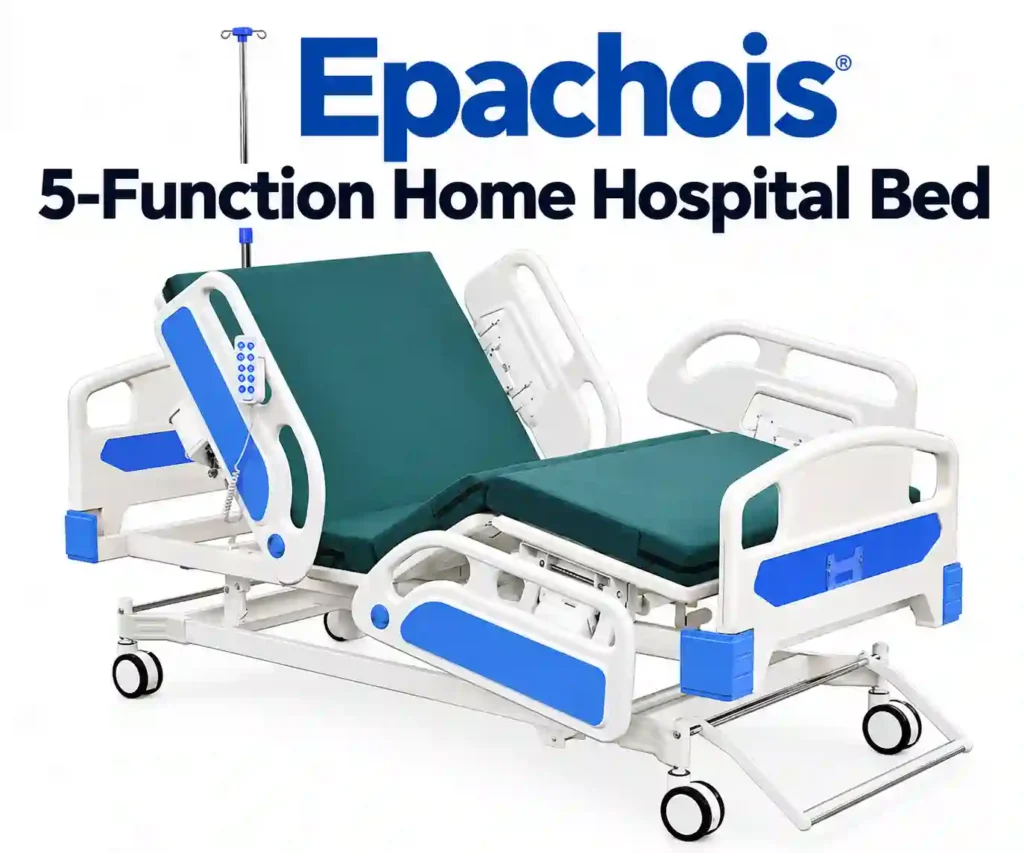
Its main appeal is the combination of multiple electric adjustments with a lower price than premium residential medical beds.
| Specification | Details | Why It Matters |
|---|---|---|
| Bed type | 5-function full-electric | Multiple positioning options |
| Mattress | Included with listed package | Reduces separate buying |
| IV pole | Included | Useful for certain care situations |
| Intended use | Home care and recovery | Fits extended-care needs |
| Warranty | 1-year limited | Check coverage before purchase |
The listed price is about $2,099 at the time of research, but medical-equipment prices can change quickly. Availability should also be checked before ordering.
Pros And Cons
This model is more about practical functionality than premium furniture styling.
| Feature | Pro | Con |
|---|---|---|
| Electric adjustment | Easier than manual cranks | Requires electrical power |
| Five functions | Flexible positioning | More controls to learn |
| Mattress included | Convenient package | Mattress choice is less flexible |
| IV pole | Useful for some care setups | Not needed by every user |
| Price | Lower than premium beds | Shorter warranty |
Who Should Consider This Product
This bed can work well for families who need several electric positioning functions but do not want to spend several thousand dollars on a furniture-style senior bed.
Check the exact package contents and availability before ordering because equipment configurations can change.
Best For: Families seeking full-electric functions at a lower price
Not Ideal For: Buyers wanting premium residential styling
Best Home-Style Design: Opera Solo Comfort
The Opera Solo Comfort combines medical-bed functionality with a more residential appearance. It can move from about 4¼ inches to 29 inches at the mattress platform and includes an auto-regression backrest.
It also offers an in-bed chair position and an upholstered design. This makes it attractive for seniors who spend a lot of time in bed but do not want the room to look like a clinical care area.
| Specification | Details | Why It Matters |
|---|---|---|
| Height range | About 4¼–29 inches | Supports transfers and low positioning |
| Backrest | Up to 70° | Helps with upright sitting |
| Width options | 36, 42, or 48 inches | More sizing flexibility |
| Length extension | About 8 inches | Helps taller users |
| Warranty | 3 years | Useful for a long-term purchase |
The Solo Comfort starts around $5,895 and does not include the mattress.
Pros And Cons
The Solo Comfort is a strong choice when comfort and home appearance matter alongside mobility support.
| Feature | Pro | Con |
|---|---|---|
| Low height | Strong fall-safety option | May be too low for some users |
| Home appearance | Less clinical look | Costs more than basic beds |
| Chair position | Useful for sitting upright | Not needed by every user |
| Controls | Large backlit buttons | Requires power |
| Width options | Flexible sizing | Wider versions need more room |
Who Should Consider This Product
The Solo Comfort is worth considering when a senior needs substantial bed adjustment but the family also wants a bedroom-friendly appearance.
It may be excessive for someone who only needs help with mattress comfort or occasional back elevation.
Best For: Seniors needing mobility support in a home-style bed
Not Ideal For: Shoppers on a very tight budget
Comparison At A Glance
The right choice depends mostly on how much mobility support is needed, how low the bed should go, and how much caregiver assistance is required.
| Product | Best For | Key Trade-Off |
|---|---|---|
| SonderCare Aura Premium | Overall mobility support | Very expensive |
| CostCare B337 | Value and home care | Clinical appearance |
| Opera Solo | Fall-risk users | Low position may not suit every transfer |
| Epachois 5-Function | Lower-cost electric care | Less premium design |
| Opera Solo Comfort | Home-style care | Higher price |
How We Chose These Products
We focused on features that directly affect mobility rather than simply choosing popular mattresses or adjustable bases. A true hi-low hospital bed can raise and lower the entire sleeping surface, which can be more useful for transfers than a consumer adjustable base that only changes head and foot angles.
We compared current product specifications, height ranges, positioning features, weight limits where published, caregiver access, safety features, warranty information, and practical limitations.
| Evaluation Factor | Why It Matters |
|---|---|
| Height adjustment | Helps match the bed to transfers |
| Low position | Can reduce fall height |
| Caregiver height | Makes daily care easier |
| Positioning | Helps with sitting and repositioning |
| Ease of use | Important for older adults |
| Safety features | Helps address mobility-related risks |
| Value | Balances features with cost |
We did not treat price or popularity as proof that a bed is better. The goal was to match each product to a different mobility need.
What To Look For When Buying
A mobility-friendly bed should be selected around the person’s actual transfer ability, not just the number of buttons or advertised features.
Choose The Right Height Range
A bed that adjusts in height is often more useful than a standard fixed-height frame. The ideal transfer height depends on the individual. A bed should allow the user to place their feet securely on the floor and stand without an awkwardly deep or high sitting position.
Very low settings can be useful for fall-risk situations, but the lowest possible setting is not necessarily the best setting for getting out of bed.
Look For Full-Bed Height Adjustment
Do not confuse a consumer adjustable base with a hi-low medical bed.
An adjustable base can raise the head or feet. A hi-low hospital bed can also raise or lower the entire sleeping surface. That difference matters when the main problem is transferring between the bed and a wheelchair or standing position.
Check Weight Capacity
Always compare the user’s weight with the manufacturer’s published weight limit.
If the user is close to the maximum capacity, consider the total setup, including the mattress and accessories. Never assume that a wider bed automatically has a higher capacity.
Consider Caregiver Access
If someone regularly helps with dressing, repositioning, transfers, or personal care, a bed that raises to a comfortable working height can be valuable.
This can also make routine care easier for the caregiver. The benefit is especially relevant when care happens several times each day.
Think About Controls
Large, easy-to-see buttons are useful when vision, dexterity, or hand strength is limited.
A complicated remote can turn a helpful feature into a frustration. Look for simple controls and, where appropriate, lockout features.
Match The Mattress
The mattress must be compatible with the bed and its movement.
Do not buy a random mattress simply because it fits the dimensions. Check the manufacturer’s recommended mattress type, thickness, and compatibility with rails and positioning.
Common Buying Mistakes
A costly bed is not automatically a safer bed. The biggest mistakes usually come from choosing the wrong type or ignoring the user’s actual transfer needs.
| Mistake | Better Approach |
|---|---|
| Buying a normal bed because it is cheaper | Match the bed to the mobility problem |
| Choosing the lowest possible height | Find the safest practical transfer height |
| Looking only at mattress comfort | Evaluate the whole bed system |
| Ignoring weight capacity | Check the manufacturer’s limits |
| Adding random bed rails | Confirm bed, mattress, and rail compatibility |
| Buying too many features | Pay for features the senior will actually use |
Another common mistake is assuming that a bed rail automatically makes a bed safer. The FDA warns that bed rails can create entrapment and fall hazards for some older adults, particularly people with physical or cognitive limitations.
Safety Considerations
Mobility problems and fall risk make bed selection more important, but no bed can eliminate falls completely.
Bed rails should not be treated as a universal safety solution. The FDA recommends individual assessment because rails can create entrapment risks and may not be appropriate for everyone. Rails, mattresses, and bed frames also need to be compatible, with gaps checked regularly.
For someone with significant mobility limitations, repeated falls, confusion, or a condition that affects balance, it is sensible to ask a doctor, physical therapist, occupational therapist, or other qualified professional about the safest setup.
If the bed will be used for medical care, also check whether a medically necessary hospital bed may qualify for coverage. Medicare lists hospital beds as durable medical equipment, and Part B can cover medically necessary DME when ordered by an eligible health care provider for use at home.
Frequently Asked Questions
What type of bed is best for an elderly person with mobility issues?
A full-electric hi-low hospital bed is often the most useful option when getting in and out of bed is difficult. It can adjust the entire bed height as well as the head and foot sections.
Is a low bed better for seniors with mobility problems?
A low bed can reduce the height of a potential fall, but it is not automatically better for transfers. Someone who struggles to stand may need a higher transfer position.
Are adjustable beds good for seniors with mobility issues?
They can be helpful, especially when the user benefits from raising the head or legs. However, a consumer adjustable base usually does not raise or lower the entire bed, so it may not solve transfer problems.
Do seniors need bed rails?
Not necessarily. Bed rails can provide assistance with repositioning or transfers, but they can also create entrapment and fall risks. The FDA recommends assessing the individual situation before using them.
Conclusion
For most seniors with substantial mobility limitations, the SonderCare Aura Premium is the strongest overall choice because of its wide height range, electric positioning, assist rails, and caregiver-friendly design. It is expensive, though, so it makes the most sense when those features will actually be used.
For a lower-cost approach, the CostCare B337 offers practical hi-low functionality. The Opera Solo is especially interesting for serious fall-risk concerns, while the Epachois 5-Function provides a more budget-oriented full-electric setup. The Opera Solo Comfort is a good option when mobility support and a home-style appearance both matter.
The most important step is to match the bed to the person’s actual mobility needs. Focus on safe transfers, usable controls, correct height, proper sizing, and professional guidance when the person’s condition makes bed selection complicated.