
Adjustable Walking Cane Explained: Fit & Safety Guide

Bed Rail for Seniors

Lightweight Vacuum Cleaner

Back Massager with Heat
Quick Answer
An adjustable walking cane is a mobility aid with a shaft that can be lengthened or shortened to fit the user. Most models use telescoping tubes, a spring-loaded adjustment button, and sometimes a locking collar. The handle should generally align with your wrist crease when standing upright, with a slight bend in your elbow when gripping it. Correct adjustment and secure locking are essential for safe support.
What Is an Adjustable Walking Cane?
An adjustable walking cane is a walking aid that allows its height to be changed without permanently cutting or replacing the shaft. It provides an additional point of ground contact for someone who needs modest balance assistance or support while walking.
Unlike a traditional fixed-length cane, an adjustable model accommodates different heights within its specified adjustment range. This makes fitting more flexible, particularly when someone is learning to use a cane or needs to correct an unsuitable setting.
The height-adjustment feature does not automatically make a cane more supportive. Stability also depends on its base, handle, construction, condition, and suitability for the user’s mobility needs.
For a broader introduction to mobility aids, our guide explaining what walking canes do covers their main purposes and common designs.
How Does an Adjustable Walking Cane Work?
Most adjustable canes work through two overlapping shaft sections. One tube slides inside the other, allowing the overall cane length to increase or decrease.
A locking mechanism holds the selected position. On common push-button designs, a spring-loaded metal pin passes through one of several adjustment holes. Some models include a separate collar to tighten the connection and reduce movement.
The main components
- Handle: Provides the gripping surface and transfers pressure from the hand into the shaft.
- Upper shaft: Forms the upper structural section of the cane.
- Lower extension tube: Slides to change the overall height.
- Adjustment holes: Provide predetermined height positions.
- Spring-loaded button: Engages a selected hole to hold the shaft at its intended length.
- Locking collar: On compatible models, tightens around the adjustable connection.
- Rubber tip: Provides ground contact and traction during walking.
The adjustment mechanism is part of the cane’s structural integrity. A button that is only partly engaged, or a collar that has not been secured according to the instructions, can leave the cane unsafe to use.
Our explanation of walking cane shaft construction explores how telescoping and fixed shafts differ.
How to Adjust a Walking Cane to the Correct Height
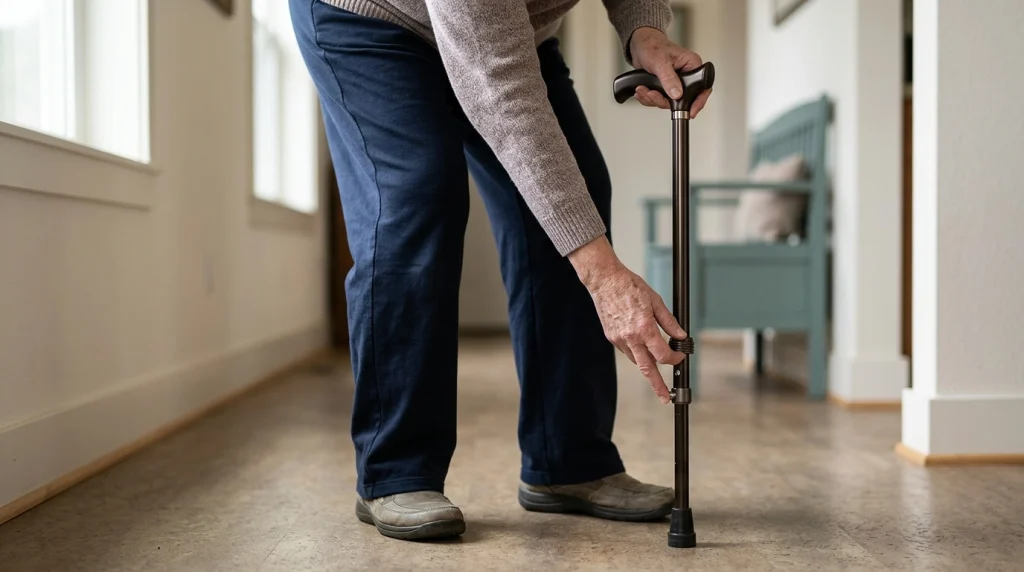
The best starting position is generally where the handle aligns with the crease of your wrist while your arm hangs naturally at your side. The final fit should allow a comfortable, slight elbow bend.
The Cleveland Clinic’s cane-fitting guidance describes wrist-crease alignment and an elbow bend of approximately 20 degrees as useful fitting references.
Step-by-step height adjustment
- Put on your usual walking shoes. Different shoe soles can change the effective height of the cane.
- Stand on a firm, level surface. Maintain a comfortable upright posture with relaxed shoulders.
- Let your arms hang naturally. Identify the wrist crease on the side where you will hold the cane.
- Position the cane beside you. Compare the handle height with your wrist crease.
- Release the adjustment mechanism. On common push-button models, loosen the collar if present, then press the adjustment button.
- Slide the lower tube. Move it until the handle reaches an appropriate height and the button aligns with an adjustment hole.
- Secure the mechanism. Confirm that the button projects completely through the hole. Tighten any locking collar as instructed by the manufacturer.
- Check the fit and stability. Hold the handle, confirm a slight elbow bend, and check that the shaft does not slip or move unexpectedly.
These steps describe a common push-button design. If your cane uses a different mechanism, follow its specific instructions rather than assuming the locking procedure is identical.
Practical Tip
Set the height while wearing the shoes you normally walk in. After locking the cane, recheck your posture and elbow position instead of relying only on a height chart or the manufacturer’s default setting.
How Can You Tell Whether Your Cane Is Too High or Too Low?
An incorrectly adjusted cane may encourage awkward posture or make walking less comfortable. Height should be checked together with how the cane feels and functions during use.
| Cane setting | Possible signs | What to check |
|---|---|---|
| Too high | Raised shoulder, awkward elbow position, difficulty moving the cane naturally | Lower the handle toward wrist-crease height |
| Too low | Sideways leaning, excessive forward bending, uncomfortable reaching | Raise the handle and reassess posture |
| Appropriate fit | Relaxed shoulder, comfortable grip, slight elbow bend, upright posture | Confirm the lock is secure and walking feels controlled |
These signs are fitting clues rather than a medical diagnosis. Persistent discomfort, leaning, or instability despite adjustment warrants a fitting assessment by a physical therapist or another qualified healthcare professional.
Adjustable vs. Fixed-Length Walking Cane: What Changes?
The main difference is fitting flexibility. Adjustable canes allow repeated height changes, while fixed-length canes maintain a set shaft length unless physically modified.
| Feature | Adjustable cane | Fixed-length cane |
|---|---|---|
| Height changes | Uses built-in adjustments | Usually requires sizing or permanent modification |
| Shaft construction | Often telescoping tubing | Usually one continuous shaft |
| Inspection needs | Locks, buttons, collars, shaft, and tip | Shaft, handle connections, and tip |
| Main advantage | Flexible fitting | Simpler construction |
Neither design is automatically safer. A properly sized, well-maintained fixed cane may be preferable to a poorly constructed adjustable one. Conversely, a securely locking adjustable cane can make achieving the correct height much easier.
Also, adjustable and folding are not interchangeable terms. A cane may adjust in height without folding, fold without offering much height adjustment, or provide both functions.
Who Can Benefit From an Adjustable Cane?
An adjustable cane can be useful for someone who needs modest walking support and benefits from a customizable handle height.
Potential situations include mild balance difficulty, discomfort affecting one leg, or temporary mobility limitations during recovery when a healthcare professional considers cane use appropriate.
Height adjustment is particularly practical when the user is still establishing a comfortable fit or when a cane needs to accommodate different footwear.
However, adjustability does not replace an assessment of how much support is required. The MedlinePlus guidance on using a cane explains that people experiencing considerable weakness, pain, or balance problems may need crutches or a walker instead.
If you need to place substantial body weight through the walking aid, experience repeated falls, or cannot walk safely with one point of support, seek an appropriate mobility assessment rather than simply selecting a heavier cane.
How Should You Walk With an Adjustable Cane?
Once the cane is correctly fitted and securely locked, the walking technique is generally the same as with a fixed-height cane.
When one leg is weaker or painful, the cane is normally held in the hand opposite that leg, unless a clinician has recommended another technique.
- Stand upright with the cane near your side, not excessively far ahead.
- Move the cane forward together with the weaker or affected leg.
- Place the cane tip securely on the ground before transferring pressure through the handle.
- Step through with the stronger leg.
- Continue at a controlled, comfortable pace.
Look ahead rather than continuously watching your feet. Keep pathways clear, and avoid placing the cane where it could interfere with your next step.
For stairs, the commonly taught sequence is stronger leg first when going up, and cane with weaker leg first when going down. Use a secure handrail when available and follow individualized instructions if you have been given them.
Common Adjustment Mistakes and Safety Checks
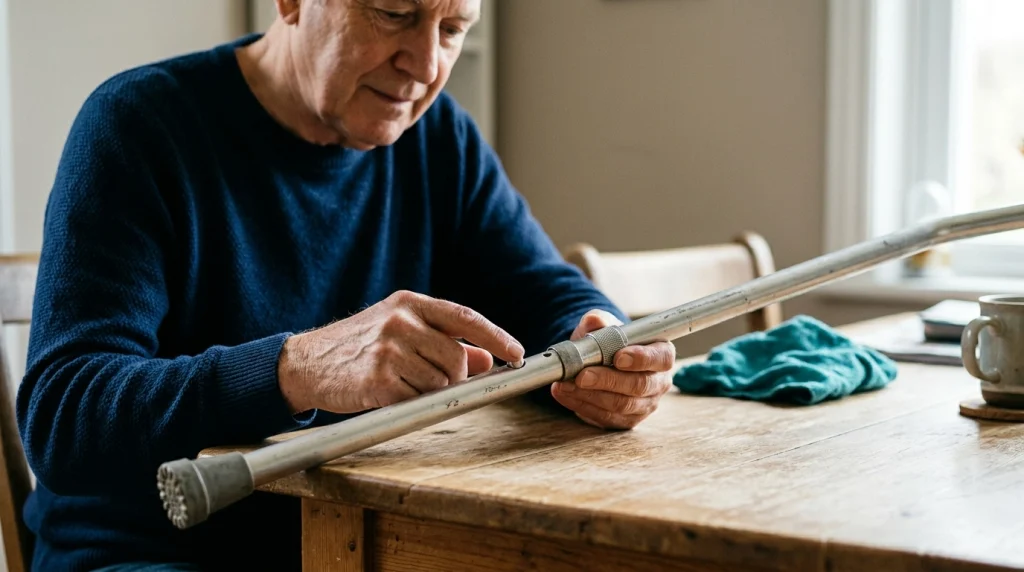
Correct height is only one part of safe cane use. The adjustment mechanism and rubber tip must also remain in good condition.
Mistakes worth avoiding
- Using the factory height: A new cane’s initial setting may not match the user.
- Leaving the button partly engaged: The pin must pass fully through the intended adjustment hole.
- Forgetting the locking collar: If the model includes one, secure it according to its instructions.
- Ignoring worn rubber: A damaged tip may provide less reliable traction.
- Exceeding the stated capacity: Use the manufacturer’s weight rating and intended-use instructions.
- Continuing with damaged tubing: Bent shafts, distorted adjustment holes, and loose components need attention.
Safety Warning
Do not use an adjustable cane if its locking button fails to engage, the shaft slips, or a structural component is damaged. Stop using it until the problem is corrected according to the manufacturer’s instructions or the cane is replaced.
A quick inspection before walking
Check that the button is fully visible through its adjustment hole, the collar is secure where applicable, the handle does not feel loose, and the rubber tip is firmly attached.
Also examine the adjustment holes for distortion and the tubing for cracks or bends. Guidance from South Tees Hospitals NHS Foundation Trust specifically recommends checking these components regularly.
If a cane repeatedly rattles, shifts, or feels unstable, identify the cause before further use. Do not use improvised tape or wedges to compensate for a faulty locking mechanism.
What Matters Most When Choosing an Adjustable Cane?
Start with an adjustment range that actually includes your required handle height. A cane labeled adjustable is not necessarily suitable for every person’s height.
Next, consider the grip. A handle should feel comfortable without requiring excessive squeezing or forcing the wrist into an awkward position.
The base matters as well. Single-point and quad-base designs provide different ground-contact arrangements, but a wider base does not make every cane suitable for every user.
Finally, check the rated capacity, locking design, available replacement tips, and manufacturer’s instructions. A suitable cane should be both correctly fitted and appropriate for the level of support required.
Related Product
Height-Adjustable Walking Canes
Explore adjustable walking canes and compare their height ranges, handles, locking mechanisms, and manufacturer-rated capacities.
As an Amazon Associate, we earn from qualifying purchases.
Frequently Asked Questions
Can two people use the same adjustable walking cane?
Possibly, if its height range, rated capacity, handle, and support design suit both individuals. The height must be reset and the locking mechanism checked whenever the user changes.
How often should you check an adjustable cane’s height?
Check it whenever the setting has been changed, the cane feels uncomfortable, or the locking mechanism appears to have moved. Confirm secure engagement before use and periodically reassess the fit.
Can an adjustable walking cane collapse while walking?
A cane with an improperly engaged or damaged adjustment mechanism may slip or collapse. A functioning, correctly secured lock is essential, and a defective cane should not be used.
Are adjustable walking canes suitable for tall people?
They can be, provided the model’s adjustment range reaches the required handle height and its other specifications are suitable. Some users need a cane designed with a longer height range.
Does an adjustable cane need a special rubber tip?
Not necessarily. It needs a replacement tip compatible with the particular cane’s shaft dimensions and design. Follow the manufacturer’s compatibility guidance rather than assuming that all cane tips fit.
Can you adjust a walking cane while sitting?
You may be able to operate the mechanism while seated, but the final height should be checked while standing safely in your normal walking shoes. Have someone assist if standing or adjusting the cane is difficult.
Final Thoughts
An adjustable walking cane makes it easier to achieve an appropriate handle height without permanently modifying the shaft. Its real value comes from combining that flexibility with a secure locking mechanism, a comfortable grip, and correct walking technique.
Fit the cane to your wrist height, confirm a slight elbow bend, inspect the locking components, and choose a design suited to your support needs. If walking remains unstable despite correct adjustment, professional mobility guidance can help determine whether a different walking aid is more appropriate.
