
Bariatric Walking Cane Explained: Types & Safety


Page Magnifier Sheet

Adjustable Bed Frame

Orthopedic Sandals
Quick Answer
A bariatric walking cane is a heavy-duty mobility aid designed to support users who need a higher weight-rated cane than a standard model. It generally features reinforced construction, an adjustable shaft, and a sturdy handle. Some models have a single rubber tip, while others have a four-point base. Certain bariatric canes are rated for 500 pounds, but the actual limit depends on the manufacturer and model. A higher weight rating does not automatically mean the cane provides enough balance or walking support for every user.
What Is a Bariatric Walking Cane?
A bariatric walking cane is a specially designed cane that offers a higher manufacturer-rated weight capacity than many ordinary walking canes. It serves the same basic purpose as a standard cane: providing an additional point of contact with the ground to assist balance and reduce some pressure on a weaker or painful leg.
The main distinction is structural. Bariatric models generally use heavy-duty tubing, reinforced components, durable grips, and bases designed for their stated loads.
For example, the Dynarex Bari+Max Offset Cane is rated for 500 pounds. That rating belongs to the specific model, not every cane described as bariatric.
The term bariatric describes the device’s intended support category. It does not establish that someone needs a cane based solely on their body weight.
A person may need a heavy-duty cane because their existing cane is not rated for their weight. Another person may have significant balance limitations and need a walker, even though their body weight falls within a cane’s advertised capacity.
For a broader explanation of mobility aids, see our walking cane guide.
How Is a Bariatric Cane Different From a Regular Cane?
The key difference is the combination of manufacturer-rated capacity and construction. However, the actual comparison depends on the models involved.
| Feature | Standard Cane | Bariatric Cane |
|---|---|---|
| Weight rating | Often lower | Designed for higher rated loads |
| Construction | Varies by model | Heavy-duty or reinforced design |
| Handle | Straight, curved, or offset | Often offset or contoured |
| Base | Single-tip or multi-point | Single-tip or heavy-duty quad |
| Suitability | Depends on fit and support needs | Also requires appropriate fit and support needs |
A bariatric cane is not necessarily wider, heavier, or more stable than every regular cane. For example, a heavy-duty single-point cane may offer less base contact than a standard quad cane.
The important question is not simply whether the product is labeled heavy-duty. It is whether the complete device is suitable for the user’s weight, balance, strength, walking pattern, and environment.
What Types of Bariatric Walking Canes Are Available?

The two main configurations are heavy-duty single-point canes and bariatric quad canes. The correct option depends on the amount of support needed and how comfortably the user can move the cane.
Heavy-Duty Single-Point Cane
This design has one ground-contact tip, usually attached to a reinforced shaft. Many models use an offset handle to position hand pressure over the shaft.
A single-point design is generally easier to maneuver through narrow spaces and can feel more natural during walking. It may suit someone who needs modest assistance while retaining reasonably good balance.
However, its single contact point offers a narrower support base than a quad cane.
Bariatric Quad Cane
A bariatric quad cane has four rubber-tipped contact points. Its wider footprint can offer additional support during slow, deliberate walking.
The Graham-Field Bariatric Quad Cane, for instance, has a large four-point base and a stated maximum capacity of 500 pounds under the manufacturer’s specified loading conditions.
Quad canes can also be more awkward to position around furniture, narrow walkways, or uneven surfaces. All four feet should contact the ground properly before the user relies on the base.
The best choice is not necessarily the widest cane. It is the design the user can position, control, and walk with safely.
How Much Weight Can a Bariatric Cane Support?
Some bariatric walking canes have a stated capacity of 500 pounds. Others may have different limits. There is no universal weight rating that applies to every bariatric cane.
The manufacturer provides the applicable capacity for each model. For example:
- Dynarex Bari+Max Offset Cane: 500-pound stated capacity.
- Graham-Field Bariatric Quad Cane: 500-pound maximum capacity, specified as evenly distributed.
- NOVA Heavy Duty Quad Cane: 500-pound stated capacity for the identified model.
These figures are examples of published specifications, not independent performance-test results.
Key Insight
A 500-pound cane rating does not mean the cane can replace a walker or safely carry a person’s entire body weight during every movement. The rating describes a manufacturer’s specified limit; it does not determine the amount of balance assistance a person needs.
Check the exact product model and its instructions before use. The stated capacity should be suitable for the intended user, and the cane must be used within the manufacturer’s conditions.
Also examine the shaft, height-locking mechanism, handle, and rubber tip. A high capacity printed on a label does not compensate for a damaged or incorrectly assembled component.
Who May Benefit From a Bariatric Walking Cane?
A bariatric cane may be appropriate for someone who needs a higher-rated mobility aid but can still walk safely with support from one hand.
Possible situations include:
- A person whose weight exceeds the published limit of an existing standard cane.
- Someone with mild one-sided leg weakness who needs appropriately rated support.
- A person with joint discomfort who has been advised to use a cane for partial unloading.
- A user who can walk independently but needs a suitable heavy-duty device for occasional balance assistance.
Body weight is only one factor. Hand strength, upper-body control, gait, balance, pain, and the need to unload a leg also matter.
Someone who frequently falls, cannot remain upright with one-handed support, or must place substantial weight through both arms may require a different mobility device.
MedlinePlus advises that a walker or crutches may be more appropriate when someone has considerable weakness, pain, or balance problems.
A physical therapist can assess the person’s walking pattern and help determine whether a cane provides enough support.
How to Choose the Right Bariatric Walking Cane
Start with the support required, not the appearance of the cane. A practical assessment should consider five main factors.
1. Verified Weight Capacity
Check the specific manufacturer’s weight limit. Do not assume that two visually similar products have identical ratings.
Look for a clear model number, product instructions, and published specifications. Avoid relying entirely on broad labels such as extra-strong or heavy-duty.
2. Appropriate Base
A single-point base generally favors easier movement. A quad base provides several ground-contact points but requires more deliberate placement.
Neither design is automatically suitable for severe instability. Choose based on the user’s functional needs, preferably with professional assessment.
3. Adjustable Height
The cane must reach the user’s wrist comfortably when standing upright. Make sure the stated adjustment range includes the required height.
Check that the push-button lock engages fully and that any locking collar is properly secured.
4. Handle Comfort
An uncomfortable grip can create hand or wrist strain, especially when the cane is used regularly.
Look for a handle that allows a secure, comfortable hold without excessive finger pressure. A contoured or offset grip may be useful, but comfort varies between users.
5. Everyday Maneuverability
Consider where the cane will be used: narrow hallways, outdoor paths, stairs, or crowded rooms.
A large quad base may feel secure on level flooring but become inconvenient in a tight space. The user should be able to lift, position, and control the cane without struggling.
Material and shaft design also affect handling. Our guide to walking cane shafts explains how construction, adjustment, and component condition matter.
How to Adjust and Use a Bariatric Cane Safely
Correct fitting is essential regardless of the cane’s weight rating. The MedlinePlus cane-use guidance recommends positioning the handle near wrist height with the elbow slightly bent.
- Stand upright: Wear normal walking shoes and allow the arms to hang comfortably at the sides.
- Check handle height: Adjust the handle to approximately the wrist crease.
- Confirm elbow position: Hold the grip and check that the elbow remains slightly bent rather than fully straight or sharply flexed.
- Secure adjustments: Ensure the height button engages and the locking collar is tightened where applicable.
- Check ground contact: Confirm that the rubber tip, or every foot of a quad cane, contacts the floor securely.
- Practice walking: Begin on a level, uncluttered surface with assistance nearby if needed.
When one leg is painful or weaker, the cane is commonly held in the opposite hand. Move the cane forward with the affected leg, then step through with the stronger leg.
The Mayo Clinic cane-fitting guide also explains why incorrect cane height can create awkward posture and make walking harder.
If a healthcare professional has provided a different walking sequence because of a specific condition, follow that individualized instruction.
When Is a Bariatric Walker Better Than a Cane?
A walker may be more appropriate when someone needs a broader support structure or cannot walk safely with a one-handed device.
Consider professional reassessment when a person:
- Has repeated falls or frequent near-falls.
- Needs to grip furniture or walls while walking.
- Has significant weakness affecting both legs.
- Cannot consistently position the cane securely.
- Needs more weight-bearing assistance than a cane can safely provide.
A heavy-duty cane does not become equivalent to a walker simply because both devices have high advertised weight capacities.
A walker provides a different pattern of support, often using both hands and a larger ground-contact footprint. However, it also must be properly rated, fitted, and used correctly.
If walking ability has recently deteriorated or falls are becoming frequent, obtaining a mobility assessment is more useful than simply choosing a stronger cane.
Common Bariatric Cane Safety Mistakes
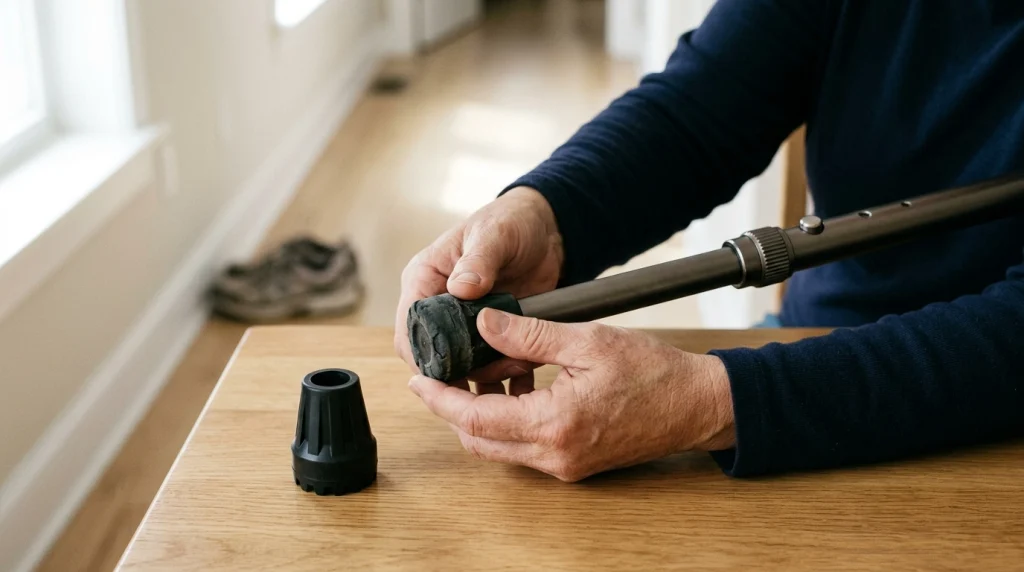
Even a well-built cane can become unreliable when its components are neglected or it is used incorrectly.
- Ignoring the stated capacity: Using a cane beyond its manufacturer’s limit creates an avoidable risk.
- Incorrect height: A cane that is too low can encourage leaning, while one that is too high may interfere with comfortable walking.
- Worn rubber tips: Damaged tips can reduce grip on walking surfaces.
- Loose adjustment hardware: An unsecured locking collar or button can compromise the selected height.
- Using a cane for full-body transfers: A walking cane should not automatically be treated as a stable handle for pulling yourself out of a chair.
- Assuming a quad base prevents falls: Four feet do not eliminate tipping, tripping, or improper placement.
Safety Warning
Stop using a cane if the shaft is bent, a structural joint is damaged, or its height lock will not hold securely. Replace worn tips with compatible parts. A person experiencing sudden new weakness or difficulty walking should seek prompt medical assessment rather than relying on a stronger cane.
Inspect the cane regularly, particularly the tip, handle connection, and adjustment hardware. Use stable footwear and keep frequently traveled indoor paths free of loose rugs, cords, and clutter.
Related Product: Heavy-Duty Bariatric Walking Cane
If a healthcare professional has confirmed that a cane is appropriate, compare heavy-duty models by documented capacity, adjustment range, handle comfort, and base design.
Relevant Product
Heavy-Duty Bariatric Walking Canes
Compare adjustable single-point and quad-base models, and confirm the manufacturer’s published weight rating before choosing.
As an Amazon Associate, we earn from qualifying purchases.
Frequently Asked Questions
1. Is a bariatric cane only for people with obesity?
No. A bariatric cane is a higher-weight-rated mobility device. Whether someone needs one depends on the manufacturer’s capacity and the person’s support requirements, not an obesity diagnosis alone.
2. Can a bariatric cane support 500 pounds?
Some models are rated for 500 pounds, including specific Dynarex, NOVA, and Graham-Field canes. Check the exact product’s specifications and conditions because the rating is not universal.
3. Is a bariatric quad cane better than a single-point cane?
Not necessarily. A quad cane provides a wider contact base, while a single-point cane can be easier to maneuver. The appropriate choice depends on balance, gait, strength, and the user’s environment.
4. Can you use a bariatric cane after knee surgery?
Possibly, if the surgical team or physical therapist approves cane use and the prescribed weight-bearing restrictions allow it. Some patients need a walker or crutches during earlier recovery stages.
5. Are bariatric walking canes adjustable?
Many are height-adjustable, but their adjustment ranges differ. The handle should fit near wrist height, with a slight elbow bend, and the adjustment mechanism must lock securely.
6. Can a bariatric cane be used on stairs?
Some users can negotiate stairs with a properly fitted cane and a secure handrail after appropriate instruction. Stair use depends on individual balance, strength, the cane design, and the person’s ability to follow a safe stepping sequence.
Conclusion
A bariatric walking cane provides a higher-weight-rated option for people who can safely use one-handed walking support. Choosing the right model means checking its published capacity, selecting a suitable base, adjusting the height correctly, and inspecting the device regularly. Most importantly, a higher weight rating should never be confused with greater balance support. When a cane is not enough for safe walking, a properly fitted walker or another professionally recommended mobility aid may be the better solution.
