
Tripod Cane Explained: Benefits, Fit & Safe Use


Folding Walking Stick with Seat

Compression Socks

Raised Toilet Seat
Quick Answer
A tripod cane is a walking aid with three ground-contact points instead of the single tip found on a standard cane. Its wider base can provide additional stability and balance support for people with mild to moderate walking difficulties. However, correct height, secure ground contact, and appropriate walking technique are essential. A tripod cane is not a substitute for a walker when substantial support is needed.
What Is a Tripod Cane?
A tripod cane is a mobility aid with one handle, one supporting shaft, and a three-point base. The three contact points form a triangular support area that is generally wider than the contact area of a conventional single-tip walking cane.
It belongs to the family of multi-point canes, alongside four-point or quad canes. These designs are intended to provide additional ground contact while still allowing the user to hold the walking aid with one hand.
The name describes the base rather than the handle or shaft. A genuine tripod cane has three distinct ground-contact points, although some manufacturers also market three-lobed rubber cane tips as tripod-style bases.
For a broader explanation of different walking aids, see our guide to walking cane types.
How Does a Tripod Cane Work?
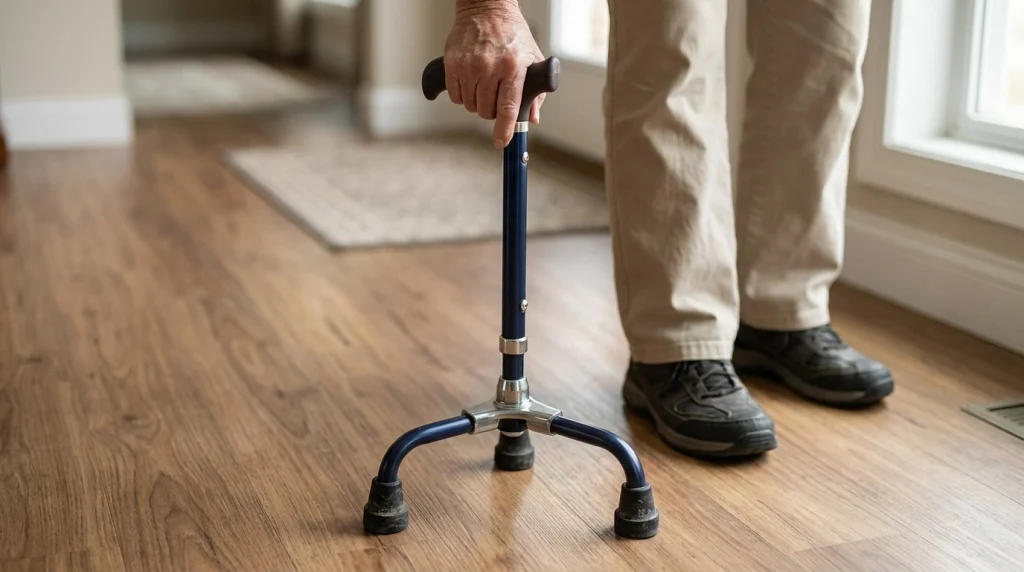
A tripod cane works by transferring some of the user’s downward force through the handle and shaft to three points on the ground. This creates an additional support area beside the user’s feet.
Its design has three important elements.
1. The Three-Point Base
Three feet spread across a triangular area can help resist tipping better than a narrow single-point contact under certain conditions. The actual benefit depends on the base dimensions, grip, cane angle, and whether the feet contact the floor securely.
A wider base does not guarantee stability on every surface. Uneven flooring can prevent all three feet from making reliable contact.
2. The Supporting Shaft
The shaft connects the handle to the base and carries the forces applied while walking. Many mobility canes use adjustable metal shafts, although materials and adjustment systems vary.
The shaft must remain securely locked at the selected height. A loose adjustment mechanism can make even a well-designed base unreliable.
Our explanation of walking cane shafts covers how construction and adjustment affect everyday usability.
3. The Handle and Grip
The handle lets the user apply controlled downward pressure. A comfortable grip can reduce unnecessary hand strain, while the correct handle height helps maintain an upright posture.
Some tripod canes have fixed bases. Others have flexible or pivoting joints that allow the shaft to tilt while the lower feet remain in contact with the surface.
These mechanisms differ by model and should not be assumed to perform identically.
What Are the Benefits of a Tripod Cane?
The main potential benefit is extra ground contact without moving to a two-handed walking aid. This may be useful when a conventional cane feels insufficient but a clinician determines that a cane still provides adequate support.
- Broader support area: Three contact points can offer a larger support footprint than a conventional narrow tip.
- One-handed operation: The user can hold the cane with one hand while following an appropriate walking pattern.
- Controlled weight distribution: The cane can help reduce some pressure through a painful or weaker leg.
- Potential standing convenience: Certain models can remain upright independently on level surfaces, although this is not guaranteed.
- Additional design choices: Adjustable shafts, ergonomic handles, and pivoting bases may improve usability for particular users.
These are potential functional advantages, not proof that every tripod cane prevents falls or performs better than every other walking aid.
Key Insight
Three contact points improve the potential support footprint, but the number of feet alone does not determine safety. Base dimensions, surface grip, cane fit, walking technique, and the user’s balance all matter.
Tripod Cane vs. Regular Cane vs. Quad Cane
The practical difference between these cane types is the size and configuration of their support bases, together with how easily each design moves during walking.
| Feature | Single-Point | Tripod | Quad |
|---|---|---|---|
| Contact points | One | Three | Four |
| Base design | Narrow | Triangular | Four-point |
| Maneuverability | Usually easiest | Varies by base | May be bulkier |
| Potential advantage | Simple, natural movement | Extra ground contact | Often a broad support base |
| Main tradeoff | Smaller support area | More base clearance needed | Additional size and weight |
A tripod design is not necessarily halfway between a single-point and quad cane in actual stability. A compact quad base can be smaller than a wide tripod base, so the specific design matters more than simply counting the feet.
For a concrete example of four-point construction, see the Medline quad cane review.
Who May Benefit From a Tripod Cane?
A tripod cane may suit someone who can still walk with one-handed assistance but would benefit from additional ground contact. It is most relevant when the support needs are compatible with cane use rather than a walker or crutches.
Possible situations include mild balance difficulties, certain walking changes following rehabilitation, or discomfort affecting one leg.
However, someone with frequent falls, substantial leg weakness, significant weight-bearing restrictions, or difficulty maintaining an upright posture may need a different mobility aid.
The Cleveland Clinic’s cane guidance explains that multi-point canes offer additional balance support but are not appropriate for everyone who needs substantial weight-bearing assistance.
A physical therapist can assess walking pattern, strength, balance, and how much support is needed before recommending a particular design.
How to Adjust a Tripod Cane to the Correct Height
The correct handle height generally allows the user to stand upright with a slight bend at the elbow. The adjustment process is similar to that used for other walking canes.
- Wear the shoes normally used for walking.
- Stand upright on a firm, level surface, with assistance if needed.
- Relax the arm beside the body.
- Position the handle approximately level with the wrist crease.
- Adjust the shaft according to the manufacturer’s instructions.
- Secure the adjustment button, collar, or locking mechanism.
- Grip the handle and confirm a slight elbow bend without leaning sideways.
If the shoulder rises to reach the handle, the cane may be too tall. If the user must bend toward the cane, it may be too short.
These are starting checks rather than a substitute for an individualized fitting. A clinician may recommend a different adjustment for a particular condition or walking pattern.
How Do You Walk With a Tripod Cane Safely?
For a person with one weaker or painful leg, the cane is normally held in the hand opposite that leg. The cane and affected leg move forward together, followed by the stronger leg.
- Stand upright, holding the tripod cane securely in the opposite hand from the weaker leg.
- Make sure the three feet are positioned securely on the floor before applying pressure.
- Move the cane forward a comfortable, short distance as the weaker leg steps forward.
- Apply only the amount of support appropriate for the cane and your prescribed walking plan.
- Bring the stronger leg forward while keeping your posture upright.
- Continue at a controlled pace, watching the path ahead.
The MedlinePlus instructions for using a cane describe the opposite-hand walking pattern, correct fitting, and basic stair techniques.
Tripod-specific consideration: When the base is rigid, confirm that the feet contact the walking surface as intended. On pivoting models, follow the manufacturer’s directions for how the base should move.
What About Stairs and Curbs?
With ordinary cane-assisted stair walking, the stronger leg usually leads when going up, while the cane and weaker leg lead when going down.
Tripod bases need special attention because the complete base must fit securely on the step. A narrow tread may not accommodate the feet safely.
Use a handrail where available. If the base cannot be planted securely, do not attempt the stairs with that setup. Ask a physical therapist for instruction on a safe alternative.
Safety Warning
Do not assume that a tripod cane is stable merely because it has three feet. Wet flooring, uneven surfaces, worn rubber, or incomplete ground contact can make the cane slip or tip. If your balance requires heavy or continuous support, seek an assessment before relying on a cane.
Common Problems and How to Recognize Them
The Cane Rocks When Planted
First check whether the walking surface is level and whether all three feet make contact. Inspect the rubber for uneven wear, missing sections, or debris.
If the base remains unstable on a flat floor, stop using it until the problem has been resolved.
The Base Keeps Catching on Furniture
The base may extend farther outward than the user expects. This can happen around chair legs, narrow doorways, or cluttered walking paths.
Clearing obstacles may help. If the design consistently interferes with natural walking, a different cane base may be more appropriate.
Walking Feels Slow or Awkward
Multi-point bases may require more deliberate placement than a single-tip cane. Incorrect height or an unsuitable walking pattern can increase that difficulty.
Check the fitting and ask a physical therapist to observe the walking technique rather than assuming the base alone is responsible.
How to Check and Maintain a Tripod Cane
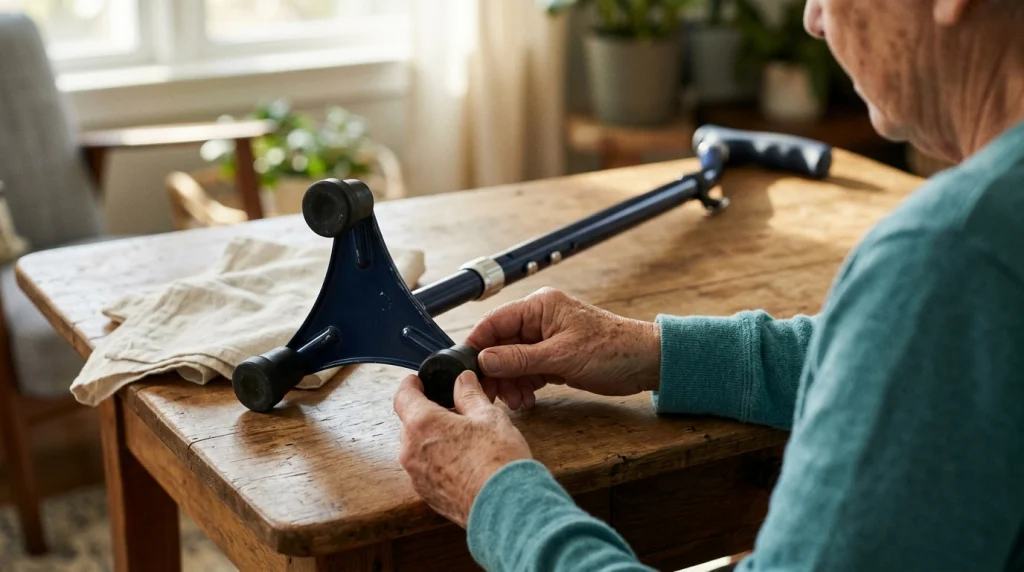
Routine inspection helps identify damage before it affects support. The base deserves particular attention because each contact point contributes to how the cane behaves.
- Rubber feet: Check for cracks, flattening, looseness, and uneven wear.
- Base connection: Look for movement where the base attaches to the shaft.
- Height lock: Confirm that buttons or collars remain fully engaged.
- Handle: Check that the grip is secure and not rotating unexpectedly.
- Pivot mechanism: If present, inspect it according to the manufacturer’s maintenance instructions.
Clean the contact surfaces and replace damaged components with compatible parts. Do not improvise repairs to load-bearing components.
A cane that becomes loose, cracked, bent, or unpredictably unstable should be taken out of service until it has been properly assessed or replaced.
When Is a Tripod Cane Not Enough?
A tripod cane may not provide sufficient assistance when a person needs substantial body-weight support, has difficulty controlling both legs, or cannot maintain safe balance using a one-handed aid.
Warning signs include repeated near-falls despite correct cane use, needing to lean heavily on the handle, or feeling unable to walk safely without someone holding you.
A walker, crutches, or another prescribed mobility aid may offer more appropriate support. The decision should reflect an individual assessment rather than the assumption that a larger cane base automatically solves more serious walking problems.
Frequently Asked Questions
Is a tripod cane better than a regular walking cane?
Not for everyone. Its three-point base can offer additional ground contact, but a regular cane is often lighter and easier to maneuver. The better option depends on balance needs, comfort, and walking technique.
Can a tripod cane stand on its own?
Some models can remain upright on a firm, level floor, but this depends on base width, weight distribution, and design. Do not rely on self-standing ability as proof of safe walking support.
Can a tripod cane be used outdoors?
Yes, if the particular model is suitable for the surface and the user can maintain secure contact. Uneven ground, gravel, ice, and slippery pavement can create additional hazards.
Which hand should hold a tripod cane?
If one leg is weaker or painful, the cane is generally held in the opposite hand. A healthcare professional may recommend a different arrangement for specific rehabilitation needs.
Is a tripod cane suitable for someone recovering from a stroke?
It may be appropriate for certain individuals, but stroke-related balance, weakness, and coordination difficulties vary considerably. A rehabilitation professional should determine whether a tripod cane, quad cane, or another aid is safer.
Can a tripod cane replace a walker?
Not when the walker is needed for substantial support or balance assistance. A tripod cane remains a one-handed walking aid and provides less comprehensive support than many walkers.
Final Thoughts
A tripod cane provides three ground-contact points to offer a broader support area than a conventional narrow-tip cane. It can be a useful mobility option when additional stability is needed and one-handed cane assistance remains appropriate.
The most important considerations are correct fit, reliable ground contact, comfortable walking technique, and selecting a support level that matches the individual’s mobility needs. When those needs are uncertain, a physical therapist can help determine whether a tripod cane is suitable.
