
Quad Cane Explained: Benefits, Types & Safe Use


Smart Digital Photo Frame

Large Button TV Remote

Toilet Safety Rails
Quick Answer
A quad cane is a walking aid with four rubber-tipped feet at its base instead of one. Its wider support area can improve stability for people with certain balance difficulties, leg weakness, or walking limitations. Quad canes provide more ground contact than standard single-point canes, but they are usually heavier and less convenient to maneuver. Proper fitting and walking technique are essential for safe use.
What Is a Quad Cane?
A quad cane, sometimes called a four-prong cane or four-footed walking cane, is an assistive device designed to provide additional support while standing and walking. It has a handle, an upright shaft, and a base with four separate contact points.
Unlike a traditional cane that rests on one rubber tip, a quad cane spreads its contact points over a larger area. This can be helpful when someone needs extra stability but can still walk with a one-handed mobility aid.
Quad canes are commonly considered for people recovering from certain injuries, experiencing weakness on one side, or managing balance problems. They may also be recommended during rehabilitation after a stroke.
However, a quad cane is not automatically necessary for every older adult. Some people walk more naturally with a regular cane, while others need the greater support of a walker. For an overview of these differences, see our guide to walking cane types.
How Does a Quad Cane Work?
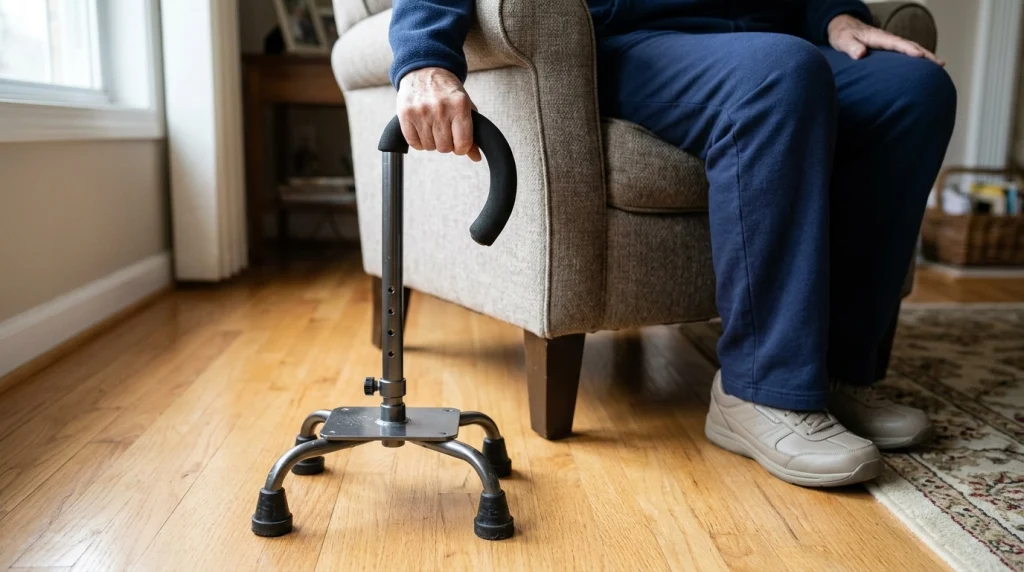
A quad cane works by creating a broader ground-contact area through four separate rubber feet. When positioned correctly, the base provides an additional point of support as the user transfers weight between their legs.
Its main components work together:
- Four-point base: Creates a wider support footprint than a conventional single-tip cane.
- Rubber feet: Provide traction on appropriate walking surfaces and help reduce unwanted sliding.
- Upright shaft: Connects the base to the handle and transfers force through the cane.
- Handle: Provides a gripping surface for control and partial weight support.
- Height adjustment: On adjustable models, allows the handle position to match the user’s body dimensions.
The four feet do not eliminate the need for balance. A quad cane can still tip, slide, or become caught on an obstacle if placed incorrectly.
Why Does the Base Width Matter?
The base width affects the area over which the cane can provide support. A larger base generally offers a broader footprint, but it also occupies more space beside the user.
This creates a practical tradeoff: additional contact area may improve stability in certain situations, while extra size can interfere with a natural walking rhythm or movement through tight spaces.
The best base is therefore not necessarily the widest one. It is the base that provides sufficient support without interfering with safe foot placement.
Small-Base vs. Large-Base Quad Canes
Quad canes generally come in small-base and large-base designs. Both use four ground-contact points, but their footprint and handling characteristics differ.
| Feature | Small Base | Large Base |
|---|---|---|
| Support footprint | More compact | Wider |
| Maneuvering | Often easier in narrow spaces | May require more clearance |
| Weight and bulk | Generally less bulky | Often bulkier |
| Typical consideration | Balance support with easier handling | Broader planted support |
A small-base model may suit someone who needs extra stability but walks through doorways, hallways, and other confined areas regularly.
A large-base model may be considered when a broader support footprint is useful, provided the person can lift, position, and control it safely.
For a concrete example of a compact design, our small-base quad cane review explains the construction and everyday handling considerations of one specific model.
Who Might Benefit From a Quad Cane?
A quad cane may be appropriate for someone who needs more walking stability than a standard cane provides, but does not require the level of support offered by a walker.
Possible situations include:
- One-sided weakness: A person with reduced strength or control in one leg may benefit from support on the opposite side.
- Stroke rehabilitation: Some people recovering from a stroke may find a quad cane useful as part of a supervised mobility plan.
- Balance difficulties: A broader support footprint may help when a single-point cane feels insufficiently stable.
- Recovery from illness or injury: A clinician may recommend a quad cane during a particular stage of recovery.
- Reduced walking confidence: Some people feel more comfortable with a wider cane base, although confidence alone does not establish that the device is safe or appropriate.
According to Mayo Clinic’s cane guidance, quad canes offer a broader base of support, but their additional weight and handling demands can make them less convenient for some users.
The underlying reason for walking difficulty matters more than age alone. A physical therapist can evaluate balance, gait, arm strength, and the amount of support required.
How to Adjust a Quad Cane to the Correct Height
Proper height adjustment helps the user maintain a more natural upright posture. A cane that is too short may encourage bending forward, while one that is too tall may force the shoulder upward or make the arm uncomfortable.
- Put on your usual walking shoes. Footwear can affect your standing height and balance.
- Stand upright. Keep your shoulders relaxed and allow your arms to hang naturally beside your body.
- Check wrist position. The top of the cane handle should generally align with the crease of your wrist.
- Adjust the shaft. Set the cane to the closest appropriate height using its adjustment mechanism.
- Grip the handle. Your elbow should remain slightly bent, rather than completely straight or sharply flexed.
- Secure the adjustment. Confirm that the locking button or other height mechanism is fully engaged before walking.
These are general fitting principles. An individualized clinical assessment may identify a different setup based on posture, arm function, or rehabilitation needs.
Practical Tip
After adjusting the height, practice a few steps on a level, dry floor with appropriate supervision if needed. Watch for shoulder elevation, leaning, or the cane base striking your foot. These can indicate that the fit, positioning, or walking technique needs correction.
How to Walk Properly With a Quad Cane
When one leg is weaker or painful, the usual technique is to hold the cane in the hand opposite that leg. The cane and affected leg advance together, followed by the stronger leg.
This approach helps provide support during the step involving the weaker side. A therapist may modify the sequence for specific neurological or orthopedic conditions.
- Stand in a stable position. Hold the cane securely on the stronger side of your body.
- Position the base. Keep it beside you with sufficient clearance to avoid striking your foot.
- Move the cane forward. Advance it a comfortable step distance together with your weaker leg.
- Plant the base securely. Make sure all four rubber feet are contacting a suitable surface before relying on the cane.
- Step with the stronger leg. Move it forward while maintaining control of your balance.
- Repeat at a manageable pace. Keep your gaze forward and avoid rushing or taking unusually long steps.
Unlike a single-tip cane, some fixed-base quad canes need to be lifted and repositioned deliberately. Dragging the base can catch the feet on flooring or obstacles.
Guidance from MedlinePlus on using a cane explains proper cane positioning, movement sequence, and basic precautions.
What About Stairs and Curbs?
Stairs require extra caution because a quad cane’s full base may not fit securely on a narrow step. Some models are particularly awkward to maneuver on staircases.
With an appropriate cane and suitable handrail, general cane technique involves leading with the stronger leg when ascending and the weaker leg when descending. However, quad cane users should receive device-specific stair training rather than assuming their base will fit every tread.
Do not position the cane where any of its four feet overhang a step. If the base cannot be placed securely, use a safer method recommended by a physical therapist.
Quad Cane vs. Regular Cane vs. Walker
The main difference is the amount and arrangement of support each mobility aid provides.
- Regular cane: A single ground-contact point makes it relatively simple to position and carry. It is often suitable for lighter balance assistance.
- Quad cane: Four contact points create a broader base but require additional space and more deliberate placement.
- Walker: A much larger support structure is generally appropriate for people who need greater stability or more substantial assistance while walking.
A quad cane occupies a useful middle position, but that does not mean everyone should progress through these devices in a fixed order.
If someone needs substantial weight support, struggles to remain upright, or experiences repeated falls despite using a cane, a walker or another mobility solution may be safer after professional evaluation.
Common Quad Cane Mistakes to Avoid
Even a correctly selected quad cane can create problems when used improperly. The following mistakes deserve particular attention.
- Using the wrong height: Poor adjustment can interfere with posture and arm positioning.
- Placing the base too close to the feet: This may cause accidental contact or tripping.
- Allowing part of the base to overhang an edge: The cane may become unstable on steps or other changes in floor level.
- Using worn rubber feet: Damaged tips can reduce grip and create uneven ground contact.
- Rushing through turns: Abrupt changes of direction can be difficult to control with a wide base.
- Relying on the cane for excessive weight support: A cane should not replace a walker when significantly greater assistance is necessary.
Safety Warning
Do not assume that a self-standing quad cane is secure enough to pull yourself up from a chair. Use stable chair armrests or the transfer method recommended by your therapist. A free-standing cane can tip or slide when loaded in an unintended direction.
When Is a Quad Cane Not Enough?
A quad cane may be insufficient when someone needs substantial support through both arms or cannot walk safely while holding a device in one hand.
Warning signs include frequent falls, repeated loss of balance, difficulty advancing the cane, inability to keep the base clear of the feet, or needing to lean heavily on the handle.
New or worsening walking difficulty deserves medical assessment, particularly when it appears suddenly or is accompanied by weakness, dizziness, or other neurological symptoms.
Sudden weakness on one side, facial drooping, or new speech difficulty can indicate a stroke and requires emergency medical attention.
Choosing a mobility aid should therefore begin with the user’s functional needs, not simply the number of feet on its base.
How to Maintain a Quad Cane
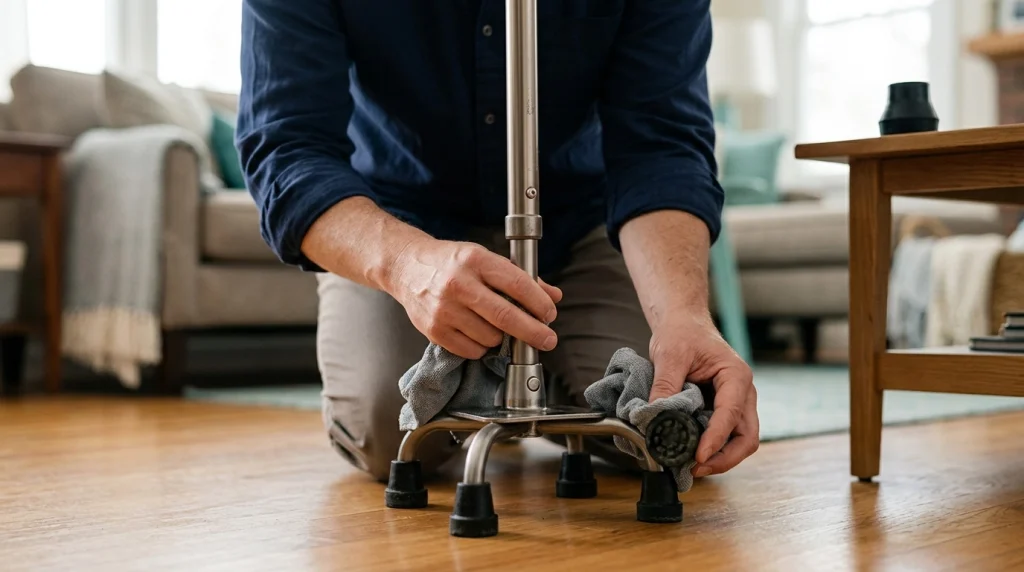
Routine inspection helps prevent avoidable equipment problems. Check the cane regularly and whenever its stability or handling seems different.
- Inspect all four rubber feet for cracks, uneven wear, or missing material.
- Remove dirt or debris that could interfere with traction.
- Confirm the shaft and base are firmly connected.
- Check that the height-adjustment mechanism remains locked.
- Replace worn or damaged components with compatible manufacturer-approved parts.
- Keep the cane clean and dry according to its care instructions.
For folding quad canes, check every folding connection before applying weight. Our folding quad cane review illustrates why locking mechanisms and portability features deserve attention.
If a cane bends, develops excessive movement at a connection, or feels unstable despite correct positioning, stop using it until the problem has been resolved.
Related Mobility Aid: Adjustable Quad Cane
An adjustable quad cane with four nonslip feet may be worth discussing with a physical therapist if you need a broader support base. Check handle height, base size, rubber-tip condition, device weight, and the manufacturer’s stated capacity before choosing one.
View Adjustable Quad Canes on Amazon
Affiliate disclosure: As an Amazon Associate, we may earn from qualifying purchases.
Frequently Asked Questions
Can a quad cane stand on its own?
Many quad canes can remain upright independently on a suitable level surface. However, self-standing ability varies with base design, floor condition, and handle position. It should not be treated as a guarantee against tipping.
Which direction should the quad cane base face?
Some quad canes have an asymmetric base with a longer and shorter side. Follow the manufacturer’s positioning instructions so the base provides support without interfering with your leg. Certain models allow the base to be repositioned for right- or left-handed use.
Can you use a quad cane with either hand?
Many models support either hand, but some require the base or handle to be reconfigured. When one leg is weaker, a cane is generally held on the opposite side unless a clinician recommends otherwise.
Is a quad cane suitable for outdoor walking?
A quad cane may be usable outdoors on firm, reasonably even surfaces. Loose gravel, mud, ice, uneven pavement, and sloped ground can make secure placement difficult. Outdoor suitability depends on the cane design and the user’s balance.
Are all four feet supposed to touch the ground?
For a conventional fixed-base quad cane, all four feet should be firmly planted before relying on it for support. Some specialty pivoting designs operate differently, so follow their specific instructions.
Can a quad cane be used after knee or hip surgery?
Sometimes, depending on the procedure, weight-bearing restrictions, strength, and recovery stage. Do not choose a quad cane solely because it appears more stable. The surgeon or rehabilitation therapist should confirm which mobility aid and walking pattern are appropriate.
Final Thoughts
A quad cane provides a wider support base than a regular cane and may help people who need additional stability while walking. Its four rubber feet, adjustable shaft, and various base sizes make it a useful option for certain mobility needs.
The most important considerations are proper fit, secure base placement, manageable handling, and the right level of support. A quad cane can be helpful, but the safest mobility aid is the one matched to the individual’s walking ability and environment.
