
Standard Walking Cane Explained: Fit, Uses & Safety


Upright Walker

GPS Tracker for Elderly

Automatic Jar Opener
Quick Answer
A standard walking cane is a single-point mobility aid with a handle, straight shaft, and one ground-contact tip. It provides an extra point of support for people with mild balance difficulties, leg weakness, or discomfort while walking. A properly fitted cane can make walking steadier, but it is not intended to replace a walker or provide substantial full-body support.
What Exactly Is a Standard Walking Cane?
A standard walking cane is one of the simplest walking aids. Its defining feature is a single tip that contacts the ground, rather than the three- or four-point base found on some other canes.
It is often called a single-point cane, a conventional cane, or a walking stick. Traditional versions have a curved crook handle, although single-point canes can also have straight or ergonomically shaped grips.
The purpose is to add a contact point alongside the user’s two feet. This extra support can improve confidence and help redistribute some pressure away from a painful or weaker leg.
Unlike a decorative walking stick, a cane intended for mobility support should have suitable construction, an appropriate weight rating, a secure handle, and a traction tip.
For a broader overview of cane categories, see our guide explaining walking cane types and their different purposes.
The Three Main Parts of a Standard Cane
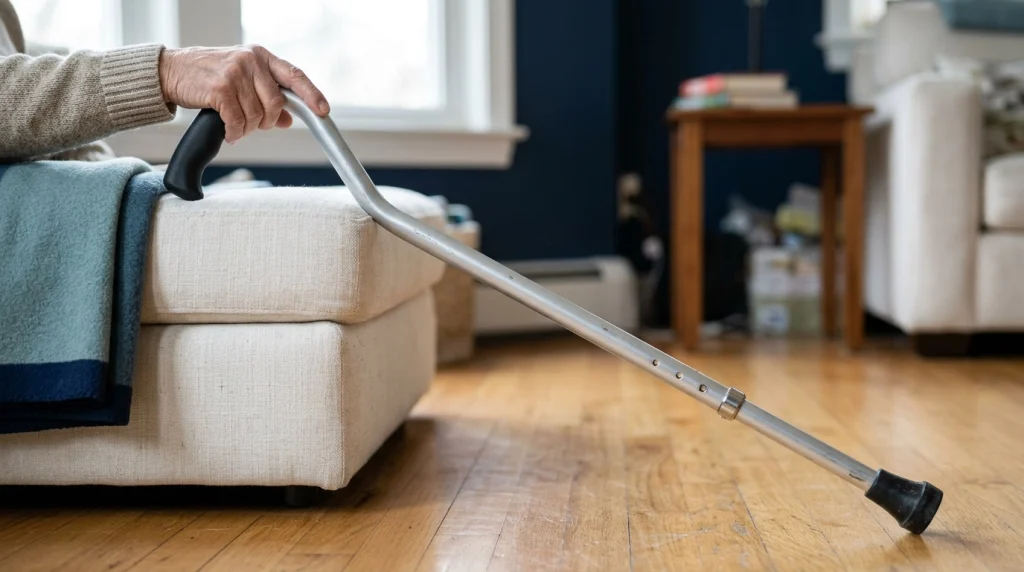
Understanding the basic construction makes it easier to recognize what affects comfort, stability, and durability.
1. Handle: Where Your Hand Applies Support
The handle provides the gripping surface. Traditional crook handles are recognizable, while T-shaped and contoured handles may distribute pressure differently across the hand.
The best grip is one that feels secure without requiring excessive finger pressure. Someone with painful fingers or limited hand strength may find a larger, ergonomically shaped grip more comfortable.
A handle that causes numbness, wrist discomfort, or persistent palm pain may be unsuitable, even when the cane itself is the correct height.
2. Shaft: The Cane’s Main Structure
The shaft connects the handle to the tip and transfers applied force toward the ground. Standard canes commonly use wood or aluminum.
Wooden shafts are often fixed-length and require careful sizing. Aluminum designs commonly offer push-button height adjustment.
Neither material automatically guarantees safety. Construction quality, physical condition, correct fit, and the manufacturer’s stated load limit all matter.
Our explanation of walking cane shafts covers how shaft design influences stability, adjustment, and maintenance.
3. Rubber Tip: The Ground-Contact Point
The rubber tip creates traction between the cane and the walking surface. Because a standard cane has only one ground-contact point, the condition of this small component is particularly important.
Worn tread, hardened rubber, or an insecurely attached tip can reduce grip. Replace damaged tips with correctly sized components rather than continuing to use them.
Who Is a Standard Walking Cane Best Suited For?
A standard cane is generally most appropriate for someone who can already walk but benefits from a modest amount of extra stability or partial support.
Common situations include:
- Mild balance difficulties: Someone who occasionally feels slightly unsteady during ordinary walking.
- One-sided leg discomfort: A person who needs to reduce some pressure on one hip, knee, ankle, or foot.
- Mild weakness: Someone who can support most of their own weight but benefits from an additional contact point.
- Recovery: A patient instructed by a healthcare professional to use a cane during a specific stage of rehabilitation.
- Everyday mobility: A person who needs limited support on familiar, relatively even surfaces.
Age alone does not determine whether someone needs a cane. The important considerations are walking ability, strength, balance, pain, and the amount of physical support required.
A cane may be inappropriate if the person repeatedly loses balance, experiences frequent falls, has significant weakness in both legs, or cannot walk without placing substantial body weight onto the aid.
Key Insight
The number of cane tips is not the only factor that determines safety. A person must also have enough balance, coordination, and strength to use the device correctly.
How Does a Standard Cane Compare With Other Walking Aids?
The most useful distinction is the amount and type of support each design provides.
| Walking Aid | Main Advantage | Main Limitation |
|---|---|---|
| Standard cane | Lightweight, simple, one-point support | Limited stability for major balance problems |
| Offset cane | Grip positioned to support controlled downward loading | Still usually has one ground-contact tip |
| Quad cane | Broader base with four contact points | Bulkier and potentially awkward during walking |
| Walker | Larger support area for substantial stability needs | Requires more space and different walking technique |
A standard cane is easier to carry and maneuver than many larger aids. However, convenience should never outweigh the user’s actual support needs.
Someone who is unable to walk safely with a single-point cane may need an assessment for a different device. Our guide to safe walking assistance explores additional considerations for caregivers.
How Tall Should a Standard Walking Cane Be?
The cane handle should generally reach the crease of your wrist when you stand upright in your usual walking shoes with your arms relaxed beside your body.
When you grip the handle, your elbow should remain comfortably bent. Mayo Clinic describes a typical elbow bend of approximately 15 to 30 degrees.
Follow this practical fitting process:
- Put on the shoes you normally wear while walking.
- Stand upright on a level surface with relaxed shoulders.
- Allow your arms to hang naturally at your sides.
- Position the cane handle approximately level with your wrist crease.
- Grip the handle and check for a slight, comfortable elbow bend.
- If the cane is adjustable, secure its height-locking mechanism fully before walking.
A cane that is too tall may make the shoulder lift unnecessarily. One that is too short may encourage leaning and poor posture.
Wrist height is a starting guideline, not a substitute for individualized fitting when mobility or posture is complicated. The Mayo Clinic cane-fitting guidance explains these principles in greater detail.
Which Hand Should Hold a Standard Cane?
If one leg is weaker or painful, hold the cane in the opposite hand, unless your rehabilitation professional has recommended a different technique.
For example, if your right knee is painful, you would normally hold the cane in your left hand.
This allows the cane and affected leg to move together, helping distribute some of the walking load away from that leg.
Holding a cane on the same side as the painful leg is a common misunderstanding. Although it might feel intuitive, it does not produce the usual recommended walking pattern.
For general balance assistance without a clearly weaker leg, hand selection can depend on coordination, grip strength, other health limitations, and professional advice.
How to Walk Correctly With a Standard Cane
The basic walking pattern is simple: move the cane with the weaker leg, then step forward with the stronger leg.
- Start in a stable position. Stand upright with your feet comfortably apart and the cane beside your stronger leg.
- Advance the cane. Move it a comfortable short distance forward while stepping with your affected leg.
- Place the tip securely. Ensure the tip makes stable contact with the floor as you transfer the appropriate amount of pressure through the handle.
- Bring the stronger leg forward. Step through naturally without leaning excessively on the cane.
- Continue at a controlled pace. Keep your head up, look ahead, and avoid rushing turns.
The cane should remain reasonably close to your body rather than being placed far out in front or to the side.
For detailed illustrated instructions, the MedlinePlus cane-use guide covers walking patterns, positioning, steps, and safety precautions.
Practical Tip
Practice on a clear, dry, level surface before attempting crowded spaces, curbs, or uneven ground. If you feel unstable even during basic practice, have a physical therapist assess your walking pattern.
Using a Standard Cane on Stairs and Curbs
When stairs are appropriate for your mobility level, the usual sequence is to lead with the stronger leg going up and the weaker leg going down.
Going Up
- Use the handrail whenever one is available.
- Step onto the higher level with your stronger leg.
- Bring your weaker leg and cane up to the same level.
- Pause to regain stable balance before continuing.
Going Down
- Position the cane securely on the lower step.
- Lower your weaker leg onto that step.
- Bring your stronger leg down afterward.
- Continue carefully, one step at a time.
Stair use requires adequate coordination and strength. Someone who cannot remain steady with a handrail and cane should not attempt stairs independently.
Common Mistakes That Make a Standard Cane Less Safe
Even a correctly sized cane can become unsafe when used incorrectly.
- Using the wrong hand: This can prevent the cane from assisting the affected leg in the intended way.
- Reaching too far forward: Placing the tip excessively far away can destabilize your posture.
- Walking with a worn tip: Damaged rubber may offer less traction, particularly on smooth surfaces.
- Ignoring a loose adjustment mechanism: An unsecured shaft can unexpectedly change length.
- Leaning heavily on one cane: A standard cane is not a substitute for a more supportive mobility device.
- Using the cane to pull yourself upright: A cane is not normally a secure substitute for chair armrests during standing transfers.
Also keep walking paths clear of loose rugs, electrical cords, spills, and low obstacles. Appropriate footwear and good lighting help reduce preventable hazards.
When Is a Standard Cane Not Enough?
A standard cane may not offer sufficient support if you need substantial help bearing weight or maintaining balance.
Signs that your mobility needs deserve reassessment include:
- Repeated falls or near-falls despite using the cane.
- Needing another person to support most of your weight.
- Marked weakness affecting both legs.
- Difficulty coordinating cane and leg movements.
- Persistent hand, wrist, shoulder, or back discomfort while using the cane.
- Feeling unable to walk safely even on level indoor surfaces.
A physical therapist or other qualified healthcare professional can assess walking technique and determine whether a quad cane, walker, or another mobility aid is appropriate.
Safety Warning
A sudden inability to walk, new severe leg weakness, or serious pain after a fall should not be managed simply by switching canes. Stop walking and obtain prompt medical assessment. Sudden one-sided weakness, especially with facial drooping or speech difficulty, requires emergency assistance.
How to Check and Maintain a Standard Cane
Routine inspection helps identify problems before they affect walking.
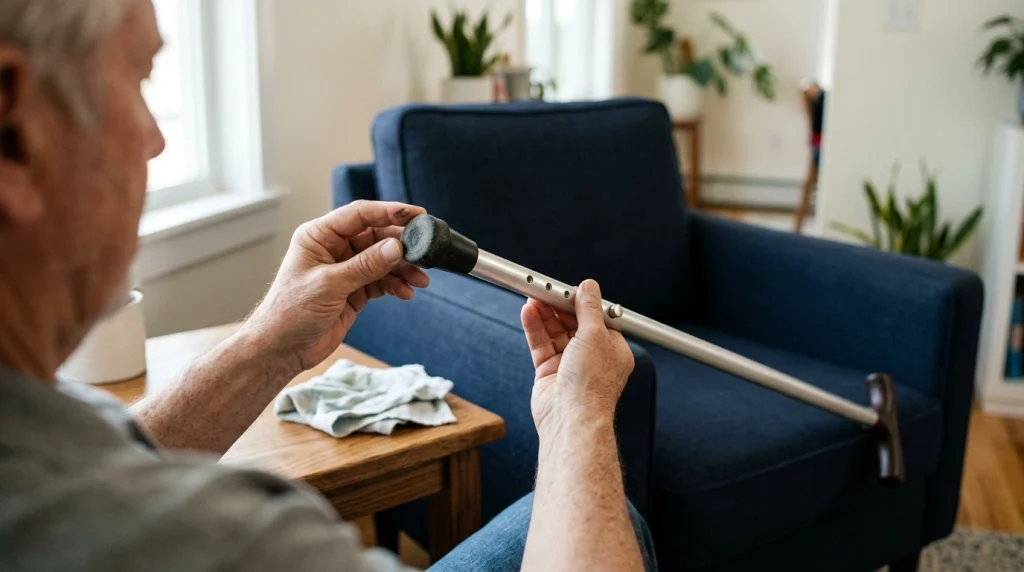
Check the rubber tip for wear, cracks, or looseness. Inspect the shaft for bending, damage, or cracks, especially on wooden models.
For adjustable canes, make sure the adjustment button is fully engaged and any locking collar is secured. Confirm that the handle is firmly attached and does not twist unexpectedly.
Clean dirt from the tip and allow wet components to dry. Replace damaged parts using components compatible with the cane model.
If the cane has structural damage or an unreliable locking system, discontinue use until it can be safely repaired or replaced.
Frequently Asked Questions
Can a standard walking cane help with knee pain?
Yes. When used correctly in the hand opposite the painful knee, a cane can reduce some loading on that leg during walking. It does not treat the underlying cause of knee pain.
Is a wooden standard cane better than an aluminum cane?
Neither material is universally better. Wooden canes often offer simple fixed construction, while aluminum canes commonly allow height adjustment. Fit, condition, comfort, and the stated load rating are more important than material alone.
Can I use a standard cane outdoors?
Yes, on suitable walking surfaces. However, rain, ice, loose gravel, uneven pavement, and steep ground can make a single-point cane less secure. Outdoor use should match your balance ability and the cane’s design.
Does a standard cane stand upright on its own?
Most conventional single-tip canes do not stand independently without support. Some specialty bases are designed to self-stand, but that feature should not be confused with guaranteed stability while walking.
Can someone use a standard cane after hip surgery?
Sometimes. A cane may be introduced during recovery when the surgeon or rehabilitation professional determines it is appropriate. The timing depends on the operation, permitted weight bearing, balance, and individual progress.
How often should a cane tip be replaced?
There is no universal replacement schedule. Inspect it regularly and replace it when the rubber becomes worn, cracked, hardened, loose, or noticeably less secure on the floor.
Final Thoughts
A standard walking cane offers simple, lightweight support for people who need modest assistance while walking. Its effectiveness depends on proper sizing, a secure tip, the correct walking pattern, and realistic expectations about how much stability it can provide.
If a single-point cane does not allow you to walk comfortably and safely, the next step is to reassess your mobility needs rather than depend more heavily on an unsuitable device.
