
Walking Stick vs Walking Cane: What’s the Difference?


Bathroom Grab Bar Set

Toilet Safety Rails

Gardening Kneeler Bench
Quick Answer
A walking stick and a walking cane can mean the same thing. In British English, “walking stick” is a common name for a handheld mobility aid, while Americans more often say “cane.” When distinguishing products, however, “walking stick” may describe an outdoor hiking staff, while “walking cane” usually suggests a shorter, handled aid for everyday balance and support. These are usage conventions, not strict universal definitions. The device’s intended purpose, construction, and fit matter more than its name.
Are a Walking Stick and a Walking Cane the Same Thing?
Yes, in many situations, walking sticks and walking canes are simply different names for the same type of handheld walking aid. Both terms can describe a device used to improve balance, provide an additional point of ground contact, and make walking feel more secure.
The confusion comes from two different ways people use these words: everyday language and product classification.
In everyday conversation, someone in the United Kingdom might say they need a walking stick after knee surgery. An American describing the same situation would more naturally say they need a cane.
Neither person is necessarily describing a different device.
However, when browsing outdoor equipment or mobility products, the labels sometimes suggest different designs. A traditional outdoor walking stick may be long, rustic, and intended for recreational walking. A medical-style cane generally has a defined handgrip, a suitable ground-contact tip, and construction intended for everyday mobility assistance.
This distinction is useful when comparing products, but it should not be treated as a fixed dictionary rule.
For a closer explanation of the everyday mobility device, see our guide to walking cane types, including their uses, common designs, and limitations.
Walking Stick vs Walking Cane: Key Terminology Differences
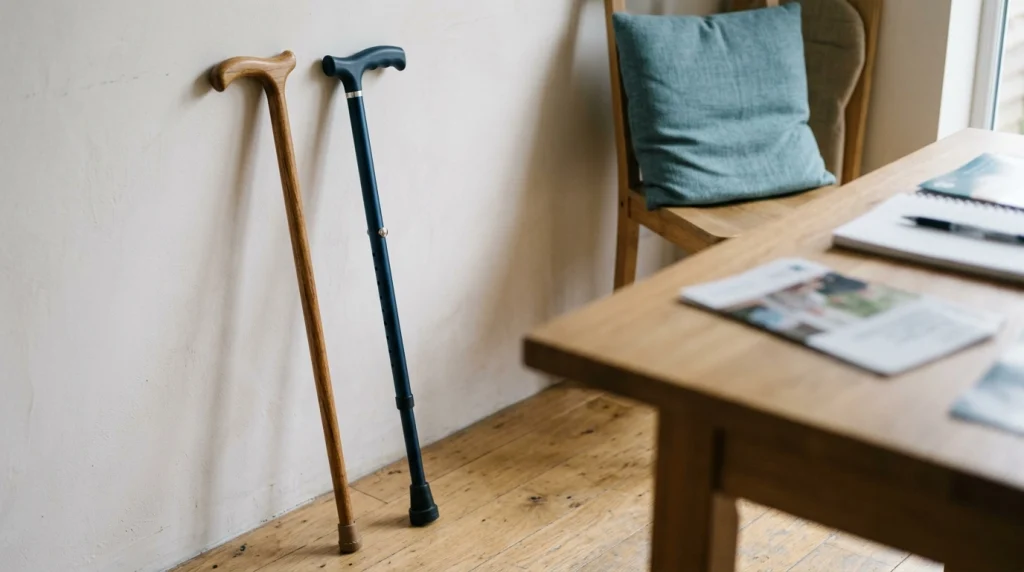
The clearest way to understand the terminology is to separate language differences from typical product features. The table below describes common usage rather than strict requirements.
| Feature | Walking Stick | Walking Cane |
|---|---|---|
| Everyday meaning | General term for a handheld walking support | General term for a handheld walking support |
| Regional usage | Especially common in British English | Especially common in American English |
| Product association | Mobility support or recreational walking | Everyday mobility, balance, or partial support |
| Typical appearance | May be straight, rustic, or staff-like | Often has a shaped or ergonomic handle |
| Materials | Wood, metal, or composite | Wood, aluminum, or composite |
| Support suitability | Depends on the specific design | Depends on the specific design and rating |
The most important distinction is not whether the label says “stick” or “cane.” It is whether the device has been designed and fitted for the kind of walking support the user actually needs.
Why Do British and American English Use Different Terms?
Regional vocabulary explains much of the walking stick versus walking cane confusion.
In British English, “walking stick” is a familiar expression for the support device carried by someone who needs help with balance or walking. British healthcare organizations routinely use this wording in patient guidance.
For example, the NHS walking aids guide uses “walking sticks” when discussing equipment for balance, mobility, and comfort.
In American English, “cane” is generally the more familiar everyday term for that same mobility aid. American medical resources commonly describe cane fitting, cane use, and different cane designs.
American speakers certainly understand “walking stick,” but they may associate it with hiking, outdoor recreation, or a traditional wooden staff.
That association is not absolute. Americans also use “walking stick” for ordinary mobility aids, and British speakers understand “cane.”
Does the word “cane” have a different meaning?
Yes. Outside mobility terminology, a cane can also refer to a plant stem, such as sugarcane or bamboo cane. Historically, canes have also been carried as decorative accessories rather than essential walking supports.
Context usually makes the intended meaning clear.
A “walking cane” in a mobility shop refers to a support device. A “decorative cane” may be intended primarily for appearance, and a cane made from plant material describes its construction rather than its medical suitability.
The same word therefore does not guarantee a specific function or support capacity.
How Are Mobility Canes Different From Hiking Walking Sticks?
When manufacturers distinguish these products, the difference is generally about their intended use rather than their names.
A mobility cane is commonly designed to provide predictable balance assistance during daily activities. A recreational walking stick is generally selected to help with outdoor walking, changing ground conditions, or walking rhythm.
Mobility cane: everyday balance and support
A mobility cane typically has a handle positioned for a natural arm angle and a ground-contact tip appropriate for its intended walking surfaces.
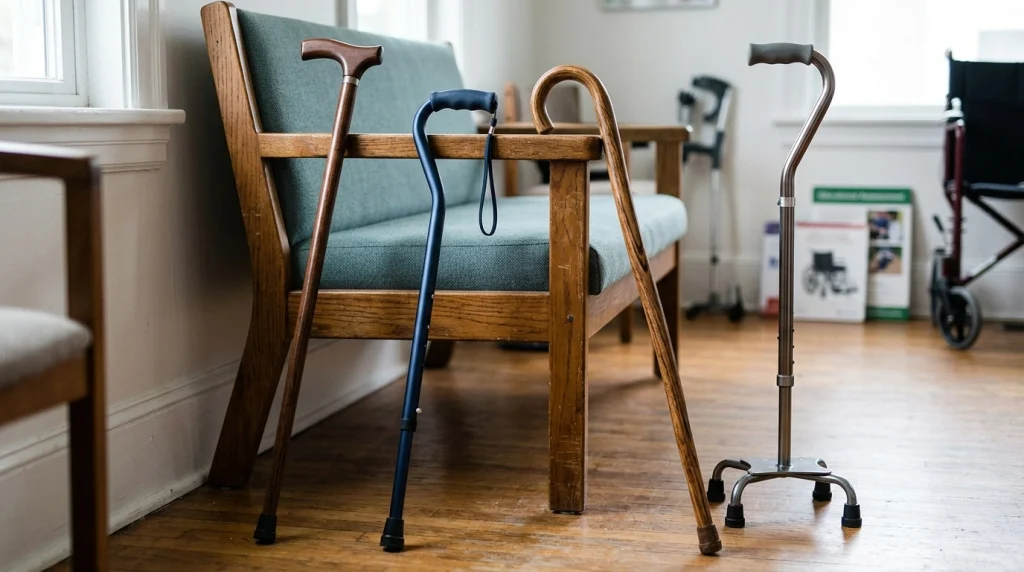
Common designs include single-point canes, offset-handle canes, folding canes, and quad canes with several feet.
They may be useful for someone with mild balance difficulties or a weaker or painful leg, provided the device matches the person’s mobility needs.
Correct fit and technique are essential. An unsuitable cane can create additional difficulties rather than solving them.
Hiking stick: recreational terrain assistance
A recreational walking stick is often chosen to provide an extra contact point when following a trail, walking over irregular ground, or navigating gentle slopes.
Some hiking sticks are taller than everyday canes and are gripped along the shaft. Others have wrist straps, specialized tips, or adjustable sections.
Their design may prioritize changing terrain, portability, and outdoor handling rather than clinical mobility assistance.
A hiking stick should not automatically be substituted for a medical walking aid when someone has pain, weakness, or a significant balance problem.
Key Insight
A wooden walking stick can be a genuine mobility aid, and a metal walking cane can be unsuitable for a particular user. Material and product name alone do not establish safety. Intended use, secure construction, tip traction, correct height, and appropriate support capacity are more informative.
Other Walking Aid Terms That Are Easy to Confuse
Several related expressions appear in dictionaries, medical guidance, and outdoor equipment listings. They overlap, but they are not always interchangeable.
Walking staff
A walking staff usually describes a relatively long pole carried during walking. Traditional staffs may extend well above the hand position used for a typical everyday cane.
The term often suggests outdoor travel, historical use, or a traditional wooden design. A staff is not necessarily manufactured or rated for medical mobility support.
Trekking pole
A trekking pole is designed for recreational walking and hiking. Trekking poles often feature adjustable shafts, wrist straps, and specialized ground-contact tips.
They are frequently used in pairs, although a single pole may also be carried. Their handling technique differs from the way a medical cane is commonly used to assist a painful or weak leg.
Quad cane
A quad cane is a mobility cane with a base that has four ground-contact feet. It creates a different support arrangement from a conventional single-tip cane.
Its wider base may help certain users, but it is not automatically ideal for everyone. Weight, ground contact, walking speed, and individual stability needs still matter.
White cane
A white cane is commonly associated with visual impairment and navigation. Long white canes may be used to detect obstacles and changes in the walking environment.
Many are not designed for weight-bearing support. A white navigation cane should not be assumed to function like an ordinary mobility cane.
This is one example of why the word “cane” does not always mean a device intended to support body weight.
Which Term Should You Use When Looking for a Walking Aid?
Use the term that best describes the intended purpose, and include specific design features when searching.
For general American mobility products, “walking cane” is a useful starting term. For British mobility information, “walking stick” will often lead to the same category of equipment.
More descriptive searches can reduce confusion:
- Everyday balance: Adjustable walking cane or mobility walking stick.
- Portable daily assistance: Folding walking cane.
- Traditional design: Wooden walking cane or wooden walking stick.
- Wider ground-contact base: Quad walking cane.
- Recreational trails: Hiking walking stick or trekking pole.
- Visual navigation: White mobility cane or long white cane.
These search phrases identify the likely function much more clearly than the word “stick” alone.
When comparing designs, material and shaft construction also affect how a device handles. Our explanation of walking cane shafts covers the construction differences in more detail.
How to Decide Whether a Walking Stick or Cane Is Appropriate
If the goal is simply to understand terminology, either name may be correct. If the goal is to use the device safely, the decision requires more than a vocabulary comparison.
Consider these practical questions.
1. What kind of support is needed?
Someone wanting occasional assistance during a recreational walk may have different requirements from someone relying on a device every day because one leg is painful or weak.
A conventional cane can provide additional balance and some support, but it does not replace the support provided by a walker when greater stability is necessary.
If walking has become substantially less steady, an individualized assessment is more useful than simply choosing the strongest-looking cane.
2. Is the device the correct height?
For a conventional mobility cane, the handle should generally reach approximately the wrist crease when the user stands upright with arms relaxed at the sides.
The elbow should remain slightly bent when holding the cane. A device that is too tall or short can interfere with comfortable walking mechanics.
Outdoor staffs and trekking poles may use different sizing methods according to their intended activity.
3. Does the tip suit the walking surface?
A mobility cane intended for ordinary floors and pavements typically uses a rubber ferrule or another manufacturer-approved ground-contact tip.
The tip should be securely fitted and inspected for wear. A damaged or inappropriate tip can compromise traction.
Hiking equipment may use specialized tips for outdoor conditions, but those should not be assumed suitable for smooth indoor flooring.
4. Is the handle comfortable and secure?
The user should be able to hold the device comfortably without excessive gripping or an awkward wrist position.
Handle designs vary considerably. Ergonomic grips, offset handles, and traditional crook handles do not necessarily serve identical needs.
Comfort matters, but it must be considered alongside correct fit and the support requirements of the person using the aid.
5. Is a cane sufficient?
A person who cannot walk steadily with a single handheld support may need a different mobility aid.
Walking frames and other devices offer different levels of stability. For families helping an older adult, our senior mobility checklist explains how different equipment fits into a safer daily routine.
Safety Note
If a walking aid is needed after surgery, a fall, a new injury, or worsening balance difficulties, ask a healthcare professional or physical therapist about the appropriate device and technique. A recreational stick is not automatically a safe substitute for a fitted medical walking aid.
Common Misunderstandings About Walking Sticks and Canes
Several assumptions make this terminology unnecessarily confusing.
- “All walking sticks are for hiking.” Incorrect. In British healthcare terminology, a walking stick may be the same everyday mobility aid Americans call a cane.
- “A walking cane must have a curved handle.” Incorrect. Medical-style canes can have straight, offset, ergonomic, and other handle configurations.
- “Wooden sticks cannot be mobility aids.” Incorrect. A suitably constructed, appropriately fitted wooden cane may be intended for everyday walking support.
- “Any sturdy stick can replace a cane.” Incorrect. Apparent strength does not establish appropriate fit, grip, traction, or safe support capacity.
- “A wider cane base is always better.” Not necessarily. Different base designs have different handling characteristics, and user needs vary.
A useful rule is to interpret product claims by function rather than by a familiar name. Look for the manufacturer’s intended-use information, adjustment instructions, and support limitations.
Does Terminology Matter When Buying or Describing a Cane?
Terminology matters for clear communication, but it should not determine the purchase by itself.
When speaking with a healthcare professional, describing the mobility problem is more helpful than insisting on one specific product name. Explain whether the concern involves balance, pain, weakness, confidence, or difficulty walking on particular surfaces.
When reading online listings, check what the device is actually designed to do. A product called a “walking stick” may be appropriate for daily mobility support, while another product with the same label may be intended only for recreational use.
This is also why medical guidance from different countries may appear to use different vocabulary for similar equipment.
The practical meaning is usually clear once the surrounding context is considered.
Relevant Product
Adjustable Walking Canes
If you are comparing everyday mobility aids rather than recreational hiking sticks, adjustable walking canes are a useful category to explore. Compare handle design, adjustment range, tip construction, and the manufacturer’s intended-use guidance. A qualified professional can help determine whether a cane is appropriate for your needs.
As an Amazon Associate, we earn from qualifying purchases.
Frequently Asked Questions
What do Americans call a walking stick?
Americans commonly use the word “cane” for a handheld mobility aid. “Walking stick” is also understood in American English, especially when referring to recreational walking or a traditional staff.
What is a walking stick called in the UK?
In the United Kingdom, “walking stick” is a common term for a handheld walking aid used for balance or mobility support. The term appears frequently in NHS guidance and ordinary British conversation.
Is a walking cane considered a medical device?
A cane intended to assist someone with a medical mobility limitation may qualify as a medical device under applicable regulations. Recreational walking sticks are not automatically classified the same way. The manufacturer’s intended purpose and relevant jurisdiction matter.
Can a hiking stick be used instead of a walking cane?
A hiking stick may provide light assistance during recreational walking, but it is not automatically suitable as a medical mobility aid. People needing support because of an injury, weakness, or significant balance difficulty should seek advice about an appropriate device.
Is a walking staff taller than a cane?
Traditional walking staffs are often taller than conventional mobility canes, although there is no single required height for every product using these names. Cane height is generally selected for appropriate hand position and walking technique, while staff dimensions depend on the activity and design.
Does the word “cane” mean the device supports body weight?
No. The term alone does not guarantee a particular weight-bearing capacity. Some canes are designed for partial walking support, while others, including certain visual-navigation canes, are not intended for body-weight support. Always check the device’s stated purpose and limitations.
Conclusion
The difference between a walking stick and a walking cane is mainly a matter of language and context. British English commonly uses “walking stick” where American English often uses “cane,” while outdoor equipment descriptions may distinguish recreational staffs from everyday mobility aids.
Neither term guarantees a specific design or level of support. The safest approach is to choose a device according to its intended purpose, construction, correct fit, and the user’s actual walking needs rather than its name alone.
