
Ares Senior Direct Lending Fund Iii


Bedside Commode Chair

Reading Light for Bed

GPS Tracker for Elderly
Ares Senior Direct Lending Fund III is a private credit fund managed by Ares Management that focuses on providing senior secured loans to middle-market companies. With a disciplined investment approach and access to Ares’ deep credit expertise, the fund targets consistent cash flow and capital preservation, making it an attractive option for sophisticated investors. It emphasizes direct lending relationships and asset-backed security, offering potentially higher yields than traditional fixed-income products.
Key Takeaways
- Ares Management is the fund manager: The fund is overseen by Ares Management Corporation, a leading global alternative asset manager with decades of experience in credit markets.
- Focus on senior secured debt: Investments are primarily in first-lien senior secured loans, offering strong collateral protection and downside resilience.
- Targeting middle-market companies: The fund lends to U.S.-based companies with revenues typically between $50 million and $750 million, filling a gap left by traditional banks.
- Attractive risk-adjusted returns: By focusing on direct lending and avoiding public bond markets, the fund aims to deliver superior net returns compared to broadly syndicated loans.
- Ideal for accredited investors: Due to its private nature and illiquid structure, the fund is accessible only to qualified or accredited investors.
- Active portfolio management: Ares employs rigorous underwriting standards and continuous monitoring to manage risk and optimize performance.
- Long-term investment horizon: Investors should expect a 5- to 10-year commitment period, aligning with typical direct lending fund lifecycles.
📑 Table of Contents
- What Is Ares Senior Direct Lending Fund III?
- The Rise of Direct Lending and Why It Matters
- How Does Ares Senior Direct Lending Fund III Work?
- Investment Strategy and Portfolio Construction
- Risks and Considerations for Investors
- Comparing Ares Senior Direct Lending Fund III to Alternatives
- Who Should Invest in Ares Senior Direct Lending Fund III?
- Looking Ahead: The Future of Private Credit
What Is Ares Senior Direct Lending Fund III?
Ares Senior Direct Lending Fund III represents the latest evolution in Ares Management’s long-standing strategy of providing direct financing solutions to middle-market companies across North America. Unlike publicly traded bond funds or broadly syndicated loan vehicles, this fund operates through privately negotiated transactions—directly lending capital to borrowers under customized terms. This approach allows Ares to bypass intermediaries like commercial banks, which have increasingly retreated from middle-market lending since the global financial crisis.
The fund is structured as a closed-end vehicle, meaning investors commit capital for a fixed term (typically five to ten years), with limited opportunities for early withdrawal. It is not listed on any public exchange and is available exclusively to accredited investors, such as high-net-worth individuals, pension plans, endowments, and family offices. This exclusivity ensures that only those with sufficient financial sophistication and risk tolerance can participate.
At its core, Ares Senior Direct Lending Fund III seeks to generate current income and capital appreciation by investing primarily in senior secured loans. These are typically first-lien obligations, meaning they carry the highest priority claim on a company’s assets in the event of default. This structural advantage provides strong downside protection compared to subordinated or unsecured debt instruments.
The Rise of Direct Lending and Why It Matters

Visual guide about Ares Senior Direct Lending Fund Iii
Image source: connectmoney.com
Over the past two decades, the landscape of corporate financing has shifted dramatically. Traditional banks once dominated middle-market lending, but regulatory pressures, capital constraints, and evolving risk appetites have pushed many out of this space. As a result, a significant funding gap emerged—one that private credit managers like Ares stepped into with force.
Direct lending has become one of the fastest-growing segments in alternative finance. According to industry reports, the global private debt market now exceeds $1 trillion in assets under management, with direct lending accounting for a substantial portion of that growth. Funds like Ares Senior Direct Lending Fund III are at the forefront of this movement, offering institutional-quality credit products outside the public markets.
One key reason for this shift is the desire for better risk control. When you invest in a broadly syndicated loan traded on the secondary market, you’re essentially buying a piece of a bond issued by a large corporation—but you may never know who the lender was originally, let alone negotiate terms. In contrast, direct lenders maintain ongoing relationships with borrowers, allowing them to monitor financial health, adjust covenants, and respond quickly to distress signals.
For investors, this translates into more predictable cash flows and reduced volatility. Consider a hypothetical scenario: a manufacturing company needs $10 million to expand its production line. A traditional bank might offer a syndicated loan with standardized terms, while Ares could structure a bespoke agreement with interest tied to EBITDA performance, financial covenants aligned with operational milestones, and even equity kickers for upside participation. Such flexibility isn’t common in public bond markets.
Moreover, direct lending often delivers higher yields than comparable public securities. Because these loans are illiquid and harder to syndicate, borrowers pay a premium—and so do investors who provide the capital. According to data from S&P Global Market Intelligence, average spreads on middle-market senior secured loans have historically outperformed both investment-grade and high-yield corporate bonds over rolling five-year periods.
How Does Ares Senior Direct Lending Fund III Work?
Fundamentally, Ares Senior Direct Lending Fund III functions as a conduit for institutional capital seeking exposure to private credit. Investors contribute capital to the fund, which is then pooled and deployed by Ares’ dedicated credit team. The fund’s investment mandate centers on senior secured loans, typically ranging from $25 million to $150 million per transaction.
Each loan is structured as a first-lien obligation, secured by tangible assets such as inventory, receivables, machinery, or real estate. This collateral backing significantly reduces recovery risk in default scenarios. Additionally, Ares often includes financial covenants—agreed-upon metrics like leverage ratios or interest coverage—that trigger additional scrutiny if breached.
Risk management is embedded throughout the process. Before committing capital, Ares conducts extensive due diligence, including on-site visits, management interviews, third-party appraisals, and stress testing under various economic scenarios. Post-investment, the team monitors portfolio companies monthly using key performance indicators and holds quarterly board-level discussions when necessary.
Another distinguishing feature is the fund’s focus on North American mid-cap firms. These companies generally fall within the $50 million to $750 million revenue range—a sweet spot where traditional banks hesitate due to cost constraints, and larger private equity sponsors prefer mezzanine or subordinated structures. By targeting this segment, Ares fills a critical role in supporting organic growth, refinancing existing debt, or facilitating strategic acquisitions.
From an investor perspective, returns come from two main sources: regular interest payments (often paid monthly or quarterly) and potential capital gains if loan values appreciate. While most loans are held to maturity, Ares retains flexibility to exit positions opportunistically through sales to other institutional buyers or recapitalizations.
It’s important to note that unlike mutual funds or ETFs, there is no daily NAV calculation or liquidity mechanism. Redemptions are rare and subject to gate provisions or lock-up periods. Early withdrawals may incur penalties or be entirely prohibited during the initial years of the fund’s life. This illiquidity premium justifies the higher expected returns but requires careful consideration by prospective investors.
Investment Strategy and Portfolio Construction
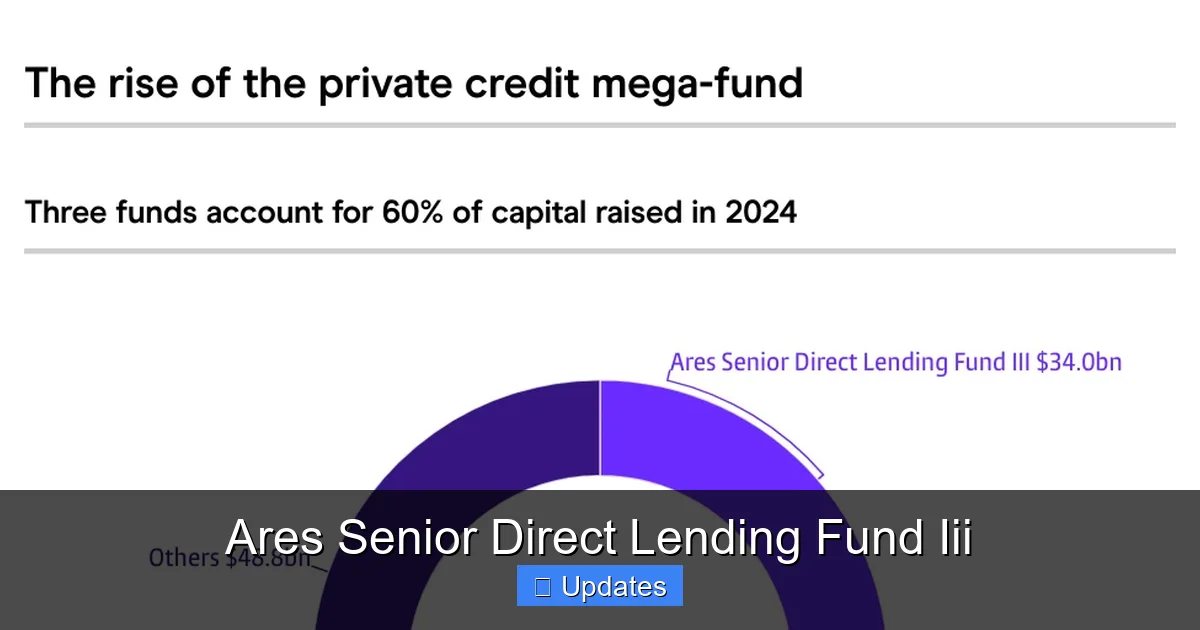
Visual guide about Ares Senior Direct Lending Fund Iii
Image source: infogram-thumbs-1024.s3-eu-west-1.amazonaws.com
Diversification Across Industries and Geographies
Ares Senior Direct Lending Fund III maintains a diversified portfolio across multiple industries to mitigate sector-specific risks. Historically, the fund has allocated capital among business services, healthcare, manufacturing, technology, and consumer goods—sectors that demonstrate stable cash generation and lower sensitivity to macroeconomic cycles.
Geographically, the fund concentrates on the United States, with occasional Canadian investments. This regional focus allows Ares to leverage local market knowledge and maintain close operational oversight. However, it also means the fund carries concentration risk relative to globally diversified credit strategies.
To enhance diversification within each sector, Ares typically limits individual exposures to 3–5% of total assets. This cap prevents excessive reliance on any single borrower and aligns with best practices in institutional portfolio construction. For example, if the fund has $1 billion in committed capital, no single loan would exceed $30–50 million absent exceptional circumstances.
Credit Underwriting Standards
Ares applies a rigorous, repeatable underwriting framework known as the “Ares Credit Process.” This involves evaluating five core pillars:
1. **Business fundamentals**: Revenue stability, customer diversification, competitive positioning, and management quality.
2. **Financial performance**: Historical and projected EBITDA margins, free cash flow generation, and balance sheet strength.
3. **Collateral adequacy**: Appraised value of pledged assets, liquidation value estimates, and lien perfection status.
4. **Sponsor profile** (if applicable): Track record of the private equity sponsor, alignment of incentives, and prior exits.
5. **Macro tailwinds**: Industry trends, regulatory environment, and technological disruption risks.
During the pandemic, for instance, Ares paused new commitments to certain hospitality and leisure sectors due to prolonged uncertainty around travel demand. Instead, it increased allocations to essential services like medical staffing and e-commerce fulfillment—industries with resilient underlying economics.
Return Enhancement Mechanisms
Beyond base interest rates, Ares incorporates several return enhancement features:
– **Step-ups**: Interest rates increase after certain performance thresholds are met.
– **PIK toggle options**: Borrowers can elect to pay interest in-kind (added to principal) under predefined conditions, though this usually requires consent.
– **Equity warrants**: Occasionally, Ares receives warrants exercisable into the borrower’s equity, creating upside participation without diluting core debt returns.
– **Fee income**: Structuring fees, amendment fees, and prepayment premiums supplement yield.
These tools help offset inflation, reward strong execution, and compensate for illiquidity. However, they must be balanced against potential conflicts of interest—for example, incentivizing borrowers to take on excessive leverage to trigger step-ups.
Risks and Considerations for Investors
While Ares Senior Direct Lending Fund III offers compelling opportunities, it is not without risks. Understanding these upfront helps investors assess whether the fund fits their overall strategy.
Illiquidity and Lock-Up Periods
As noted earlier, the fund operates with a long-term horizon. Most investors face a minimum holding period of five years, with redemptions possible only after year seven under normal circumstances. Even then, gates may restrict outflows if too many requests occur simultaneously. This lack of liquidity means investors cannot react immediately to changing market conditions or personal needs.
Market and Credit Risks
Economic downturns can impair borrower performance, leading to covenant breaches or defaults. Although senior secured loans are well-collateralized, recovery rates in distressed scenarios rarely exceed 70–80 cents on the dollar—especially if asset values decline sharply (e.g., during a recession). Ares mitigates this via proactive portfolio management, but no strategy eliminates downside entirely.
Interest rate fluctuations also impact valuations. Rising rates can depress the price of existing fixed-rate loans, even if they remain current. That said, many Ares loans carry floating rates tied to LIBOR or SOFR, insulating investors from rate hikes.
Operational and Manager Risk
All private funds depend heavily on their manager’s capabilities. If Ares’ credit team were to lose key personnel or deviate from its disciplined approach, performance could suffer. Additionally, administrative challenges—such as accurate NAV reporting, tax compliance, and investor communications—require robust infrastructure.
Fees and Expenses
Like most private credit vehicles, the fund charges both management fees (typically 1.5% annually) and incentive fees (often 20% above a hurdle rate). These costs erode net returns and must be weighed against projected gross performance. Some investors negotiate lower fee schedules, especially in larger commitments.
Comparing Ares Senior Direct Lending Fund III to Alternatives
To contextualize its value proposition, it’s helpful to compare Ares SDLF III with similar offerings:
– **Blackstone Senior Direct Lending Fund**: Another top-tier direct lender, Blackstone focuses on broadly syndicated loans with some direct exposure. Its fund tends to have lower fees but less customization.
– **Apollo Senior Floating Rate Fund Inc**: Publicly traded CEF offering floating-rate notes, but exposed to broader market volatility and less direct control over individual credits.
– **CLOs (Collateralized Loan Obligations)**: Securitized pools of loans sold to retail investors; however, they introduce complexity, leverage, and opacity around underlying assets.
Compared to these, Ares SDLF III stands out for its hands-on approach, transparency, and alignment with institutional investor interests. It avoids the structural risks of leveraged securitizations and provides clearer governance rights.
For conservative portfolios seeking steady income without equity market correlation, direct lending funds represent a compelling bridge between traditional bonds and private equity. They offer higher yields than Treasuries or IG corporates while maintaining debt-like characteristics.
Who Should Invest in Ares Senior Direct Lending Fund III?
This fund appeals primarily to sophisticated investors with long-term horizons and a tolerance for illiquidity. Ideal candidates include:
– **Endowments and foundations** seeking uncorrelated returns.
– **Pension funds** looking to diversify away from public equities.
– **High-net-worth families** building generational wealth.
– **Family offices** managing multi-generational capital.
Retail investors generally cannot access the fund directly. Even institutional clients must meet minimum investment thresholds—commonly starting at $5 million or more.
Before committing, investors should consult advisors familiar with private credit, review the confidential offering memorandum thoroughly, and stress-test assumptions under adverse scenarios. Diversification across multiple private credit strategies remains prudent, as overexposure to a single manager or vintage year increases vulnerability.
Looking Ahead: The Future of Private Credit
The trajectory of Ares Senior Direct Lending Fund III reflects broader trends reshaping global finance. As central banks normalize monetary policy and public fixed-income markets become more volatile, demand for private credit is expected to grow. Institutional investors increasingly view direct lending as a strategic allocation rather than a niche alternative.
Regulatory scrutiny is rising, particularly around fee transparency, valuation methodologies, and conflict-of-interest disclosures. Ares has proactively adopted best practices, including third-party audits of NAV calculations and independent board oversight—measures that build trust and reduce litigation risk.
Technological innovation is also transforming the space. Ares uses proprietary analytics platforms to model borrower performance, track covenant compliance, and simulate stress scenarios in real time. These tools improve decision-making and enable faster response times during market dislocations.
Ultimately, funds like Ares SDLF III represent a maturation of the private credit ecosystem—one that blends Wall Street rigor with Main Street relevance. For investors willing to navigate its complexities, the payoff can be significant: stable cash flows, enhanced diversification, and access to capital structures unavailable elsewhere.
Frequently Asked Questions
Is Ares Senior Direct Lending Fund III suitable for retail investors?
No, the fund is only available to accredited or qualified investors due to its private placement structure and illiquid nature. Minimum investments typically start at $5 million or higher.
How does Ares Senior Direct Lending Fund III generate returns?
The fund earns income primarily through interest on senior secured loans, often paid monthly or quarterly. Additional returns may come from structuring fees, prepayment premiums, and occasional equity warrants.
Can I redeem my investment before the fund’s maturity?
Redemptions are generally restricted until year seven of the fund’s life, and even then subject to gate provisions. Early withdrawal is highly uncommon and may incur penalties.
What industries does the fund target?
Ares focuses on North American middle-market companies across stable sectors such as business services, healthcare, manufacturing, technology, and consumer goods.
How is the fund’s net asset value (NAV) determined?
The NAV is calculated monthly based on fair value assessments of underlying loans, reviewed by internal teams and audited by external accountants. Unlike public funds, it’s not marked-to-market daily.
Does Ares Senior Direct Lending Fund III use leverage?
Leverage usage varies but is typically moderate (e.g., 1.5x to 2x debt-to-equity). Excessive borrowing is avoided to preserve capital and maintain flexibility.