
What Is a Senior Secured Note


Gardening Kneeler Bench

Orthopedic Sandals

Handheld Shower Head
A senior secured note is a type of debt security that ranks highest in repayment priority and is backed by specific collateral. Issued by companies to raise capital, these notes offer investors lower risk due to their seniority in the capital structure and asset protection. With interest payments and principal repayment prioritized over other debts, they are attractive to conservative investors seeking steady income with reduced exposure to default risk.
What Is a Senior Secured Note?
If you’ve ever wondered how companies raise money without selling equity—or how investors can earn steady income with relatively low risk—senior secured notes might be part of the answer. These financial instruments sit somewhere between traditional loans and bonds, offering a blend of security, priority, and yield. But what exactly makes a senior secured note different from other types of debt?
At its core, a senior secured note is a bond issued by a corporation or government entity that comes with two key protections: first, it’s backed by specific physical assets (like property or machinery), and second, it holds top priority in repayment if the issuer defaults. Think of it like a mortgage—you borrow money, and the bank takes your house as collateral. If you don’t pay, they can sell the house to recover their funds. In the world of corporate finance, senior secured notes work similarly, but on a larger scale.
These notes are especially popular among institutional investors, pension funds, and anyone looking for stable returns with strong downside protection. Unlike common stock, which offers growth potential but no guaranteed income, or unsecured bonds, which lack asset backing and repayment priority, senior secured notes strike a balance. They’re not always the highest-yielding option, but they’re often among the safest in volatile markets.
In this article, we’ll break down everything you need to know about senior secured notes—from how they function and who issues them, to the risks involved and how to evaluate them as an investor. Whether you’re a beginner curious about fixed-income securities or a seasoned investor refining your portfolio strategy, this guide will give you a clear, practical understanding of what a senior secured note really is and why it matters.
Key Takeaways
- Senior secured notes are high-priority debt instruments: They rank above most other creditors in the event of bankruptcy, increasing the likelihood of repayment.
- Backed by tangible assets: These notes are secured by specific collateral such as real estate, equipment, or inventory, providing additional investor protection.
- Offer predictable cash flows: Investors receive regular interest payments, making them ideal for income-focused portfolios.
- Lower default risk compared to unsecured debt: Because they are secured and prioritized, they carry less credit risk than subordinated or unsecured bonds.
- Used by corporations and governments for funding: Entities issue senior secured notes to finance projects, expansions, or refinancing existing obligations.
- Require careful legal structuring: Proper documentation, including security agreements and trust indentures, is essential to enforce rights and protect both issuers and investors.
📑 Table of Contents
- Understanding Debt Instruments and Their Hierarchy
- The Mechanics of a Senior Secured Note
- Benefits of Investing in Senior Secured Notes
- Risks Associated with Senior Secured Notes
- Who Issues Senior Secured Notes?
- How to Evaluate Senior Secured Notes as an Investor
- Senior Secured Notes vs. Other Debt Securities
- The Role of Credit Ratings and Regulatory Oversight
- Historical Performance and Market Trends
- Conclusion: Are Senior Secured Notes Right for You?
Understanding Debt Instruments and Their Hierarchy
Before diving into the specifics of senior secured notes, it helps to understand the broader landscape of debt financing. Companies and governments raise money through various forms of borrowing, each with different levels of risk and return. The key difference lies in priority—that is, who gets paid first if things go wrong.
Imagine a company goes bankrupt. Among its many creditors, some have stronger claims than others. At the top of the list are those who lent money with collateral and senior status. Below them are unsecured creditors, followed by subordinated debt holders, and finally, shareholders, who get whatever is left (if anything).
Senior secured notes occupy one of the strongest positions in this hierarchy. They are not only secured by specific assets but also rank ahead of almost every other type of debt. This dual protection makes them highly attractive during economic downturns when default risk increases.
To put it simply: senior secured notes = high priority + collateral = lower risk. This combination appeals to risk-averse investors who want reliable income without gambling on the company’s long-term success.
The Mechanics of a Senior Secured Note
Visual guide about What Is a Senior Secured Note
Image source: source.cocosign.com
So how does a senior secured note actually work in practice? Let’s walk through the process step by step.
When a company decides to issue senior secured notes, it typically does so through a public offering or private placement. The issuer negotiates terms such as interest rate (coupon), maturity date, amount raised, and the nature of the collateral. Once finalized, the notes are sold to investors—often through underwriters—and listed on financial exchanges or traded over-the-counter.
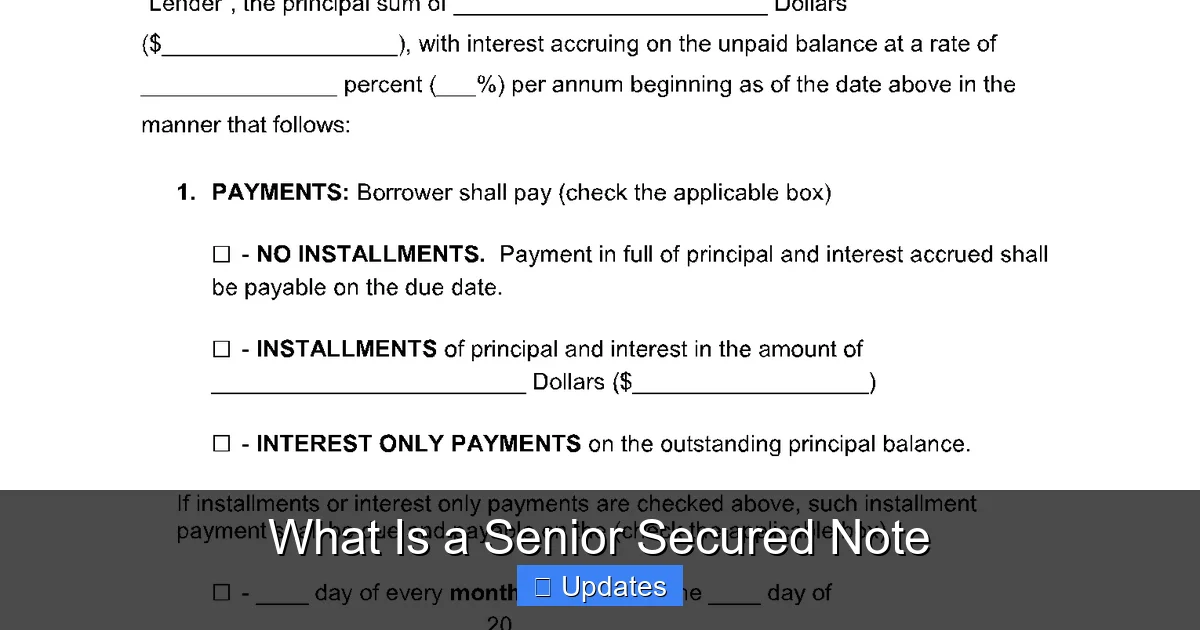
The critical feature of a senior secured note is the security agreement, a legal document that pledges specific assets to back the debt. For example, a manufacturing firm might use its factory buildings, production equipment, and accounts receivable as collateral. If the company fails to make payments, the noteholders can seize and liquidate these assets to recover their investment.
Another important component is the trust indenture, an agreement between the issuer and a trustee (usually a bank) that outlines the rights and responsibilities of all parties. It includes covenants—rules the issuer must follow—such as maintaining certain financial ratios or limiting additional debt issuance.
Interest payments are usually made semi-annually, though some notes offer zero-coupon structures where the investor receives the full payoff at maturity. Maturities can range from a few years to over a decade, depending on the purpose of the funding.
Example Scenario: A Real Estate Developer Issues Notes
Let’s say a real estate development company wants to fund a new apartment complex. Instead of taking out a bank loan, it opts to issue $50 million in senior secured notes. Here’s how it unfolds:
– The company pledges the land, construction materials, and future rental income streams as collateral.
– The notes carry a 6% annual interest rate, payable every six months.
– The notes mature in 10 years, after which the principal is due.
– Because they’re senior and secured, no other lender can claim those assets unless the notes are fully repaid.
– Institutional investors buy the notes, attracted by the combination of steady income and asset protection.
If the project succeeds, the company pays back the notes with interest. If it fails, the noteholders can foreclose on the property and recoup their losses—before junior lenders or shareholders see any action.
This example illustrates why senior secured notes are so valuable: they turn abstract financial risk into concrete, tradable assets backed by real-world value.
Benefits of Investing in Senior Secured Notes

Visual guide about What Is a Senior Secured Note
Image source: i0.wp.com
Investors choose senior secured notes for several compelling reasons. Chief among them is safety. In uncertain economic times, when corporate defaults rise, having top-tier creditor status and collateral backing can mean the difference between getting paid and walking away empty-handed.
One major benefit is predictability. Most senior secured notes come with fixed interest rates, meaning investors know exactly how much they’ll earn each year. This contrasts sharply with stocks, whose returns fluctuate wildly based on market sentiment.
Another advantage is liquidity. While not as freely traded as Treasury bonds, many senior secured notes are listed on major exchanges or available through brokerage platforms. This allows investors to buy and sell them relatively easily if needed.
Credit rating agencies also play a role. Firms issuing senior secured notes often seek high ratings (e.g., BBB or higher), further reassuring investors of their stability. Even if the company stumbles, the secured nature of the debt provides a buffer.
For retirees or conservative portfolios, these notes serve as a reliable source of income. Unlike speculative ventures, they don’t require constant monitoring or analysis. You invest once, collect checks, and rest easy knowing your principal is protected.
Tip: Diversify Within the Fixed-Income Space
While senior secured notes are safer than many alternatives, they’re not risk-free. To truly protect your portfolio, consider diversifying across sectors—energy, healthcare, technology—and maturities. Just like you wouldn’t put all your eggs in one basket, avoid concentrating too much in a single issuer or industry.
Risks Associated with Senior Secured Notes

Visual guide about What Is a Senior Secured Note
Image source: images.pexels.com
Despite their strengths, senior secured notes aren’t immune to risk. Understanding the downsides helps you make informed decisions.
First, collateral value can decline. If the assets backing the notes lose worth—say, due to market crashes or obsolescence—the protection they provide shrinks. Imagine a tech company using outdated servers as collateral; if demand for that hardware plummets, even secured notes become riskier.
Second, liquidation isn’t always straightforward. Selling collateral during a crisis can be slow, messy, or result in fire-sale prices. Banks faced this exact problem during the 2008 financial crisis, when even highly rated secured loans turned toxic.
Third, covenant violations can trigger defaults. If the issuer breaches terms—like missing an interest payment or failing to maintain required debt-to-equity ratios—it may accelerate repayment demands, potentially leading to insolvency.
Fourth, interest rate risk exists. If rates rise after you buy the note, its market value drops. This doesn’t affect your actual cash flow, but it impacts resale value.
Finally, limited upside: unlike equity, you don’t benefit from company growth beyond your fixed return. So while safe, senior secured notes won’t make you rich overnight.
How to Mitigate Risks
To reduce exposure:
– Research the issuer’s financial health thoroughly.
– Check the quality and liquidity of the collateral.
– Review the trust indenture for restrictive covenants.
– Monitor macroeconomic trends affecting the sector.
– Consider professional advice before large investments.
Remember: even secure debt carries some uncertainty. The goal isn’t perfection—it’s smart, balanced risk management.
Who Issues Senior Secured Notes?
Most commonly, senior secured notes are issued by corporations, particularly those in capital-intensive industries like manufacturing, utilities, or real estate. These businesses rely heavily on physical assets, making them natural candidates for secured lending.
Government-sponsored enterprises (GSEs) like Fannie Mae or Freddie Mac also issue secured debt instruments, though these are often classified differently due to their quasi-public status.
In recent years, private equity firms have begun using senior secured notes in leveraged buyouts. They borrow money to acquire companies, using the target’s assets as collateral—a practice known as “asset-backed lending.”
Not all issuers are created equal. Large, established firms with strong balance sheets tend to offer better terms. Smaller or distressed companies may issue notes at higher yields to compensate for increased risk.
Why Corporations Choose This Financing Route
Companies prefer senior secured notes for several reasons:
– They provide access to larger pools of capital than traditional bank loans.
– Interest rates may be lower than unsecured debt due to collateral backing.
– They help preserve shareholder equity by avoiding dilution.
– They support long-term projects without short-term repayment pressure.
For instance, a solar energy startup might issue $100 million in senior secured notes to build a new plant. The collateral? Solar panels, land leases, and power purchase agreements. Investors feel confident because the assets are tangible and essential to operations.
How to Evaluate Senior Secured Notes as an Investor
Deciding whether to invest in senior secured notes requires due diligence. Here’s a checklist to guide your analysis:
- Review the prospectus: This legal document details the terms, risks, collateral, and issuer background. Read it carefully—don’t skip it!
- Assess creditworthiness: Use tools like Moody’s or S&P ratings. Lower-rated notes offer higher yields but greater risk.
- Understand the collateral: Are the pledged assets liquid? Will they retain value in a downturn? Appraisals matter.
- Check covenant strength: Strong protective clauses reduce default likelihood. Weak ones increase vulnerability.
- Compare yields: Weigh returns against inflation and alternative investments. Higher yield should reflect higher risk.
- Diversify: Don’t bet everything on one note or issuer.
Professional investors often use models to estimate recovery rates—the percentage of principal expected to be recovered in default. For senior secured notes, recovery rates are typically higher than for unsecured debt (often 60–80%), according to historical data.
Practical Tip: Start Small and Scale Up
If you’re new to fixed-income investing, begin with exchange-traded senior secured notes. They’re more transparent and easier to research than private placements. As you gain experience, explore direct purchases from issuers or specialized funds.
Senior Secured Notes vs. Other Debt Securities
To appreciate what makes senior secured notes unique, compare them to similar instruments:
| Type of Debt | Secured? | Repayment Priority | Typical Yield | Risk Level |
|---|---|---|---|---|
| Senior Secured Note | Yes | Highest | Moderate | Low-Moderate |
| Unsecured Bond | No | Middle/Low | Higher | Moderate-High |
| Subordinated Debt | Sometimes | Lowest | High | High |
| Bank Loan (Term Loan) | Yes | High (but private) | Variable | Low-Moderate |
As shown, senior secured notes offer a sweet spot: decent yield with solid protection. They’re less risky than unsecured bonds and more accessible than private loans.
Note on Market Accessibility
Unlike bank loans, which are negotiated privately, senior secured notes are often publicly traded. This transparency helps investors compare options and exit positions more easily. However, pricing can still be opaque for smaller offerings.
The Role of Credit Ratings and Regulatory Oversight
Credit rating agencies assign grades to senior secured notes based on issuer strength, collateral quality, and structural safeguards. High ratings (e.g., A or AA) signal low default probability; lower ratings (BB or below) suggest higher risk—and often higher yields.
Regulators oversee the issuance process to ensure fairness and transparency. In the U.S., the SEC requires detailed disclosures for public offerings. Private placements follow Rule 144A, allowing qualified buyers to trade restricted securities.
Compliance with these standards builds investor confidence. It also means issuers must maintain accurate records and honor their obligations—otherwise, penalties apply.
Why Ratings Matter (But Aren’t Everything)
Even highly rated notes can default—especially during systemic crises. During the 2008 crash, many “investment-grade” bonds lost value rapidly. That’s why it’s wise to treat ratings as one input among many, not gospel truth.
Historical Performance and Market Trends
Over the past two decades, senior secured notes have delivered consistent returns, particularly during bear markets. According to industry reports, average annualized returns hover around 5–7%, outperforming cash and rivaling high-quality corporate bonds.
Their popularity surged post-2008 as regulators tightened rules on unsecured lending. Banks shifted toward asset-backed models, boosting demand for secured instruments.
Today, ESG-focused funds increasingly include senior secured notes in portfolios. Why? Because collateral-based lending tends to align with sustainable practices—issuers must maintain valuable assets, discouraging reckless behavior.
Trend Alert: Rise of Private Credit
More investors are turning to private senior secured notes offered directly by middle-market companies. These deals often carry higher yields but less liquidity. They suit accredited investors comfortable with longer holding periods.
Conclusion: Are Senior Secured Notes Right for You?
In summary, a senior secured note is a powerful tool for both borrowers and lenders. For companies, it’s a way to access cheap, large-scale funding without sacrificing control. For investors, it’s a path to stable income with enhanced security.
They’re not perfect—no investment is—but their combination of priority and collateral makes them stand out in the crowded world of fixed income. If you value predictability, downside protection, and reasonable returns, they deserve serious consideration.
Just remember: do your homework. Understand the collateral, monitor covenants, and never ignore red flags. And always keep your overall financial goals in mind.
Whether you’re building a retirement nest egg, rebalancing a portfolio, or exploring new asset classes, senior secured notes can play a valuable role. They’re not flashy, but they’re dependable—exactly what many investors need in today’s unpredictable economy.
For further reading on related topics, check out our guides on senior bonds and senior analysts, which explore adjacent areas of finance and career progression.
Frequently Asked Questions
What does “senior” mean in a senior secured note?
In finance, “senior” refers to the order of repayment. Senior secured notes have the highest claim on a company’s assets and cash flow, meaning they get paid before most other creditors in case of bankruptcy or restructuring.
Can I lose money on a senior secured note?
Yes, although rare. If the issuer defaults and the collateral loses enough value, you may recover less than your principal. Economic downturns, poor asset performance, or legal complications can reduce recovery rates.
Are senior secured notes taxable?
Generally, yes. Interest earned is treated as taxable income at your marginal tax rate. Consult a tax advisor for specifics, especially if you hold the notes in a retirement account.
How do I buy senior secured notes?
You can purchase them through brokerage accounts, mutual funds, ETFs focused on senior loans, or directly from issuers in private placements—though the latter requires accreditation under securities laws.
What happens if the issuer files for bankruptcy?
The trustee oversees asset liquidation. Senior secured noteholders get paid first from the proceeds of the collateral. Only after full repayment do junior creditors and shareholders see any remaining funds.
Are senior secured notes suitable for beginners?
They can be, especially exchange-traded versions. Beginners should start small, diversify, and learn about credit ratings and collateral before committing significant capital.