
What Is Mid Senior Level


Electric Kettle with Auto Shutoff

Orthopedic Sandals

Folding Walking Cane
Mid senior level refers to an advanced career stage where professionals have significant experience, leadership responsibilities, and expertise. This level sits between junior and executive roles, offering a balance of independence and mentorship opportunities. Whether in business, sports, or personal development, understanding mid senior level helps set clear goals and expectations for growth.
Have you ever wondered what it really means to be at the “mid senior level”? It’s one of those phrases you hear everywhere—job postings, performance reviews, golf club recommendations, and even dog food packaging. But what does it actually mean? Is it just about age, or is there more to it?
Let’s break it down. The term mid senior level isn’t a rigid definition—it’s more of a spectrum. It describes someone who has moved beyond entry-level work but hasn’t yet reached the highest echelons of leadership. Think of it as the bridge between being a reliable contributor and becoming a decision-maker. In this article, we’ll explore what mid senior level truly means across different contexts, why it matters, and how you can identify when you—or someone you know—is operating at this stage.
Whether you’re climbing the corporate ladder, upgrading your golf gear, or simply trying to understand workplace jargon, this guide will give you clarity. We’ll cover everything from professional development stages to real-world examples in sports and finance. By the end, you’ll not only know what mid senior level means but also how to recognize it in action.
Key Takeaways
- Experience and Expertise: Mid senior level professionals typically have 7–15 years of experience, combining deep knowledge with practical application.
- Leadership Responsibilities: They often lead projects, mentor junior staff, and make strategic decisions without direct supervision.
- Career Progression: This level is a natural stepping stone toward senior leadership roles like director or VP.
- Industry Variance: The definition of “mid senior” varies by field—tech, finance, education, and even golf all use the term differently.
- Skill Development: Success at this level requires strong communication, problem-solving, and emotional intelligence.
- Recognition and Compensation: Mid senior roles usually come with higher pay, more autonomy, and greater influence over company direction.
- Flexibility Across Sectors: From corporate roles to recreational activities like golf, “senior” labels help categorize performance or eligibility levels.
Quick Answers to Common Questions
What does “mid senior level” mean in a job description?
It indicates a role requiring significant experience and some leadership duties, typically between 7–15 years in the field. Professionals at this level operate independently while mentoring others.
Is “senior” always about age?
No. While “senior citizen” refers to people over 65, terms like “senior flex golf club” describe equipment suited to certain swing speeds, not age.
How long does it take to reach the mid senior level?
Most people achieve it within 7–15 years, depending on industry, pace of learning, and opportunities for advancement.
Can younger professionals be at the mid senior level?
Absolutely. With rapid skill acquisition, certifications, and proactive career moves, someone in their late 20s or early 30s can hold a mid senior title.
Why do companies use “senior” in product names?
Brands use “senior” to signal features tailored to experienced users or specific needs—like softer grips or lighter weight—without implying age.
📑 Table of Contents
- Understanding Career Levels: From Junior to Executive
- What Does “Senior” Mean in Different Fields?
- How to Recognize If You’re at the Mid Senior Level
- The Role of Age in Defining “Senior”
- Mid Senior Level vs. Executive Roles
- Examples of Mid Senior Level in Action
- Conclusion: Embracing Growth at Every Stage
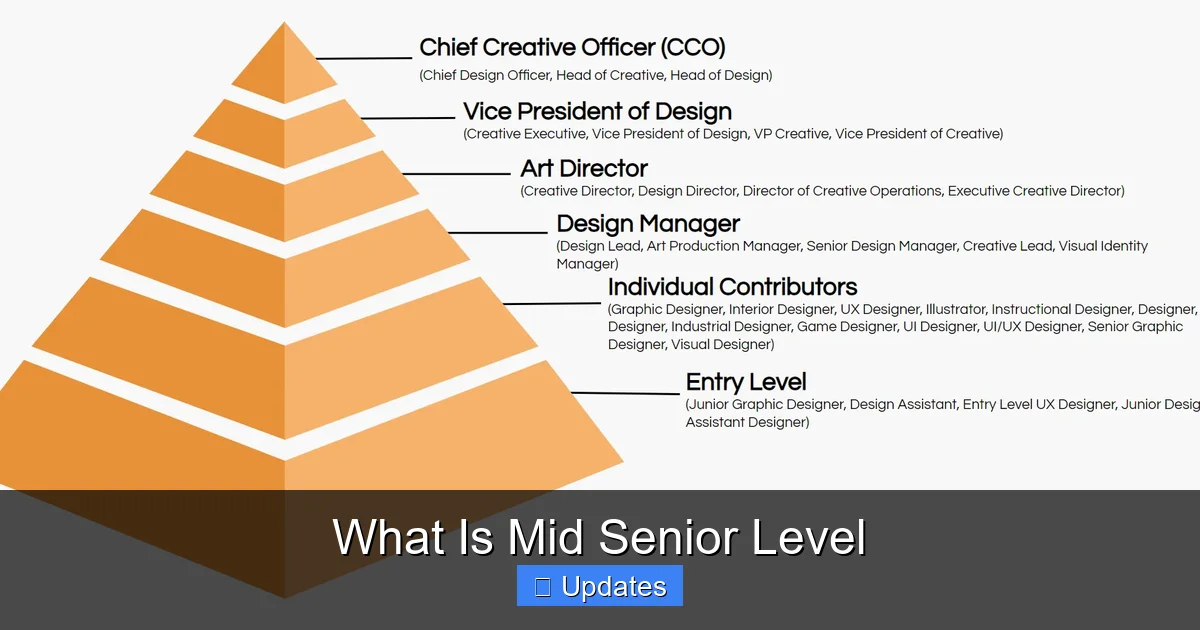
Understanding Career Levels: From Junior to Executive
So, how do career levels actually work? Most organizations use a tiered system to categorize employee roles based on experience, responsibility, and skill. These levels help companies structure promotions, compensation, and training programs.
At the bottom are junior roles, where individuals are still learning the ropes. Then comes the intermediate or mid-level position, followed by the senior level. The mid senior level sits right above mid-level and below principal or executive roles.
This progression isn’t always linear. Some people jump quickly due to exceptional talent; others take longer because they prioritize work-life balance or niche specializations. But generally, reaching the mid senior level means you’re no longer following instructions blindly—you’re interpreting them, improving processes, and guiding others.
In tech companies, for example, a mid senior engineer might design system architectures while mentoring new hires. In finance, a mid senior analyst could lead client presentations and own entire portfolios. The key? You’ve earned trust, and now you’re expected to deliver results independently.
The Importance of Clear Role Definitions
Without clear definitions, job titles become meaningless. That’s why many firms now publish detailed competency frameworks. For instance, Google’s L3, L4, and L5 engineers each have distinct expectations around autonomy, impact, and team leadership.
When you see “mid senior” in a job description, look for clues like:
– Leading cross-functional teams
– Owning end-to-end projects
– Providing technical guidance
– Making high-stakes decisions
If these sound familiar, congratulations—you might already be operating at that level!
What Does “Senior” Mean in Different Fields?

Visual guide about What Is Mid Senior Level
Image source: wrkpod.com
One common misconception is that “senior” always refers to age. While age can be a factor (especially in retirement planning), it’s far from universal. In fact, “senior” often describes skill level, experience, or eligibility rather than chronological years.
Take golf clubs, for instance. A senior flex shaft is designed for players with slower swing speeds—usually adults over 50, but not always. Similarly, a mid senior league bat might be lighter or have a larger sweet spot to accommodate less powerful swings. Here, “senior” signals equipment suitability, not age alone.
In business, titles like senior analyst or senior associate reflect years of service and demonstrated competence. These roles require advanced analytical skills, client interaction, and sometimes supervisory duties. At the mid senior level, professionals are expected to operate with minimal oversight while contributing strategically.
Even in legal contexts, a senior investigating officer handles complex cases independently, drawing on years of fieldwork and procedural knowledge. Again, this isn’t about age—it’s about authority and experience.
Breaking Down Common “Senior” Titles
Let’s look at some real-world examples:
– Senior Accountant: Oversees financial reporting, ensures compliance, and may supervise junior accountants.
– Senior Project Manager: Manages large-scale initiatives across departments, often interfacing directly with executives.
– Senior Software Developer: Writes clean, scalable code, mentors teammates, and influences technical direction.
Each of these roles represents the mid senior level—where individual excellence meets organizational impact.
How to Recognize If You’re at the Mid Senior Level
Visual guide about What Is Mid Senior Level
Image source: d2shvezvv4hf5p.cloudfront.net
Wondering if you’ve hit this milestone? Here are telltale signs:
- You mentor others: Newcomers seek your advice, and you enjoy sharing knowledge.
- You make decisions autonomously: Your manager trusts you to handle tasks without constant check-ins.
- Your work has visible impact: Projects you lead affect company metrics, customer satisfaction, or revenue.
- You stay updated on industry trends: You read trade journals, attend conferences, and adapt quickly to changes.
- People look to you for guidance: Even non-direct reports ask for your input during tough situations.
If several of these resonate, you’re likely operating at the mid senior level. Of course, self-assessment isn’t perfect. Getting feedback from peers or supervisors can provide valuable perspective.
Practical Tips for Advancing to Mid Senior Status
Not everyone starts here—but most can reach it with effort. Consider these strategies:
– Seek stretch assignments: Volunteer for high-visibility projects outside your usual scope.
– Develop soft skills: Communication, empathy, and conflict resolution matter as much as technical ability.
– Build relationships: Network internally and externally to increase your influence.
– Invest in continuous learning: Certifications, courses, and workshops keep your skills sharp.
– Document your wins: Track achievements to showcase your value during performance reviews.
Remember, advancement isn’t just about doing your job well—it’s about making yourself indispensable in a broader sense.
The Role of Age in Defining “Senior”

Visual guide about What Is Mid Senior Level
Image source: greatsenioryears.com
Now, let’s address the elephant in the room: age. While senior citizen typically refers to individuals aged 65+, the term “senior” in professional or product contexts rarely correlates directly with age.
For example, a 30-year-old data scientist might hold the title of senior data scientist after eight years in the field. Conversely, a 60-year-old administrative assistant wouldn’t automatically earn a “senior” designation unless they’d proven exceptional skill or leadership.
That said, age can indirectly influence seniority through experience accumulation. Older workers often bring decades of institutional knowledge, which companies value highly. However, younger professionals can accelerate their path by taking initiative, pursuing advanced degrees, or mastering emerging technologies.
To avoid confusion, many organizations now clarify whether “senior” reflects tenure, skill level, or both. Always read the fine print!
Age Thresholds Across Industries
While “mid senior level” isn’t age-dependent, here’s how age intersects with related concepts:
– Golf: Senior flex shafts suit players over 50, though exceptions exist based on swing speed.
– Real estate: Some communities offer senior apartments for residents aged 55+.
– Finance: Retirement plans often define “senior” as 65, aligning with Social Security eligibility.
These distinctions highlight why context matters when interpreting “senior.”
Mid Senior Level vs. Executive Roles
It’s easy to assume that hitting the mid senior level means you’re halfway to the top. But in reality, the gap between mid senior and executive positions can feel vast. Executives—like VPs, CTOs, or CEOs—operate at a different plane altogether.
At the mid senior level, your focus is usually on execution and optimization. You implement strategies created by leaders above you. In contrast, executives shape strategy, define vision, and represent the organization externally.
That doesn’t mean mid senior roles lack importance—quite the opposite. They’re the engine room of most companies, driving day-to-day operations and innovation. Many executives began their careers exactly where you are now.
Pathways to Leadership
Want to move beyond the mid senior level? Start by expanding your influence. Ask yourself:
– Am I influencing decisions beyond my immediate team?
– Do I collaborate with other departments?
– Am I helping define standards or best practices?
Over time, consistent visibility and results open doors to higher roles. Mentorship from current executives can also fast-track your journey.
Examples of Mid Senior Level in Action
To make this concrete, let’s examine two scenarios:
Scenario 1: Marketing Professional
Jamal joined his company five years ago as a digital marketer. Recently, he’s taken ownership of the Q4 campaign rollout, coordinating with designers, copywriters, and sales teams. He presents findings to department heads and proposes new tactics based on market research. His manager gives him broad latitude, knowing Jamal delivers quality work with little hand-holding. Clearly, Jamal operates at the mid senior level.
Scenario 2: Golf Enthusiast
Maria is 48 and plays weekly at her local course. She prefers a senior flex golf club because it complements her moderate swing speed. Though not yet 50, she benefits from equipment tailored to her needs—not her birthday. Her choice reflects how “senior” functions as a functional label, not an age marker.
Both examples show how mid senior level applies uniquely across domains.
Lessons Learned
From these cases, we see that:
– Experience trumps age in professional settings.
– Product features often use “senior” to denote suitability, not demographics.
– Clarity in terminology prevents misunderstandings.
Conclusion: Embracing Growth at Every Stage
So, what is mid senior level? It’s more than a job title—it’s a recognition of capability, responsibility, and potential. Whether you’re aiming for that next promotion, choosing the right golf club, or simply navigating workplace culture, understanding this concept empowers you to make informed choices.
Remember, seniority isn’t static. It evolves with learning, adaptation, and contribution. By focusing on developing skills, building relationships, and delivering impact, you’ll naturally progress toward and thrive at the mid senior level.
And hey—if you’re already there? Celebrate! You’ve earned your place. If you’re working toward it, stay patient and persistent. The journey itself builds the foundation for future success.
No matter where you are, keep growing. Because at every stage, there’s room to rise—and that’s what makes life exciting.
Frequently Asked Questions
What is considered a mid senior level role?
A mid senior level role typically involves 7–15 years of experience, project ownership, mentoring, and autonomous decision-making. Examples include senior analysts, developers, and managers.
How is “senior” used in golf equipment?
In golf, “senior” describes flexible shafts designed for players with slower swing speeds, usually adults over 50, though exceptions apply based on technique.
Does “mid senior level” depend on age?
No. While age may correlate with experience, the term primarily reflects skill, responsibility, and tenure—not chronological years.
What skills are needed at the mid senior level?
Key skills include strategic thinking, communication, problem-solving, team leadership, and the ability to work with minimal supervision.
Can I use “senior” in my resume if I’m young?
Yes, if you have substantial relevant experience and can demonstrate expertise comparable to established professionals in your field.
Where can I learn more about career progression?
Explore resources like industry certifications, professional networks, and internal training programs to build toward mid senior roles.