
Senior Program Manager Job Description


Glucose Monitor Kit

Long Handle Shoe Horn

Smart Doorbell Camera
A Senior Program Manager leads complex, cross-functional initiatives from strategy to execution, ensuring alignment across teams, budgets, and timelines. This role blends strategic vision with operational excellence, making it one of the most influential positions in modern organizations. Whether you’re hiring or advancing your career, understanding the nuances of this role is essential for success.
If you’ve ever wondered what it takes to run large-scale initiatives that impact entire organizations, the answer lies in the world of senior leadership roles—and at the heart of many such operations is the Senior Program Manager. This position sits squarely between strategy and execution, acting as the conductor of complex, multi-threaded projects that require coordination across teams, technologies, and timelines.
Unlike project managers who focus on a single initiative, a Senior Program Manager oversees multiple related projects—or an entire portfolio—ensuring they all align with broader business goals. Think of them as the bridge between upper management and frontline execution teams. Their work spans planning, risk mitigation, stakeholder engagement, resource allocation, and performance tracking.
In today’s fast-paced, interconnected business environment, companies depend on individuals who can see the big picture while staying grounded in operational details. That’s where the Senior Program Manager shines. Whether launching a new product line, digitizing internal systems, or expanding into international markets, this role ensures that transformation happens smoothly, on time, and within budget.
Key Takeaways
- Leadership Across Functions: Senior Program Managers orchestrate efforts across departments, requiring strong communication and influence skills without direct authority.
- Strategic & Operational Balance: They translate high-level goals into actionable plans, managing scope, risk, and delivery simultaneously.
- Stakeholder Management: Success depends on aligning executives, clients, and team members around shared objectives.
- Data-Driven Decision Making: These professionals rely on KPIs, dashboards, and analytics to guide program performance.
- Career Path Flexibility: With experience, Senior Program Managers often transition into Director or VP roles or pivot to Product, Operations, or Consulting.
- Industry Variance: Responsibilities differ slightly by sector—tech, healthcare, finance—but core competencies remain consistent.
- Certifications Enhance Credibility: PMP, PRINCE2, or Agile certifications can accelerate career progression and validate expertise.
📑 Table of Contents
What Does a Senior Program Manager Do?
The day-to-day responsibilities of a Senior Program Manager are both diverse and demanding. While specific duties vary by industry and company size, core functions typically include:
Program Planning and Strategy
Senior Program Managers begin by defining the program vision, goals, and success metrics. They collaborate with executives to understand strategic priorities and translate them into executable roadmaps. For example, if a tech firm aims to launch three new software features in six months, the Senior Program Manager would break this down into smaller projects, assign ownership, set milestones, and establish KPIs like user adoption rates or deployment frequency.
They also conduct feasibility studies, assess risks, and develop contingency plans. A common scenario involves evaluating whether a proposed digital transformation initiative aligns with current infrastructure capabilities and regulatory requirements.
Cross-Functional Leadership
One of the most challenging aspects of the job is leading without direct authority. Senior Program Managers must influence engineers, marketers, sales reps, legal teams, and external vendors—all while maintaining morale and accountability. This requires exceptional emotional intelligence, active listening, and negotiation skills.
For instance, when two teams disagree on feature prioritization during a product rollout, the Senior Program Manager facilitates workshops to find consensus, ensuring both sides feel heard and valued. They might use techniques like RACI matrices (Responsible, Accountable, Consulted, Informed) to clarify roles and reduce friction.
Resource and Budget Oversight
Managing budgets upwards of several million dollars is routine for Senior Program Managers. They track expenditures against forecasts, approve vendor contracts, and justify spending increases to sponsors. In one real-world case, a Senior Program Manager at a Fortune 500 company saved $1.2M annually by renegotiating cloud service agreements without sacrificing performance.
They also ensure resources—whether people, tools, or data—are allocated efficiently. This includes identifying skill gaps, recommending staffing changes, and supporting team development through training or mentorship.
Risk and Issue Management
Every program faces setbacks: delays, scope creep, technical debt, or shifting market conditions. The Senior Program Manager maintains a risk register, updates stakeholders regularly, and implements mitigation strategies. When a critical supplier suddenly goes offline, they activate backup vendors and adjust timelines transparently.
Their ability to anticipate problems before they escalate often defines program success. Proactive risk management isn’t just about avoiding disasters—it’s about building resilience into every phase of the program lifecycle.
Reporting and Communication
Clear, concise reporting is non-negotiable. Senior Program Managers prepare executive dashboards showing progress against key metrics, publish weekly status updates, and present quarterly reviews to board-level audiences. Visual tools like Gantt charts, burn-down graphs, and heat maps help simplify complex data.
They also serve as the primary point of contact for external partners, investors, or regulators. Imagine coordinating with government agencies during a compliance-driven IT overhaul—this is where their diplomatic skills come into play.
Skills Required for Success
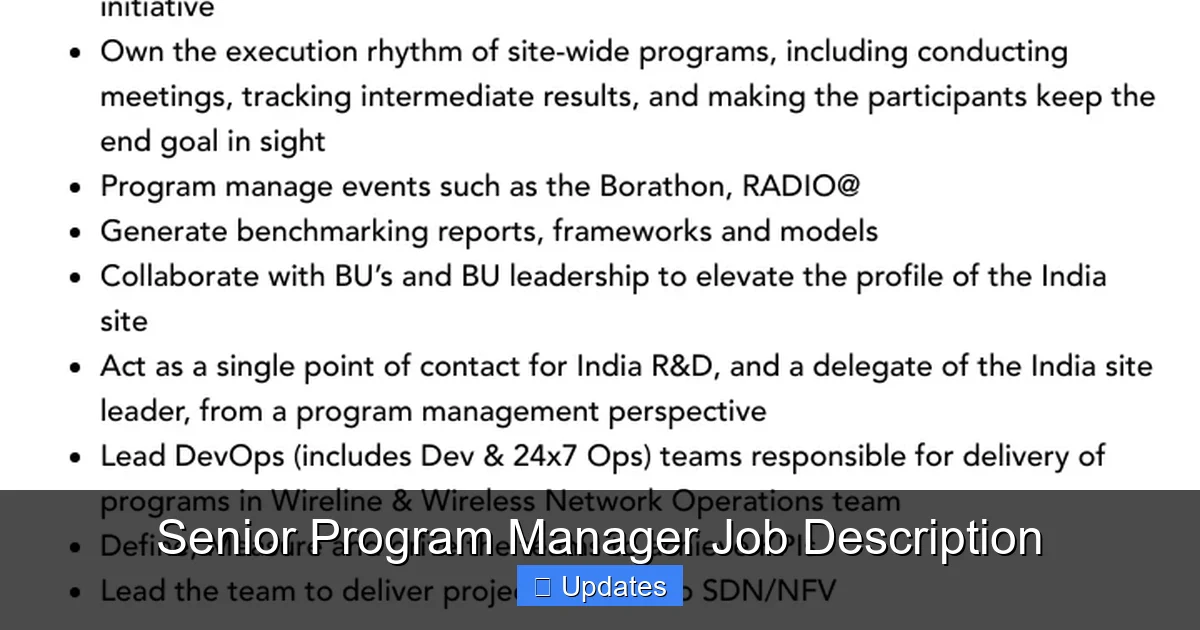
Visual guide about Senior Program Manager Job Description
Image source: asset.velvetjobs.com
To thrive as a Senior Program Manager, you need more than technical know-how. Here’s what sets top performers apart:
Technical Proficiency
Familiarity with project management frameworks (Agile, Scrum, Waterfall), Jira, Asana, Microsoft Project, or Smartsheet is essential. Understanding SDLC (Software Development Life Cycle), DevOps pipelines, or ERP systems adds value, especially in tech or manufacturing sectors.
Leadership and Influence
You don’t manage people directly, but you shape culture and direction. Strong leaders mentor junior PMs, advocate for best practices, and foster collaboration. They lead by example—demonstrating integrity, transparency, and decisiveness under pressure.
Analytical Thinking
Data informs every decision. Senior Program Managers interpret financial reports, usage analytics, customer feedback, and system logs to identify trends and opportunities. Tools like Power BI or Tableau help visualize insights for non-technical audiences.
Communication Mastery
Whether writing emails, delivering presentations, or facilitating meetings, clarity and empathy matter. Tailoring messages to different audiences—engineers vs. C-suite—is crucial. A well-crafted status report can prevent misunderstandings; a poorly worded request can derail progress.
Adaptability and Problem-Solving
Change is constant. Senior Program Managers pivot quickly when priorities shift due to market disruptions, new regulations, or internal restructuring. Their toolkit includes root cause analysis (e.g., 5 Whys), SWOT assessments, and design thinking workshops to solve ambiguous challenges.
Typical Career Path and Qualifications
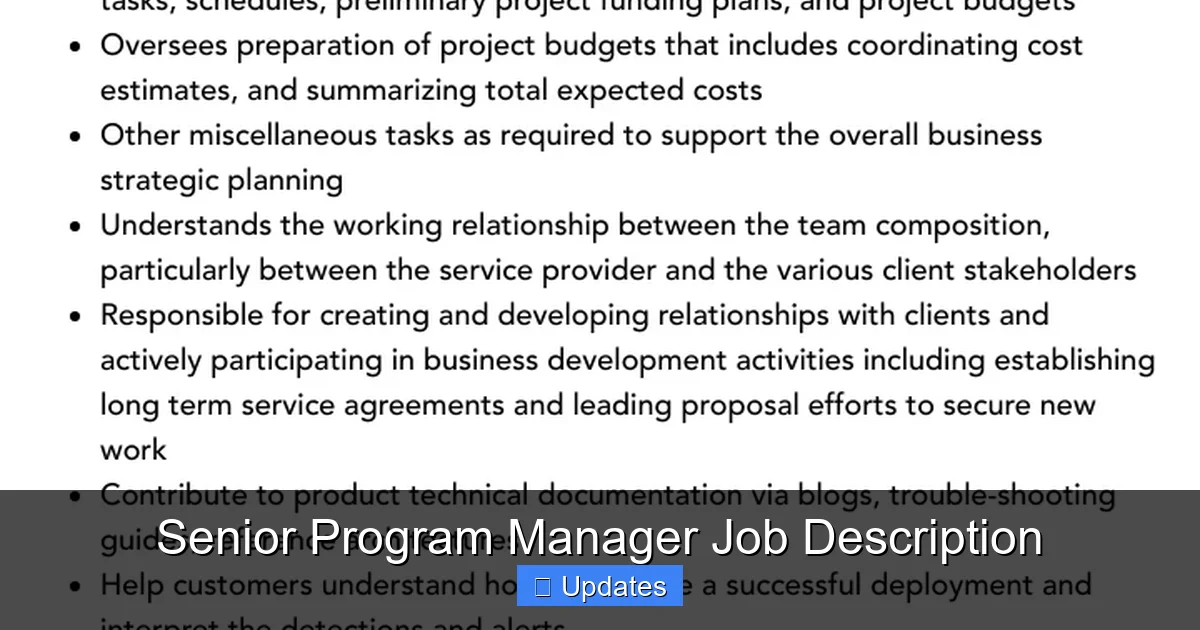
Visual guide about Senior Program Manager Job Description
Image source: asset.velvetjobs.com
Most organizations expect candidates for Senior Program Manager roles to have at least 7–10 years of experience in project or program management. Common starting points include:
– Junior Project Manager
– Business Analyst
– Technical Lead
– Operations Coordinator
Many professionals enter the field from adjacent roles like Product Management, Engineering, or Finance. For example, someone who previously managed software releases as a Technical Lead might transition into program management by broadening their scope to include marketing, sales enablement, and customer support integration.
Educational Background
While not always mandatory, a bachelor’s degree in business administration, computer science, engineering, or a related field is typical. Advanced degrees (MBA, MS) are increasingly common among senior hires, particularly in competitive industries like consulting or tech.
Certifications That Matter
Earning recognized credentials signals commitment to excellence:
- PMP (Project Management Professional): Offered by PMI, this gold-standard certification covers global best practices.
- PRINCE2 Practitioner: Popular in UK and EU-based firms.
- CSPO or PSPO (Certified Scrum Product Owner): Ideal for Agile-heavy environments.
- SAFe Program Consultant (SPC): Valuable for scaling Agile in enterprise settings.
These certifications often lead to higher salaries and greater credibility during promotions or job searches.
Industries Hiring Senior Program Managers
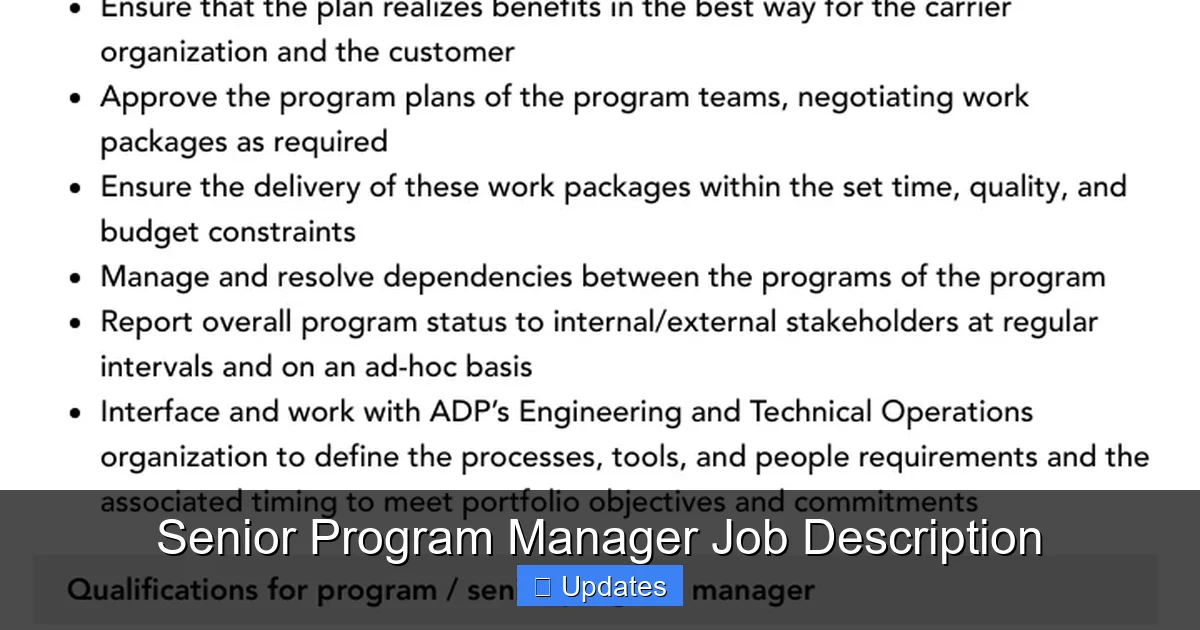
Visual guide about Senior Program Manager Job Description
Image source: asset.velvetjobs.com
This role exists in virtually every sector, but demand is highest where complexity and scale intersect:
Technology & Software
Companies like Microsoft, Google, and Amazon hire Senior Program Managers to drive platform migrations, AI integrations, or cloud adoption. At Microsoft, for instance, a Senior Program Manager might oversee the rollout of Azure AI services across global regions—coordinating with legal, security, engineering, and partner ecosystems.
Healthcare
In hospitals or pharmaceutical companies, these professionals manage EHR implementations, clinical trial launches, or interoperability projects. Ensuring HIPAA compliance while meeting tight deadlines requires meticulous planning and cross-departmental buy-in.
Finance & Banking
Banks use Senior Program Managers to modernize legacy systems, deploy fraud detection algorithms, or comply with new financial regulations. JPMorgan Chase, for example, employs them to streamline payment processing networks amid evolving anti-money laundering laws.
Manufacturing & Supply Chain
Here, the focus shifts to optimizing logistics, automating production lines, or implementing IoT sensors. A Senior Program Manager at Tesla might coordinate between design, manufacturing, and supply chain teams to bring a new battery cell technology to mass production.
Government & Nonprofits
Public sector programs—like national health initiatives or infrastructure upgrades—also employ Senior Program Managers. Their work impacts millions of lives and demands rigorous documentation, public accountability, and stakeholder trust.
How to Become a Senior Program Manager
Ready to take the leap? Here’s a practical roadmap:
Step 1: Gain Experience
Start with hands-on project management roles. Volunteer for stretch assignments involving inter-team collaboration or process improvement. Seek mentors who’ve made similar transitions.
Step 2: Build Technical Skills
Learn tools used in your industry: SQL for data analysis, Figma for UX workflows, or Six Sigma for process optimization. Online platforms like Coursera, Udemy, or LinkedIn Learning offer affordable courses.
Step 3: Earn Certifications
Choose one relevant to your goals. If you work in agile environments, start with Scrum Alliance credentials. If traditional PM frameworks dominate, aim for PMP.
Step 4: Expand Your Network
Attend conferences like PMI Global Summit or Agile20XX. Join local chapters of professional associations. LinkedIn groups like “Program Managers United” provide peer support and job leads.
Step 5: Demonstrate Impact
Document your achievements: “Reduced go-live time by 30%” or “Saved $500K through vendor consolidation.” Use quantifiable results in resumes and interviews.
Pro Tip:
Consider lateral moves into related roles like Portfolio Manager or Product Owner to broaden perspective before targeting senior titles.
Salary Expectations and Job Outlook
Compensation for Senior Program Managers reflects their strategic importance. According to recent industry surveys:
– Median Salary: $125,000–$160,000 annually (U.S.)
– Top Earners: Over $200,000 in tech or consulting
– Bonuses & Equity: Common in startups and FAANG companies
Factors influencing pay include location (San Francisco Bay Area commands premiums), industry, company revenue, and individual performance.
Job growth remains robust. The Bureau of Labor Statistics projects 7% growth for project and program management roles through 2032—faster than average—driven by digital transformation, globalization, and sustainability mandates.
For comparison, see how similar roles compare in compensation: Senior Program Manager Microsoft Salary or Salary For Senior Program Manager.
Common Challenges and How to Overcome Them
Even the best Senior Program Managers face obstacles. Here’s how to navigate them:
Scope Creep
Clients or stakeholders keep adding requests mid-program. Solution: Reinforce change control processes. Require formal approvals for any deviation, and communicate trade-offs clearly.
Team Burnout
High-pressure deadlines lead to attrition. Solution: Monitor workloads, promote work-life balance, and celebrate small wins. Offer flexible schedules or mental health resources.
Lack of Executive Support
Leadership doesn’t prioritize your program. Solution: Align messaging with corporate KPIs. Show how your initiative drives revenue, efficiency, or customer satisfaction.
Tool Fragmentation
Teams use incompatible software (Slack vs. Teams, Excel vs. Airtable). Solution: Advocate for unified platforms. Present ROI analyses showing productivity gains from standardization.
Remember: overcoming these challenges builds your reputation as a resilient, solutions-oriented leader.
Final Thoughts
Being a Senior Program Manager isn’t just a job—it’s a calling for those who love solving complex puzzles, inspiring teams, and turning vision into reality. It demands intellectual rigor, emotional maturity, and relentless curiosity. But when done well, the impact is profound: smoother operations, faster innovation, stronger partnerships, and measurable business outcomes.
Whether you’re exploring this path or already on it, embrace continuous learning. Stay updated on emerging trends like generative AI, remote collaboration tools, or sustainable program design. And never underestimate the power of clear communication—it’s the glue that holds everything together.
As organizations grow more ambitious, the need for skilled Senior Program Managers will only increase. Now is the perfect time to invest in your development and make your mark.
Frequently Asked Questions
What qualifications do I need to become a Senior Program Manager?
Typically, you’ll need 7–10 years of project or program management experience, a bachelor’s degree (often in business or tech), and certifications like PMP or Agile. Relevant experience from roles like Business Analyst or Technical Lead is highly valuable.
How does a Senior Program Manager differ from a Project Manager?
A Project Manager focuses on a single initiative with defined scope, timeline, and deliverables. A Senior Program Manager oversees multiple related projects, aligning them with strategic goals and managing cross-functional dependencies.
What industries hire Senior Program Managers?
Almost all—especially tech, healthcare, finance, manufacturing, and government. Demand is strongest where complexity and scale intersect, such as digital transformation or regulatory compliance.
Can I transition into Senior Program Management from a non-PM role?
Yes! Many come from adjacent fields like engineering, product management, or operations. Focus on gaining PM experience through volunteering, certifications, and demonstrating leadership in cross-functional settings.
What soft skills are most important for this role?
Strong communication, emotional intelligence, adaptability, and influence without authority are critical. You must build trust, resolve conflicts, and keep diverse stakeholders aligned.
Are remote opportunities available for Senior Program Managers?
Absolutely. With digital collaboration tools, many tech and consulting firms offer fully remote or hybrid roles. See Senior Product Manager Jobs Remote for insights into remote-friendly careers.
