
Senior Financial Analyst Job Description


Sock Aid for Seniors

Bathroom Grab Bar Set

Big Button Mobile Phone
A senior financial analyst plays a vital role in guiding business decisions through data-driven insights and financial modeling. This role blends strategic analysis, forecasting, and reporting to support executive leadership and drive organizational growth.
Have you ever wondered what goes on behind the scenes when a company decides to launch a new product, expand into a new market, or cut costs to improve profitability? While many factors influence these decisions, one of the most critical is financial insight—and that’s where the senior financial analyst comes in. This role sits at the intersection of data, strategy, and leadership, providing the analytical backbone that helps organizations make smart, informed choices.
Unlike entry-level financial analysts who may focus on data collection and basic reporting, senior financial analysts take ownership of complex financial models, lead forecasting efforts, and often act as trusted advisors to executives. They don’t just crunch numbers—they interpret them, spot trends, and translate financial data into actionable business recommendations. Whether it’s evaluating investment opportunities, assessing departmental performance, or preparing quarterly reports for stakeholders, their work directly impacts a company’s bottom line.
In today’s fast-paced, data-driven business environment, the demand for skilled senior financial analysts continues to grow. Companies across industries—from tech startups to Fortune 500 corporations—rely on these professionals to navigate economic uncertainty, optimize resources, and drive sustainable growth. If you’re considering a career in finance or looking to advance from a mid-level role, understanding the senior financial analyst job description is a crucial first step.
Key Takeaways
- Core Responsibilities: Senior financial analysts manage financial planning, budgeting, forecasting, and performance analysis to support strategic decisions.
- Required Skills: Strong analytical thinking, advanced Excel proficiency, financial modeling, and communication skills are essential.
- Education & Certification: A bachelor’s degree in finance, accounting, or economics is required; an MBA or CFA is often preferred.
- Industry Demand: This role is in high demand across industries like banking, tech, healthcare, and consulting due to its strategic value.
- Career Path: Many senior financial analysts advance to roles like finance manager, director of finance, or CFO.
- Salary Range: Salaries typically range from $85,000 to $130,000 annually, depending on location, experience, and company size.
- Work Environment: Most work in office settings, often collaborating with cross-functional teams and presenting findings to leadership.
📑 Table of Contents
What Does a Senior Financial Analyst Do?
At its core, the senior financial analyst job description revolves around turning raw financial data into meaningful insights that guide business strategy. While day-to-day tasks can vary depending on the industry and company size, the role generally includes a mix of analytical, strategic, and communication responsibilities.
One of the primary duties is financial planning and analysis (FP&A). This involves creating detailed budgets, forecasting future revenues and expenses, and monitoring actual performance against projections. For example, a senior financial analyst at a retail company might develop a quarterly forecast based on seasonal trends, marketing campaigns, and inventory levels. They’ll then compare actual sales data to the forecast and explain any variances to department heads or executives.
Another key responsibility is financial modeling. Senior analysts build complex Excel models to simulate different business scenarios—such as launching a new product line, acquiring a competitor, or entering a new geographic market. These models help leadership assess risks, estimate returns, and make data-backed decisions. For instance, if a tech company is considering a merger, the senior financial analyst might create a discounted cash flow (DCF) model to estimate the target company’s value and determine whether the deal makes financial sense.
In addition to modeling and forecasting, senior financial analysts are often responsible for performance reporting. They prepare monthly, quarterly, and annual financial reports that highlight key metrics like revenue growth, profit margins, and operating expenses. These reports are shared with senior management, board members, or external stakeholders, so clarity and accuracy are essential.
Beyond numbers, senior financial analysts play a consultative role. They collaborate with departments like marketing, operations, and HR to understand their financial needs and provide guidance on budgeting and cost control. For example, if the marketing team wants to increase its ad spend, the analyst might analyze past campaign ROI and recommend an optimal budget allocation.
They also support strategic initiatives such as capital allocation, cost reduction programs, and long-term planning. By identifying inefficiencies and opportunities for improvement, they help organizations operate more efficiently and profitably.
Key Responsibilities of a Senior Financial Analyst
Visual guide about Senior Financial Analyst Job Description
Image source: asset.velvetjobs.com
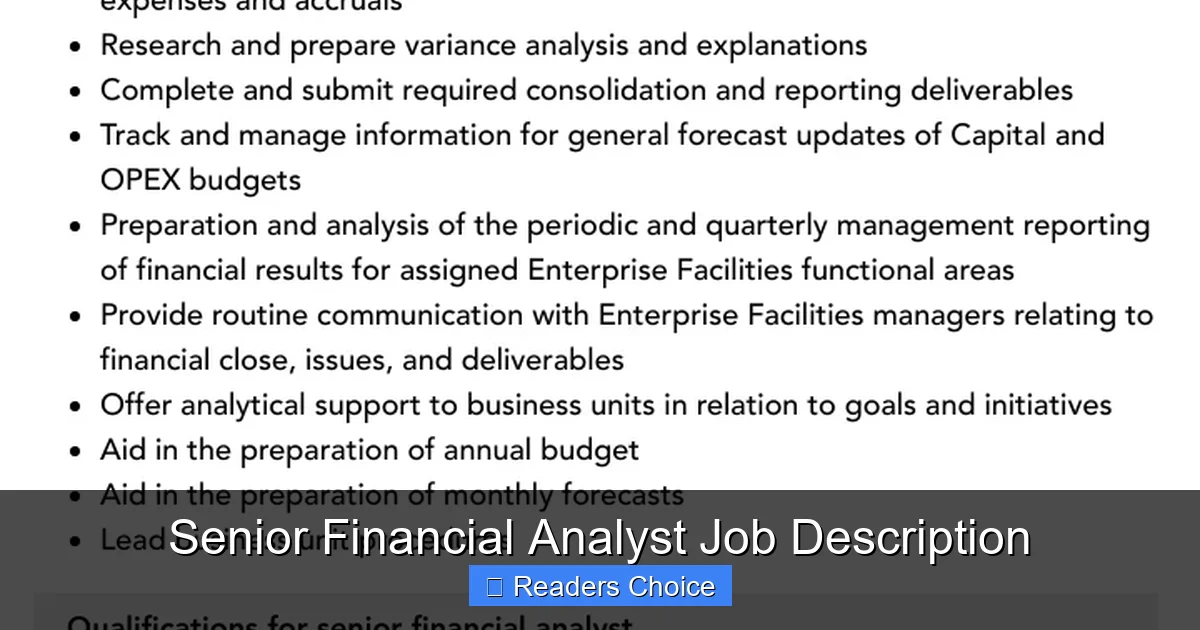
The senior financial analyst job description includes a wide range of responsibilities that go beyond basic number-crunching. These professionals are expected to take initiative, think strategically, and communicate effectively with both financial and non-financial stakeholders.
One of the most important responsibilities is leading the budgeting and forecasting process. Unlike junior analysts who may assist with data entry, senior analysts often own the entire cycle—from gathering input from department heads to finalizing the annual budget and updating rolling forecasts. They ensure that projections are realistic, aligned with company goals, and based on sound assumptions.
For example, in a manufacturing company, the senior financial analyst might work with plant managers to estimate production costs, raw material prices, and labor expenses for the upcoming year. They’ll then consolidate this data into a master budget and present it to the CFO for approval.
Another critical task is variance analysis. This involves comparing actual financial results to budgets or forecasts and explaining the reasons behind any differences. If a company’s revenue is 10% below forecast, the analyst investigates whether it’s due to lower sales volume, pricing changes, or external factors like economic downturns. Their findings help leadership adjust strategies and improve future planning.
Senior financial analysts also conduct profitability analysis. They evaluate the financial performance of products, services, customer segments, or business units to determine which areas are driving value and which are underperforming. For instance, a software company might use this analysis to decide whether to discontinue a low-margin product or invest more in a high-growth segment.
Risk assessment is another key area. Analysts identify potential financial risks—such as currency fluctuations, supply chain disruptions, or regulatory changes—and recommend mitigation strategies. They may also perform scenario analysis to show how different risk factors could impact the company’s financial health.
In addition, they support mergers and acquisitions (M&A) activities by conducting due diligence, valuing target companies, and modeling integration costs. They also assist in investor relations by preparing earnings reports, presentations, and Q&A documents for shareholders and analysts.
Finally, senior financial analysts often mentor junior team members, review their work, and ensure consistency in reporting standards. They may also lead process improvements, such as automating reports or implementing new financial software, to increase efficiency.
Required Skills and Qualifications
Visual guide about Senior Financial Analyst Job Description
Image source: asset.velvetjobs.com
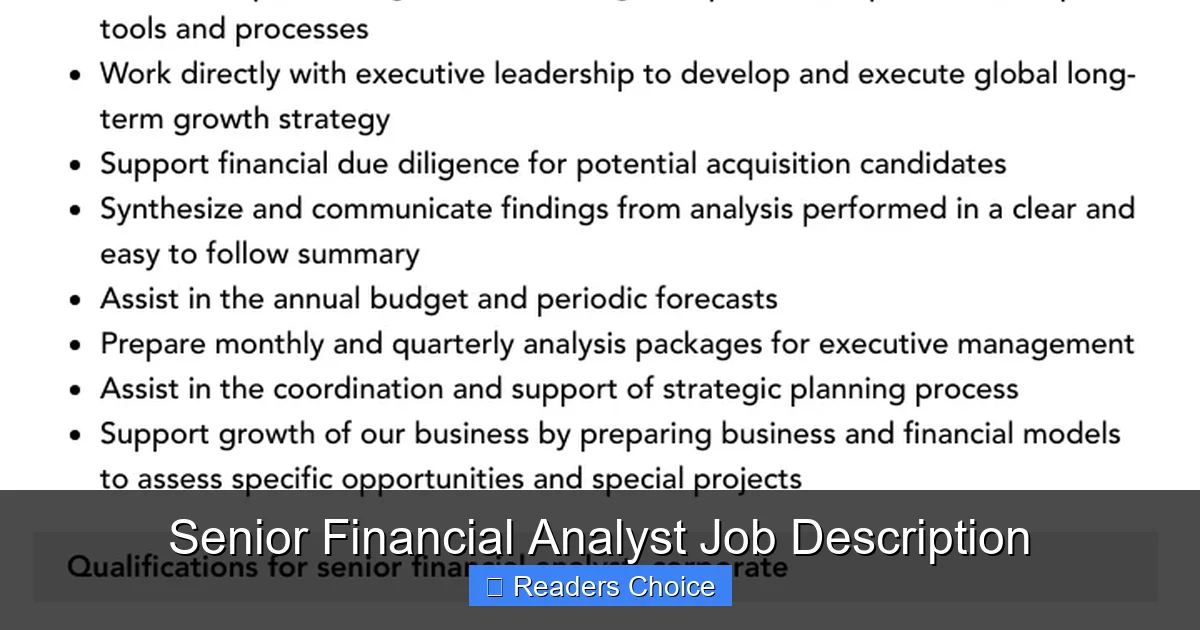
To excel in the senior financial analyst role, candidates need a strong blend of technical expertise, business acumen, and soft skills. While the specific requirements can vary by employer, most job postings emphasize a few core competencies.
First and foremost is analytical thinking. Senior financial analysts must be able to interpret complex data, identify patterns, and draw logical conclusions. This requires not just number sense but also the ability to ask the right questions—like “Why did costs spike in Q3?” or “What’s driving the decline in customer retention?”
Advanced proficiency in Excel is almost non-negotiable. Analysts use Excel daily for everything from building financial models to creating pivot tables and running macros. Many also use tools like Power Query, VBA, or Excel’s data analysis add-ins to streamline workflows. For example, a senior analyst might create a dynamic dashboard that automatically updates with the latest sales data from the company’s CRM system.
In addition to Excel, familiarity with financial software is important. Many companies use enterprise resource planning (ERP) systems like SAP or Oracle, or FP&A platforms like Adaptive Insights or Anaplan. Experience with data visualization tools like Tableau or Power BI is also increasingly valuable, as it allows analysts to present data in a clear, compelling way.
Communication skills are equally critical. Senior financial analysts must be able to explain complex financial concepts to non-financial audiences—such as marketing managers or board members—in a way that’s easy to understand. This includes writing clear reports, delivering presentations, and leading meetings. For instance, when presenting a cost-saving initiative, the analyst needs to highlight the financial impact without overwhelming the audience with technical jargon.
Attention to detail is another must-have. A small error in a financial model—like a misplaced decimal or incorrect formula—can lead to flawed decisions and significant financial consequences. Senior analysts are expected to double-check their work, validate data sources, and ensure consistency across reports.
Time management and organizational skills are also essential. These professionals often juggle multiple projects with tight deadlines, such as month-end close, quarterly reporting, and ad-hoc analyses. Being able to prioritize tasks and work efficiently under pressure is key to success.
Education and Certifications
Most senior financial analyst positions require at least a bachelor’s degree in finance, accounting, economics, or a related field. Coursework typically includes financial accounting, corporate finance, statistics, and business analytics. A strong academic background provides the foundational knowledge needed to understand financial statements, valuation techniques, and economic principles.
Many employers also prefer candidates with an MBA or a professional certification such as the Chartered Financial Analyst (CFA) designation. The CFA program covers topics like portfolio management, ethics, and advanced financial analysis, and earning the charter demonstrates a high level of expertise and commitment to the field.
Other valuable certifications include the Certified Public Accountant (CPA), which is especially useful for roles involving financial reporting and compliance, and the Financial Modeling & Valuation Analyst (FMVA) credential from the Corporate Finance Institute, which focuses on practical skills like building financial models and conducting valuations.
While not always required, relevant work experience is crucial. Most senior financial analyst roles ask for 3–7 years of experience in financial analysis, accounting, or a related role. Candidates often progress from positions like financial analyst, budget analyst, or accountant, gaining hands-on experience with financial modeling, reporting, and business partnering.
Industries and Work Environments
Visual guide about Senior Financial Analyst Job Description
Image source: financewalk.com
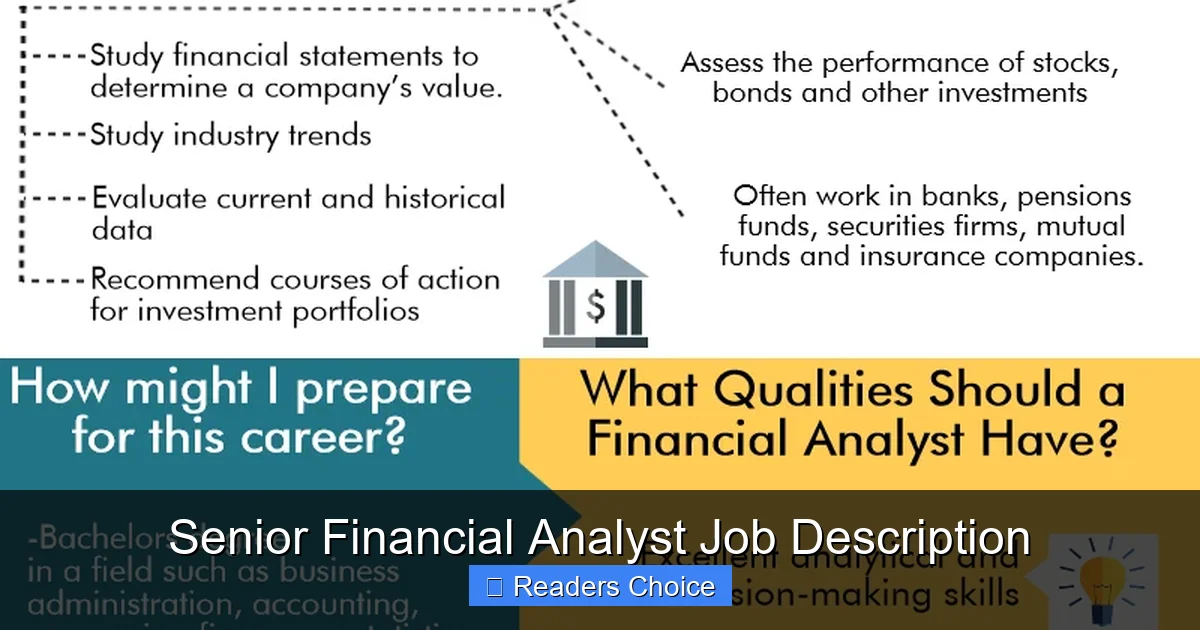
Senior financial analysts are needed across a wide range of industries, each with its own unique challenges and opportunities. Understanding where these roles are most prevalent can help job seekers target their efforts and tailor their skill sets accordingly.
One of the largest employers of senior financial analysts is the financial services sector, including banks, investment firms, insurance companies, and asset management firms. In these organizations, analysts focus on topics like credit risk, portfolio performance, regulatory compliance, and client profitability. For example, a senior financial analyst at a bank might assess the risk of loan defaults and recommend adjustments to lending policies.
The technology industry is another major hub for senior financial analysts. Tech companies—especially high-growth startups and established giants like Google or Microsoft—rely heavily on data-driven decision-making. Analysts in this space often work on product profitability, subscription revenue models, R&D spending, and international expansion. They may also support fundraising efforts by preparing financial projections for investors.
Healthcare is another growing field for financial analysts. Hospitals, pharmaceutical companies, and health tech firms need professionals who can manage complex reimbursement models, evaluate the financial impact of new treatments, and navigate regulatory requirements. A senior financial analyst in a hospital system, for instance, might analyze patient revenue by department and recommend ways to improve operational efficiency.
Consulting firms also hire senior financial analysts to support client projects. These roles often involve short-term engagements where analysts help clients with financial restructuring, cost reduction, or market entry strategies. The work is fast-paced and requires adaptability, as analysts may switch industries or focus areas frequently.
Retail and consumer goods companies also employ senior financial analysts to manage pricing strategies, inventory costs, and store performance. For example, an analyst at a clothing retailer might evaluate the profitability of different product lines and recommend which items to promote or discontinue.
In terms of work environment, most senior financial analysts work in office settings, often in corporate headquarters or regional offices. However, remote and hybrid work arrangements have become more common, especially since the pandemic. The role typically involves standard business hours, though month-end and quarter-end reporting periods may require longer hours.
Collaboration is a big part of the job. Analysts frequently work with colleagues from finance, accounting, operations, and strategy teams. They may also interact with external stakeholders like auditors, investors, or regulatory agencies.
Career Path and Advancement Opportunities
The senior financial analyst role is often a stepping stone to more senior leadership positions in finance and business. With the right experience, skills, and performance, professionals can advance to roles with greater responsibility and strategic influence.
One common career path is moving into a finance manager or finance director role. In these positions, individuals oversee entire finance teams, manage larger budgets, and play a key role in shaping company strategy. For example, a finance manager might lead the FP&A department, set financial goals, and present to the executive team.
Another option is transitioning to a specialized role such as treasury manager, risk manager, or corporate development analyst. These positions allow professionals to focus on specific areas like cash management, financial risk, or M&A strategy.
Some senior financial analysts move into consulting, where they apply their analytical skills to help clients solve complex business problems. Others pursue entrepreneurial paths, using their financial expertise to launch startups or advise early-stage companies.
For those interested in the highest levels of leadership, the ultimate goal may be chief financial officer (CFO). While this requires significant experience and often an MBA, the senior financial analyst role provides valuable preparation by exposing professionals to strategic decision-making, stakeholder management, and financial oversight.
To advance, it’s important to seek out stretch assignments, build relationships with senior leaders, and continue developing both technical and leadership skills. Pursuing an MBA or professional certification can also open doors to higher-level roles.
Salary and Job Outlook
Compensation for senior financial analysts is competitive, reflecting the high level of skill and responsibility involved. According to data from the U.S. Bureau of Labor Statistics and salary aggregation sites like Glassdoor and Payscale, the average annual salary for a senior financial analyst in the United States ranges from $85,000 to $130,000.
Salaries vary based on factors such as location, industry, company size, and level of experience. For example, analysts working in major financial hubs like New York, San Francisco, or Chicago tend to earn higher salaries due to the cost of living and concentration of high-paying firms. Similarly, those in the tech or finance sectors often command higher pay than their counterparts in non-profits or government.
Bonuses and profit-sharing can also significantly increase total compensation. Many companies offer performance-based bonuses that range from 10% to 30% of base salary, depending on individual and company performance.
The job outlook for senior financial analysts is strong. The BLS projects a 6% growth in employment for financial analysts from 2022 to 2032, which is faster than the average for all occupations. This growth is driven by the increasing complexity of financial markets, the need for data-driven decision-making, and the expansion of industries like technology and healthcare.
As businesses continue to rely on financial insights to navigate uncertainty and drive growth, the demand for skilled senior financial analysts is expected to remain robust. Professionals who stay current with industry trends, enhance their technical skills, and demonstrate strong business acumen will be well-positioned for long-term success.
Tips for Aspiring Senior Financial Analysts
If you’re aiming to land a senior financial analyst role or advance in your current position, here are some practical tips to help you stand out:
First, master the fundamentals. Ensure you have a solid understanding of financial statements, accounting principles, and key performance indicators (KPIs). Practice building financial models in Excel and learn to use advanced functions like INDEX-MATCH, OFFSET, and data tables.
Second, develop your storytelling skills. Numbers alone aren’t enough—you need to be able to explain what they mean and why they matter. Practice presenting your findings in a clear, concise way, using visuals like charts and graphs to support your points.
Third, seek out opportunities to lead projects. Volunteer to take ownership of the budget process, lead a cost-saving initiative, or present to senior management. These experiences build credibility and demonstrate your readiness for greater responsibility.
Fourth, stay curious and keep learning. Follow industry news, read financial reports, and take online courses in areas like data analytics, Python, or financial modeling. The more you know, the more valuable you’ll be to your organization.
Finally, build a strong professional network. Connect with colleagues, attend industry events, and engage with finance communities online. Networking can lead to mentorship opportunities, job referrals, and valuable insights into career advancement.
Conclusion
The senior financial analyst job description encompasses a dynamic and impactful role that sits at the heart of business strategy. These professionals combine technical expertise with strategic thinking to guide critical decisions, optimize performance, and drive organizational success.
From financial modeling and forecasting to performance analysis and stakeholder communication, the responsibilities are diverse and challenging. Success in this role requires a strong foundation in finance, advanced analytical skills, and the ability to translate data into actionable insights.
With strong demand across industries, competitive salaries, and clear pathways for advancement, the senior financial analyst role offers a rewarding and sustainable career for those passionate about numbers and strategy. Whether you’re just starting your finance journey or looking to take the next step, understanding this role is a crucial part of building a successful career in the financial world.
Frequently Asked Questions
What is the difference between a financial analyst and a senior financial analyst?
A financial analyst typically focuses on data collection, basic reporting, and supporting senior team members, while a senior financial analyst takes ownership of complex models, leads forecasting, and provides strategic recommendations to leadership. The senior role requires more experience, advanced skills, and greater responsibility.
Do I need a CFA to become a senior financial analyst?
While not always required, a CFA designation can significantly enhance your credibility and job prospects, especially in investment-focused roles. Many employers view it as a mark of expertise in financial analysis and valuation.
What software do senior financial analysts use?
Common tools include Microsoft Excel, ERP systems like SAP or Oracle, FP&A platforms like Adaptive Insights, and data visualization tools like Tableau or Power BI. Proficiency in Excel is especially critical.
Can senior financial analysts work remotely?
Yes, many companies now offer remote or hybrid work options for senior financial analysts, especially after the shift toward flexible work arrangements during the pandemic. However, some roles may require occasional in-person meetings or collaboration.
What industries hire senior financial analysts?
Senior financial analysts are in demand across industries including finance, technology, healthcare, retail, consulting, and manufacturing. Any organization that relies on data-driven financial decision-making may hire for this role.
How can I advance from a senior financial analyst to a CFO?
Advancement typically requires gaining broad experience, pursuing an MBA or advanced certification, developing leadership skills, and building a track record of strategic impact. Many CFOs start in roles like senior financial analyst and progress through finance management positions.
