
Interview Questions for Senior Leadership


LED Clip Reading Light

Mattress Topper Memory Foam

Leg Massager for Circulation
Hiring senior leaders is one of the most critical decisions an organization can make. These individuals shape culture, set strategy, and influence millions of dollars in business outcomes. The right interview questions for senior leadership go beyond technical skills—they reveal a candidate’s leadership philosophy, decision-making style, and ability to navigate complexity. In this article, we dive deep into proven frameworks and specific questions that uncover true leadership potential. Whether you’re interviewing a C-suite executive or a department head, these insights will help you build stronger teams and future-proof your organization.
Hiring senior leadership isn’t just about filling a title—it’s about securing the strategic backbone of your organization. When you bring on someone at the executive level, you’re not only investing in a single role; you’re shaping the direction of entire departments, influencing company culture, and setting the tone for decision-making at every tier. That’s why crafting thoughtful, targeted interview questions for senior leadership is essential. You need more than résumé checks or skill validations. You want insight into judgment, emotional intelligence, resilience, and vision.
Senior leaders operate at the intersection of people, strategy, and execution. Their success hinges not just on what they know, but how they lead others through uncertainty, inspire teams toward ambitious goals, and adapt when plans fall apart. Asking the right questions helps you cut through polished answers and uncover real-world examples of leadership in action. This guide walks you through proven frameworks, practical examples, and sample questions designed specifically for evaluating C-suite executives, VPs, directors, and other high-level roles.
We’ll explore categories like strategic thinking, cultural alignment, crisis management, communication, and ethical decision-making. Each section includes actionable tips so you can tailor your approach based on your organization’s unique needs. By the end, you’ll have a toolkit of powerful questions that go beyond surface-level evaluation—helping you find leaders who don’t just manage today, but build tomorrow.
Key Takeaways
- Strategic Thinking Matters: Senior leaders must align daily actions with long-term vision. Ask scenario-based questions that test their ability to balance short-term wins with sustainable growth.
- Cultural Fit Is Non-Negotiable: A leader who doesn’t resonate with your company values can erode morale. Use behavioral questions to assess how they’ve built or influenced team culture.
- Adaptability Under Pressure: The best senior leaders thrive in ambiguity. Look for examples where they pivoted during crises or managed change effectively.
- Communication Clarity: Executive presence includes clear, compelling communication across all levels. Evaluate how they simplify complex ideas for diverse audiences.
- Accountability & Ownership: Great leaders take responsibility—even when things go wrong. Seek stories that show ownership rather than blame-shifting.
- Diversity & Inclusion Leadership: Modern leadership demands inclusive practices. Assess their track record in fostering equitable environments and driving DEI initiatives.
- Succession Planning Awareness: Top-tier executives think beyond themselves. They invest in developing future leaders within their teams.
📑 Table of Contents
Why Interview Questions for Senior Leadership Matter
Most organizations focus heavily on technical competencies when hiring senior talent. After all, experience in finance, engineering, marketing, or operations is important. But here’s the truth: even the most brilliant subject-matter expert can fail as a senior leader if they lack soft skills, emotional intelligence, or strategic foresight. The gap between individual contributor excellence and transformative leadership is often defined by how well someone communicates vision, motivates teams under pressure, and makes tough calls with incomplete information.
Think about it: when a senior leader joins your company, they’re expected to represent your brand externally, mentor emerging leaders internally, and translate high-level objectives into actionable plans across multiple functions. One misstep—whether in tone, timing, or trust-building—can ripple through your entire organization. That’s why using targeted interview questions for senior leadership isn’t optional; it’s foundational to building a resilient, high-performing leadership pipeline.
Moreover, senior roles come with significant investment—both financially and culturally. A bad hire at this level can cost millions in lost productivity, damaged morale, and reputational harm. Conversely, the right person can accelerate innovation, improve retention, and position your company ahead of competitors. By designing interviews around behavioral indicators and situational judgment, you shift from guessing to measuring leadership capability.
Core Competencies to Evaluate in Senior Leaders
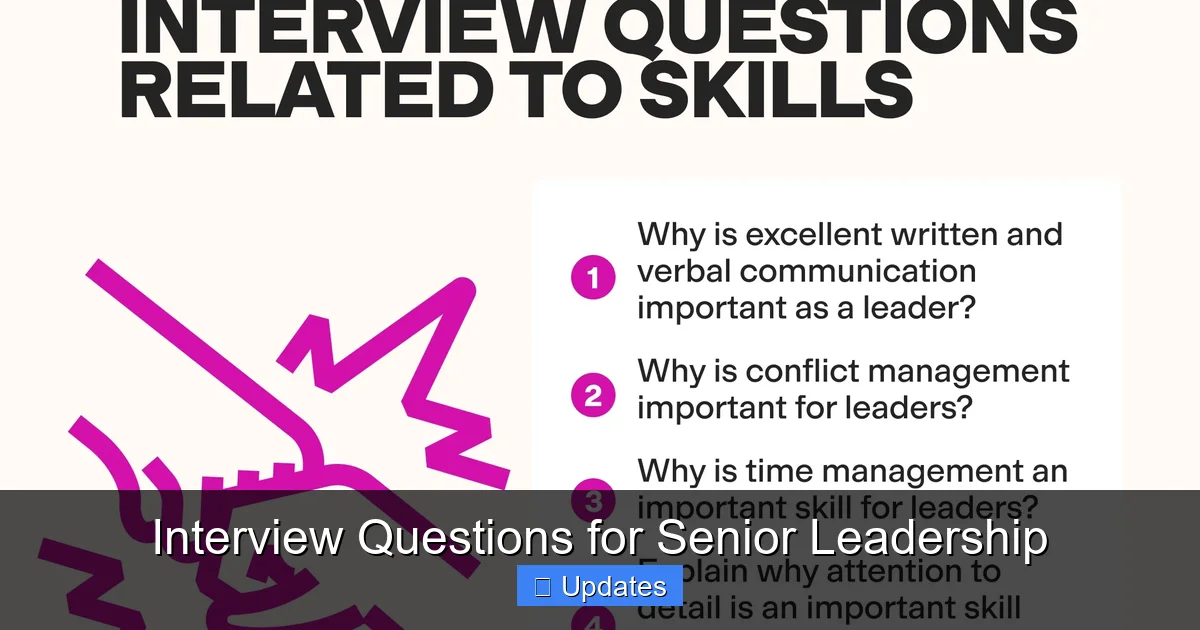
Visual guide about Interview Questions for Senior Leadership
Image source: images.ctfassets.net
Before diving into specific questions, it helps to understand the core competencies that define strong senior leadership. While different industries may emphasize certain traits, most successful executives share common qualities:
– Strategic Agility: Ability to anticipate market shifts, reprioritize goals, and adjust course without losing sight of long-term vision.
– Emotional Intelligence: Self-awareness, empathy, and interpersonal skills that enable them to connect authentically with diverse stakeholders.
– Decision-Making Under Uncertainty: Comfort with ambiguity and confidence in choosing paths forward even when data is limited.
– Change Management: Proven ability to lead transformation efforts—whether digital, organizational, or cultural—without triggering resistance.
– Ethical Judgment: Consistency in upholding values under pressure, especially when profits conflict with principles.
– Influence Without Authority: Skill in persuading peers, board members, or external partners without direct line-of-command control.
These aren’t checkboxes—they’re woven into every interaction a senior leader has. Your interview questions should probe how these traits manifest in real situations. For example, instead of asking “Are you a good communicator?” ask, “Tell me about a time you had to explain a complex strategy to a skeptical stakeholder who didn’t believe in the plan.”
How to Structure Your Interview Process
A structured approach ensures consistency and fairness across candidates. Here’s a recommended framework:
1. **Initial Screening:** Review resume and cover letter for relevant experience and achievements. Conduct a brief phone/video call to gauge communication clarity and enthusiasm.
2. **Panel Interview (2–4 senior staff):** Include HR, peer leaders, and functional managers to assess fit from multiple angles.
3. **Behavioral Deep Dive:** Dedicate 60–90 minutes to exploring past experiences using the STAR method (Situation, Task, Action, Result).
4. **Case Study or Presentation:** Have the candidate present on a current challenge facing your organization—this reveals problem-solving and strategic thinking.
5. **Reference Checks:** Prioritize references who can speak to leadership behaviors, not just job performance.
Throughout this process, use consistent scoring rubrics tied to your core competencies. Avoid leading questions or yes/no queries. Instead, open-ended prompts allow candidates to showcase depth and nuance.
Sample Interview Questions for Senior Leadership Roles
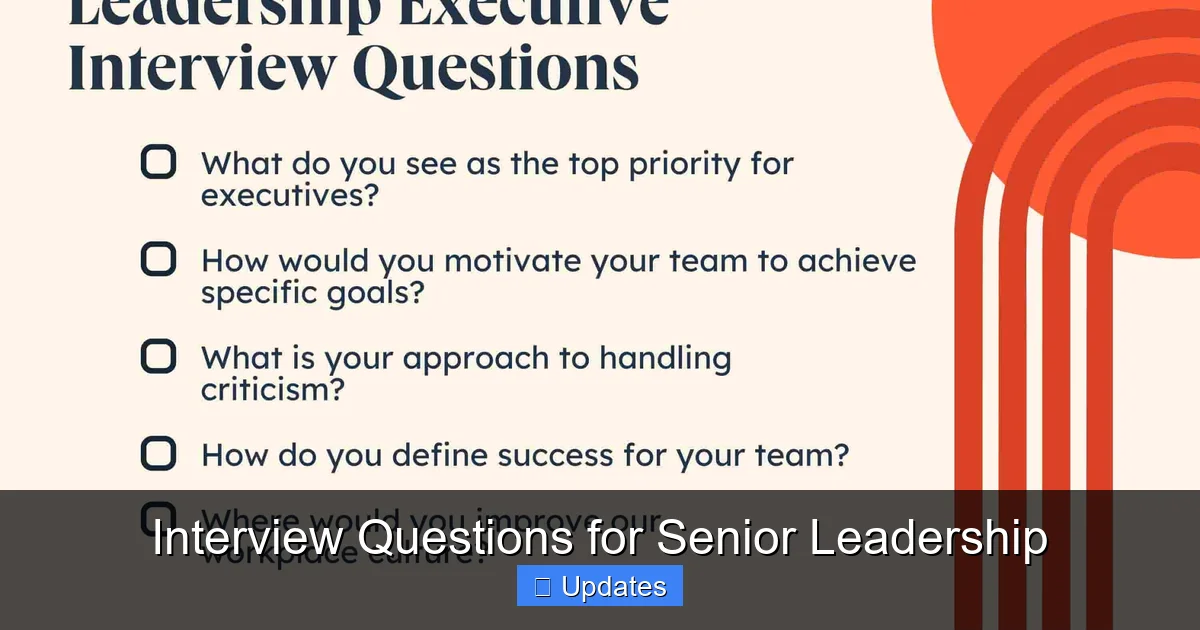
Visual guide about Interview Questions for Senior Leadership
Image source: hubspot.com
Now let’s get practical. Below are categorized questions grouped by competency area. Feel free to mix and match based on your priorities.
Strategic Vision & Decision-Making
– What does success look like for this role in year three? How would you measure it?
– Describe a time you had to make a major strategic decision with incomplete data. What factors did you prioritize?
– Walk me through how you developed a new business model or entered a new market. What assumptions did you test—and what changed your mind?
– How do you stay informed about industry trends, and how do you decide which ones to act on?
– If you could redesign our company’s mission statement overnight, what would it say—and why?
These questions reveal whether the candidate thinks big picture while staying grounded in reality. Look for evidence of data-driven reasoning, humility to revise plans, and curiosity about external forces.
Crisis Management & Resilience
– Tell me about a time your team faced a public relations crisis. How did you respond, and what did you learn?
– Describe a project that failed spectacularly. What was your role, and how did you recover?
– How do you maintain team morale during prolonged periods of uncertainty or restructuring?
– Share an instance where you had to shut down a promising initiative because new information revealed risks you hadn’t seen before.
Crises separate average leaders from exceptional ones. The best handle pressure by focusing on solutions, protecting their teams, and learning quickly. Watch for accountability, calm under fire, and commitment to transparency.
Culture & People Leadership
– How do you ensure your team feels psychologically safe to voice disagreements or raise concerns?
– Give an example of how you’ve held someone accountable for unethical behavior—even if it wasn’t your direct report.
– Describe your approach to promoting diversity, equity, and inclusion within your leadership team.
– How do you identify and nurture high-potential employees for future roles?
Culture isn’t created by policy alone—it’s modeled by leaders. Effective senior executives actively listen, celebrate vulnerability, and challenge biases. Pay attention to language that emphasizes collaboration over command-and-control.
Stakeholder Communication & Influence
– How do you tailor your message when speaking to engineers versus board members?
– Tell me about a time you convinced a resistant executive to support a change you believed in. What strategies did you use?
– Describe how you’ve used storytelling to drive alignment during a difficult transition.
– What metrics do you track to evaluate the effectiveness of your communications?
Senior leaders must be translators—converting complex ideas into compelling narratives for varied audiences. Strong communicators simplify without dumbing down, engage emotionally, and leave listeners feeling informed and inspired.
Operational Excellence & Execution
– How do you balance speed versus quality when launching new products or services?
– Share an example of how you optimized a slow or inefficient process across a large team.
– What role does technology play in your decision-making, and how do you stay current?
– How do you delegate effectively without micromanaging?
Execution separates visionaries from implementers. Top leaders create systems that empower teams, eliminate waste, and scale results. They trust others to deliver while maintaining oversight through clear expectations and feedback loops.
Common Pitfalls to Avoid
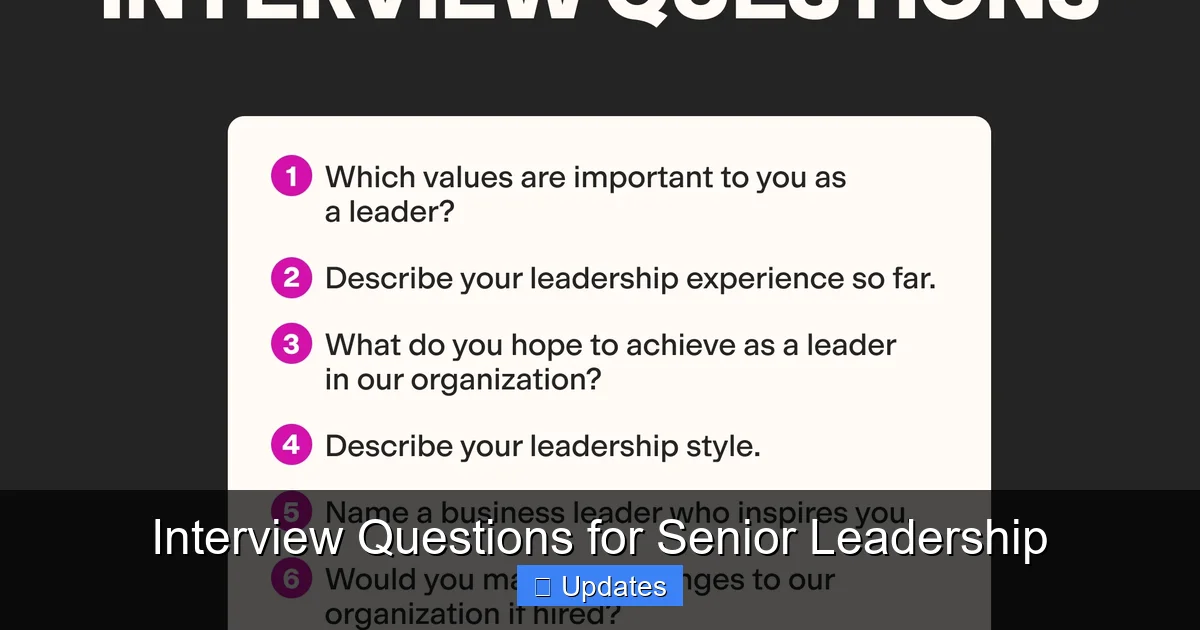
Visual guide about Interview Questions for Senior Leadership
Image source: images.ctfassets.net
Even experienced recruiters make mistakes when evaluating senior leadership. Here are red flags—and better alternatives:
– Avoid generic questions: “What’s your greatest weakness?” yields rehearsed answers. Instead, ask for concrete examples tied to specific challenges.
– Don’t overlook cultural misfit: A technically perfect candidate may clash with your values. Use situational questions like, “How would you handle a colleague who consistently undermines team cohesion?”
– Skip the ego trap: Some candidates inflate accomplishments. Dig deeper with follow-ups: “Who else was involved?” or “What obstacles did you face?”
– Neglect succession planning: Great leaders invest in successors. Ask, “How do you prepare your team for leadership transitions?”
Remember: interviewing is a two-way street. Just as you assess the candidate, they evaluate your organization. Encourage honest dialogue about expectations, challenges, and support structures.
Building a Feedback-Rich Interview Culture
To maximize insight, involve multiple perspectives in your evaluation process. After each interview round, collect brief written feedback using guided prompts:
– Which competency stood out most?
– Were there any concerning gaps?
– Would you recommend this candidate move forward?
This prevents bias and surfaces patterns across panelists. Also consider assigning a “devil’s advocate” to challenge assumptions—especially around risk tolerance or innovation appetite.
Finally, debrief with hiring managers regularly. Discuss not just who fits best, but how the interview process itself can evolve. Continuous improvement leads to better hires—and stronger leadership pipelines overall.
Conclusion: Invest in Leadership, Not Just Titles
Hiring senior leadership is about more than checking boxes—it’s about planting seeds for sustainable growth. The right interview questions for senior leadership unlock insights into character, competence, and compatibility. By focusing on behaviors rather than credentials, you attract executives who lead with integrity, inspire action, and adapt boldly to change.
Use this guide as a starting point, but always customize questions to reflect your organization’s mission and challenges. And remember: the best leaders aren’t just hired—they’re cultivated through thoughtful assessment, candid feedback, and ongoing development.
As you prepare for your next executive search, keep in mind that every question shapes perception. Frame them with care, listen deeply, and trust your instincts. With the right approach, you won’t just fill a vacancy—you’ll elevate your entire enterprise.
—
Frequently Asked Questions
What makes an effective interview question for senior leadership?
Effective interview questions for senior leadership are open-ended, behavior-based, and tied to real-world scenarios. They reveal how candidates have handled challenges, made decisions, and led teams. Avoid yes/no or hypothetical questions—instead, ask for specific examples using the STAR method (Situation, Task, Action, Result). This approach uncovers authentic leadership behaviors rather than rehearsed answers.
How many interview rounds should I conduct for senior roles?
For senior leadership positions, a multi-stage process typically includes at least three rounds: initial screening, panel interview with cross-functional leaders, and final presentation or case study. Including reference checks adds another layer of validation. Each round should focus on different competencies—such as strategic thinking in the first round and cultural fit in the last—to ensure thorough evaluation.
Should I include case studies in senior leadership interviews?
Yes, case studies are highly effective for assessing strategic thinking and problem-solving abilities. Present candidates with a realistic business challenge your organization faces—like entering a new market or improving customer retention—and ask them to develop a solution. This reveals how they analyze data, prioritize actions, and communicate recommendations to stakeholders.
How do I assess emotional intelligence during interviews?
Assess emotional intelligence by asking behavioral questions about handling conflict, managing stress, and building relationships. Examples include: “Describe a time you disagreed with a key stakeholder. How did you resolve it?” or “Tell me about a situation where you had to motivate a disengaged team.” Look for empathy, self-awareness, and constructive resolution strategies in their responses.
Can I use standardized questions for all senior roles?
While consistency is important, avoid using identical questions for every senior role. Tailor questions to the function—e.g., a CFO might discuss financial risk management, while a CTO focuses on tech scalability. However, retain core themes like ethics, change leadership, and stakeholder communication across all interviews to maintain fairness and comparability.
How important is diversity and inclusion in senior leadership selection?
Diversity and inclusion aren’t just compliance issues—they’re competitive advantages. Senior leaders must model inclusive behaviors and actively promote equitable opportunities. During interviews, ask how candidates have fostered diverse teams, addressed bias, or advanced DEI initiatives. Their answers reveal whether they see inclusion as a checkbox or a strategic priority.