
How Does a Walking Cane Provide Support?


Bathroom Grab Bar Set

Cane with LED Light

Non-Slip Slippers
Quick Answer
A walking cane provides support by adding another contact point with the ground, improving balance, and letting your arm take some pressure away from a weak or painful leg. Correct fit and technique matter, so follow reliable guidance such as the Mayo Clinic’s cane-fitting guidance when adjusting and using one.
How a cane supports you
- Improves balance: The cane creates an extra point of contact with the floor when you step.
- Shares the load: Your arm can transfer part of your weight through the cane instead of the painful leg.
- Supports weak joints: Correct cane use can reduce demand on an affected hip, knee, ankle, or leg.
- Improves confidence: A dependable contact point can make uneven ground and everyday walking feel more controlled.
- Helps maintain rhythm: Moving the cane with the weaker leg can create a steadier walking pattern.
One important rule
- For one-sided weakness or pain, the cane is generally held in the hand opposite the affected leg unless a healthcare professional advises otherwise.
A walking cane looks simple, but the way it supports your body is surprisingly clever. It can help with balance, reduce pressure on a painful side, and make each step feel more controlled.
I find it easiest to understand a cane as an extra leg that works through your arm. This guide explains exactly what that means and how to get useful support without developing poor walking habits.
In This Guide
- How does a walking cane physically support your body?
- How does a cane improve balance and stability?
- Can a cane reduce pressure on a painful leg or joint?
- Which hand should hold the walking cane?
- How does cane height affect support?
- Do different cane types provide different amounts of support?
- When is a cane not enough support?
- Frequently asked questions
- The takeaway on walking cane support
How Does a Walking Cane Physically Support Your Body?
A cane supports you by giving your body another pathway for force to reach the ground. Instead of depending only on two legs during walking, you briefly create a third contact point.
Definition: Walking cane support is the added stability and partial load sharing created when a properly fitted cane transfers force from your hand and arm to the ground.
It creates a wider base of support
Standing on two feet gives you a base underneath your body. During walking, that base becomes smaller because one foot repeatedly leaves the ground.
Placing a cane on the floor adds another contact point. That extra point can make small balance corrections easier before a wobble becomes a fall.
- Your feet provide your main support.
- Your cane tip adds another stable contact point.
- Your arm carries force down through the cane.
- Your brain receives extra information about where the ground is.
It lets your upper body share some work
When you press downward on the cane, force travels through your hand, wrist, elbow, and shoulder. The cane transfers that force into the ground.
That means the leg does not need to handle the entire job alone. The amount of relief depends on your condition, technique, strength, and the type of cane.
It changes the forces around the hip
A cane can do more than simply carry a little body weight. When held opposite an affected hip, it can also reduce the muscular effort needed to keep the pelvis level.
Research involving people with hip osteoarthritis found lower hip-loading measures on the affected side when a cane was used. Pain during walking also decreased in that study.
You can review the published findings through PubMed’s study on cane use and hip joint loading.
Think of your body like a seesaw for a moment. A cane placed on the opposite side can create a counteracting force that helps the muscles around the painful hip.
Section Takeaway: A cane provides support in two main ways: it adds another ground contact point and gives your upper body a way to help manage the forces created during walking.
How Does a Cane Improve Balance and Stability?
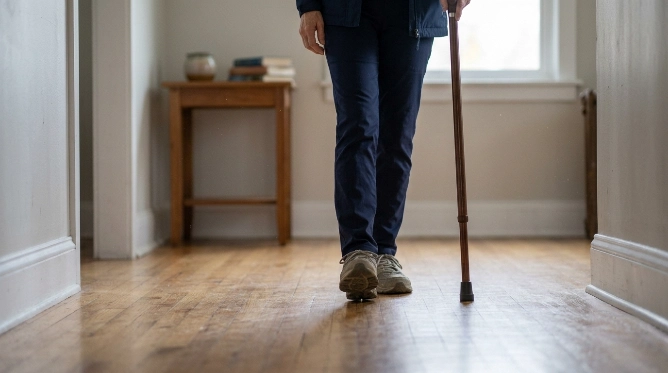
A cane improves balance by giving you something stable to press against when your center of gravity shifts. It can be especially useful during the part of a step when only one foot carries most of your weight.
The cane gives you another balance reference
Your body constantly uses vision, inner-ear information, and sensation from your feet and joints to stay upright. A cane adds another physical reference point.
When the tip touches the floor, you can feel that contact through your hand. That feedback may help you judge the ground and make smaller corrections.
- Uneven sidewalks: The cane can test or contact the surface before full weight shifts forward.
- Slow turns: The extra point can help you stay centered as you change direction.
- Standing pauses: A planted cane can add stability while you stop briefly.
- Short steps: The cane can support a more deliberate walking rhythm.
Support still depends on traction
The cane only helps when its tip grips the surface. A worn rubber tip can slide instead of supporting you.
Wet floors, loose rugs, ice, and polished surfaces also change how dependable that contact point becomes. Check the tip regularly and replace it when the tread becomes smooth or damaged.
Health note: New dizziness, sudden balance loss, repeated falls, or unexplained weakness should be assessed by a healthcare professional rather than managed only by adding a cane.
Can a Cane Reduce Pressure on a Painful Leg or Joint?
Yes. A correctly used cane can reduce some of the demand placed on a painful or weaker leg because part of the force is transferred through your arm.
However, a standard cane provides partial assistance. It is not designed to replace normal weight-bearing when someone needs substantial unloading.
Why pushing on the cane helps
Imagine your right leg hurts as you step onto it. Without assistance, your right leg and surrounding muscles manage the forces created by your body weight and movement.
If a cane is in your left hand, you can press into it while the right leg is on the ground. That gives the body another route for support.
A cane is different from a walker
Cleveland Clinic notes that a one-sided cane offers less support than a walker and may safely handle only a portion of body weight. Someone who needs major weight-bearing assistance may therefore need a different mobility aid.
See the Cleveland Clinic cane-use guide for its medical guidance on support, sizing, and safety.
| Mobility Aid | Ground Contact | Typical Role | Relative Support |
|---|---|---|---|
| Single-point cane | 1 cane tip | Mild balance help or partial one-sided support | Light |
| Quad cane | 4 cane tips | Broader standing base when extra stability is useful | Light to moderate |
| Walker | Multiple legs or wheels | Greater balance or weight-bearing assistance | Greater |
Health note: If you must lean heavily on a cane to remain upright, ask a physical therapist or another qualified professional whether a walker or different aid would be safer.
Which Hand Should Hold the Walking Cane?
For weakness or pain affecting one leg, the cane is generally held in the hand opposite that leg. The cane and affected leg then move forward at roughly the same time.
This pattern can provide support during the affected leg’s stance phase and allows the stronger leg to step through afterward.
Example: right leg pain
- Hold the cane in your left hand.
- Move the cane forward with your right leg.
- Place the cane tip securely on the floor.
- Use the cane for support as weight moves onto the right side.
- Step through with the stronger left leg.
This opposite-hand technique is also described in the MedlinePlus instructions for using a cane.
Why not simply hold it on the painful side?
Holding the cane opposite the painful side often creates a more useful mechanical counterbalance. It also follows the natural arm-and-leg pattern used during ordinary walking.
There are exceptions. Bilateral problems, neurological conditions, hand injuries, shoulder limitations, and post-surgical instructions can change the recommended technique.
Health note: A physical therapist can watch your gait and tell you which side and walking sequence are safest for your specific condition.
How Does Cane Height Affect Support?
A cane works best when you can press on it while staying upright. A cane that is too high or too low can make support awkward and may encourage poor posture.
Use your wrist crease as a starting point
Stand naturally with your arms relaxed at your sides and your normal shoes on. The top of the cane handle should generally line up near the crease of your wrist.
When you grip the handle, your elbow should remain slightly bent. Mayo Clinic describes a comfortable bend of about 15 to 30 degrees.
- Too short: You may lean sideways or forward to reach the handle.
- Too tall: Your shoulder may lift and the cane can become awkward to advance.
- Correct range: You should stand upright while keeping a relaxed elbow bend.
Why fit matters mechanically
A comfortable elbow angle gives your arm room to absorb and apply force. It also helps keep the cane close enough to your body to act as useful support.
A badly fitted cane may still touch the floor, but that does not mean it is helping efficiently. Small height changes can noticeably change posture and confidence.
Do Different Cane Types Provide Different Amounts of Support?
Yes. Cane designs differ in base size, weight, grip, portability, and how easily they stay planted on the ground.
The right choice depends on whether you mainly need a balance cue, some unloading, or a wider base for stability.
Single-point cane
A standard single-point cane has one tip. It is usually light and easy to move naturally with each step.
This design often suits people who need modest balance support or limited assistance on one side.
Quad cane
A quad cane has four tips arranged in a small base. The larger footprint gives it more ground contact than a single-tip cane.
That can help during standing and slower walking. The tradeoff is extra bulk, and all four tips need appropriate contact with the walking surface.
Folding cane
A folding cane is designed mainly for portability. Its support still depends on correct height, secure locking joints, a sound tip, and appropriate construction.
Check every joint before walking. Any looseness or incomplete locking can make the cane unreliable.
Offset-handle cane
An offset handle positions the hand more directly over the cane shaft. Some users find this shape comfortable when they need to push downward for support.
Grip shape matters too. A handle should feel secure without forcing the wrist into an uncomfortable position.
When Is a Cane Not Enough Support?
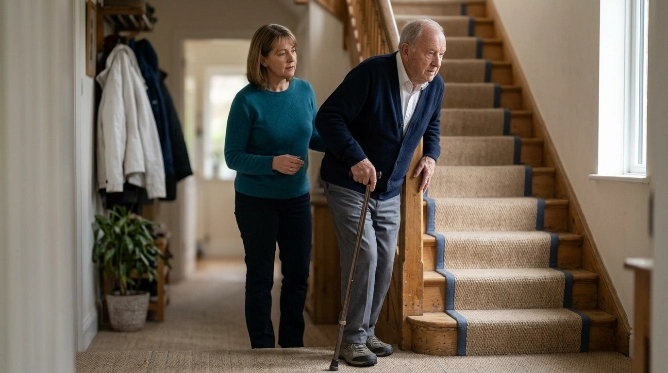
A cane may not be enough if you need substantial weight-bearing assistance, cannot remain upright with one-handed support, or continue falling despite using it correctly. Those situations call for reassessment rather than simply gripping the cane harder.
Warning signs that deserve attention
- Repeated falls: Falling despite cane use suggests that balance needs may exceed what one cane provides.
- Heavy leaning: Putting a large amount of body weight through the handle may mean more support is needed.
- Sudden weakness: New one-sided weakness requires medical attention.
- Persistent dizziness: A mobility aid does not correct the underlying cause of dizziness.
- Severe pain: Increasing pain when weight-bearing should be assessed.
- Unsafe stairs: Difficulty controlling the cane and body together on stairs deserves professional guidance.
A cane should increase independence, not hide deterioration
As of 2026, major medical guidance continues to emphasize proper selection and fitting of mobility aids. A cane can be extremely useful, but it should match the person’s actual level of mobility.
If walking ability has changed noticeably, ask a doctor or physical therapist to look at the reason. Sometimes adjusting the cane solves the problem, while other situations require rehabilitation or a different aid.
Health note: Sudden weakness, inability to bear weight, severe new pain, fainting, or acute neurological symptoms need prompt medical assessment.
Frequently Asked Questions About Walking Cane Support
Does a walking cane take weight off your leg?
Yes. Pressing down through the handle transfers some force through your arm and cane into the ground. The amount varies with technique, strength, cane design, and your condition, so a cane should not be treated as a full weight-bearing substitute.
Does a cane help more with balance or weight support?
It can do both. Some people use a cane mainly for an extra balance point, while others use it to partially unload a painful or weak leg. The correct device depends on how much assistance you need.
Why do you use a cane on the opposite side?
Holding a cane opposite a painful or weak leg lets the cane move with that leg and provides useful counter-support during the step. This technique can also reduce mechanical demand around an affected hip.
Should the cane touch the ground before I put weight on it?
Yes. The tip should make secure contact with the floor before you depend on it for support. Placing weight on a cane before the tip is stable may increase the chance of slipping or losing balance.
Can a walking cane prevent falls?
A properly fitted and correctly used cane may improve stability for someone whose needs match the device. It cannot prevent every fall, especially when dizziness, major weakness, unsafe surfaces, or more severe balance problems are present.
How do I know whether my cane is too short?
A cane may be too short if you must bend forward or lean sideways to reach it. With your arm relaxed, the handle should generally sit near wrist-crease height and allow a comfortable elbow bend when held.
Is a quad cane more supportive than a regular cane?
A quad cane has a wider base with four contact tips, which can provide greater standing stability for some users. It is also heavier and bulkier, so the wider base does not automatically make it the best choice for everyone.
The Takeaway on How a Walking Cane Provides Support
A walking cane supports you by adding another point of contact with the ground and allowing your arm to share part of the work normally handled by your legs. Used correctly, it can improve balance, reduce demand on a painful side, and create a steadier walking pattern.
The details matter. Use the correct hand, set the cane near the right height, keep the tip in good condition, and avoid depending on a cane for more support than it is designed to provide.
If walking still feels unsafe, get the device and your gait checked by a healthcare professional or physical therapist. The goal is not simply to use a cane—it is to move as safely, comfortably, and independently as possible.