
Full Dentures vs Partial Dentures: Which?


Robot Vacuum Cleaner

Digital Blood Pressure Monitor

Smart Digital Photo Frame
Full Dentures vs Partial Dentures is mainly a choice between replacing all teeth in an arch or replacing only some missing teeth while keeping the remaining natural teeth. The right option depends on how many teeth are missing, the condition of the remaining teeth, and the treatment recommended by a dentist or prosthodontist.
For seniors, the decision is also about everyday comfort and care. A denture should be practical to remove, clean, store, and wear. It should also fit properly and support normal daily activities such as eating and speaking.
Quick Comparison
Full dentures are generally intended for someone who has lost all teeth in an upper or lower arch. Partial dentures are designed for people who still have some natural teeth.
For most seniors, partial dentures may be preferable when healthy natural teeth can be retained. Full dentures become the relevant option when an entire arch needs tooth replacement. The better choice is therefore usually determined by the condition and number of remaining teeth, not age alone.
Full Dentures vs Partial Dentures At a Glance
Both options are removable, but they support replacement teeth in different ways.
| Feature | Full Dentures | Partial Dentures |
|---|---|---|
| Teeth replaced | All teeth in an arch | Some missing teeth |
| Natural teeth remain | No | Yes |
| Main support | Gums and underlying tissues | Remaining teeth, gums, and underlying tissues |
| Stability | Depends on fit and anatomy | Often benefits from remaining teeth |
| Cleaning | Remove and clean regularly | Remove and clean regularly |
| Best suited for | Complete tooth loss in an arch | Several missing teeth with usable natural teeth |
Full Dentures: What Seniors Should Know
Full dentures, also called complete dentures, replace an entire arch of missing teeth. They rest on the gums and underlying tissues rather than attaching to remaining natural teeth.
For a senior who has no remaining teeth in an arch, a full denture can provide a removable way to replace those teeth.
Ease of Use
Full dentures are designed to be removed for cleaning and care. However, getting used to a new denture can take time.
Fit matters greatly. A loose or uncomfortable denture may need adjustment or relining rather than simply more adhesive. The shape of the mouth can also change over time, affecting how well a denture fits.
Key Strengths
- Replaces all teeth in an arch.
- Provides a removable tooth-replacement option.
- Can help restore chewing and speech affected by missing teeth.
- Does not depend on remaining natural teeth in that arch.
- Can be cleaned outside the mouth.
Potential Drawbacks
- Requires an adjustment period.
- Fit can change over time.
- Lower full dentures can be less stable than upper dentures.
- Daily removal and cleaning are necessary.
- Some people may need professional adjustments or relining.
Partial Dentures: What Seniors Should Know
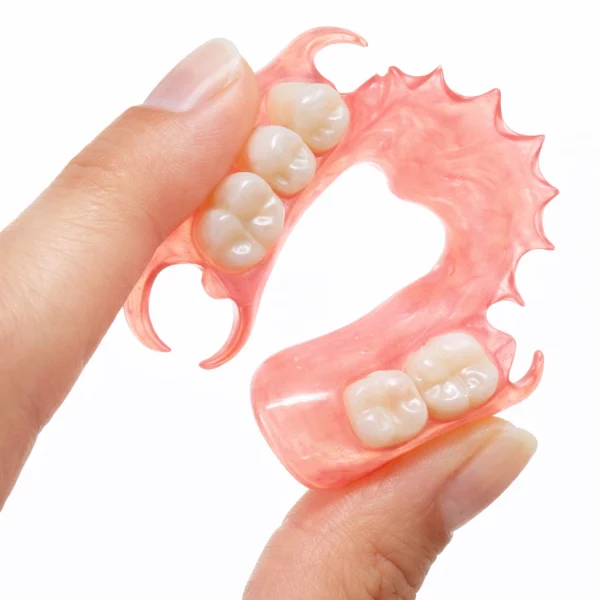
Partial dentures replace some missing teeth while allowing remaining natural teeth to stay in place. Depending on the design, they may use clasps, a metal framework, or other connectors for support.
This makes them particularly relevant when several teeth are missing but some natural teeth remain suitable for supporting the denture.
Ease of Use
A partial denture still needs to be removed and cleaned. New users may initially find it bulky or unusual, but this feeling can improve as they become accustomed to wearing it.
The design also matters. Some partial dentures use visible clasps, while other designs can use less noticeable connectors.
Key Strengths
- Keeps suitable natural teeth in use.
- Replaces several missing teeth without replacing an entire arch.
- May provide useful support from remaining teeth.
- Can be designed in different ways depending on the mouth.
- Usually makes sense when complete tooth replacement is unnecessary.
Potential Drawbacks
- Requires suitable remaining teeth for support.
- Some designs may have visible clasps.
- Cleaning involves both the denture and remaining natural teeth.
- Fit and comfort depend on the design and location of missing teeth.
Which Is Easier for Seniors to Use?
Neither type is automatically easier for every senior.
A partial denture may feel more natural to some people because it replaces only missing teeth and uses remaining teeth for additional support. A full denture may be simpler in terms of the number of natural teeth involved because there are none remaining in that arch.
The bigger issue is fit.
A well-fitting denture can be much easier to manage than one that moves, rubs, or causes discomfort. If a denture becomes loose, a dentist or prosthodontist should check the fit rather than relying on self-adjustment products.
For seniors, the best denture is not simply the one with fewer parts. It is the one that fits well and matches the person’s dental needs.
Performance Comparison
The main purpose of both dentures is to replace missing teeth and help restore everyday oral function.
| Performance Area | Full Dentures | Partial Dentures |
|---|---|---|
| Replacing a complete arch | Excellent fit for this need | Not intended for this |
| Replacing several teeth | More than may be necessary | Well suited |
| Use of natural teeth | None in the treated arch | Uses remaining teeth |
| Stability | Depends heavily on fit and anatomy | Can benefit from remaining teeth |
| Chewing support | Can improve chewing | Can improve chewing |
The American College of Prosthodontists notes that dentures can improve chewing and speech problems associated with missing teeth. Partial dentures may also use remaining teeth for anchorage and support.
Comfort, Accessibility, and Senior-Friendly Design
Comfort depends more on the individual fit and design than simply choosing full or partial dentures.
A senior who has difficulty with fine motor tasks should consider how easy the denture is to remove, rinse, clean, and store. Caregivers may also need to help with routine cleaning when necessary.
Both types should be cleaned regularly. Natural teeth, gums, the tongue, and other mouth tissues also need proper care.
For seniors with ongoing soreness, rubbing, or poor fit, professional adjustment is more appropriate than trying to permanently solve the problem with adhesive.
Features Comparison
The biggest differences are related to how each denture gains support.
| Feature | Full Dentures | Partial Dentures |
|---|---|---|
| Support | Gums and underlying tissues | Remaining teeth plus gums |
| Natural teeth | None in the arch | Some remain |
| Design options | Complete arch design | Several designs and connector types |
| Implant support | Possible | Possible |
| Removal | Yes | Yes |
Dental implants can sometimes be used to improve the retention or stability of either full or partial dentures. That is a separate treatment decision that requires professional evaluation.
Price, Maintenance, and Long-Term Value
There is no single reliable price that applies to every full or partial denture. Fees vary with treatment complexity, materials, location, and the individual dental situation.
A partial denture may appear to be the simpler choice when only several teeth are missing, but the design and condition of the remaining teeth can affect the overall cost.
Long-term value should include:
- Initial denture cost
- Professional adjustments
- Possible relining
- Replacement or repair
- Cleaning products
- Dental checkups
- Condition of remaining natural teeth
Daily maintenance matters for both types. Dentures should be cleaned with products intended for dentures rather than abrasive household products or regular toothpaste that may damage the denture surface.
Who Should Choose Full Dentures?
Choose full dentures when:
- An entire upper or lower arch needs replacement.
- There are no suitable natural teeth remaining in that arch.
- A removable complete tooth-replacement option is appropriate.
- The goal is to replace all missing teeth in one arch.
- A dentist or prosthodontist recommends complete dentures after evaluating the mouth.
Who Should Choose Partial Dentures?
Choose partial dentures when:
- Several teeth are missing but suitable natural teeth remain.
- You want to replace missing teeth without replacing the entire arch.
- Remaining teeth can provide useful support.
- A removable partial denture fits the dental situation.
- Your dental professional recommends retaining and working around the remaining teeth.
Full Dentures vs Partial Dentures — Final Verdict
Best for complete tooth loss: Full dentures
Best when some suitable natural teeth remain: Partial dentures
Best for preserving the use of remaining teeth: Partial dentures
Best for replacing an entire arch: Full dentures
There is no universal winner. A partial denture makes little sense when an entire arch has lost all usable teeth, while a full denture may be more treatment than necessary when several healthy natural teeth can remain.
The most important question is not which denture is “better” in general. It is which design fits the person’s dental condition and daily needs.
Scoring Summary
Scores here are practical editorial ratings for the comparison, not clinical measurements.
| Category | Full Dentures | Partial Dentures |
|---|---|---|
| Ease of Use | 8/10 | 8/10 |
| Senior-Friendly Design | 8/10 | 8/10 |
| Complete Tooth Replacement | 10/10 | 4/10 |
| Partial Tooth Replacement | 4/10 | 10/10 |
| Maintenance | 8/10 | 7/10 |
| Overall Practicality | 8/10 | 9/10 |
The scores are intentionally close because neither option is universally superior. The number and condition of remaining teeth are major factors.
How We Evaluate Products
For this comparison, the focus is on practical factors that matter to older adults:
- Ease of removal and cleaning
- Comfort and fit
- Stability
- Use of remaining natural teeth
- Maintenance
- Everyday practicality
- Long-term value
- Safety and professional follow-up
This is a product-information comparison, not a clinical examination or hands-on test.
Senior-Specific Buying Considerations
Physical Effort
Think about whether the person can comfortably remove, clean, and store the denture each day.
Comfort
A new denture may take time to feel normal. Persistent soreness or rubbing should be discussed with a dentist or prosthodontist.
Maintenance
Both full and partial dentures require regular cleaning. Partial denture users must also continue caring for their natural teeth.
Fit
Do not assume that a loose denture simply needs more adhesive. A professional may need to adjust or reline it.
Professional Care
Regular dental visits remain important. The mouth can change over time, and a denture that once fit well may eventually need adjustment or replacement.
Common Buying Mistakes
Avoid these common mistakes when choosing between full and partial dentures:
- Choosing based only on price.
- Assuming a partial denture is always better because natural teeth remain.
- Ignoring the condition of the remaining teeth.
- Overlooking cleaning and maintenance.
- Assuming discomfort is something you simply have to accept.
- Buying denture-care products without checking whether they are suitable for the denture.
Safety
Dentures should fit properly and should be cleaned as directed. If they become damaged, loose, painful, or difficult to wear, contact a dental professional.
Do not try to permanently reshape or repair a denture yourself. Professional adjustment is the safer approach when fit or comfort becomes a problem.
For a senior with significant oral health problems or a complicated dental history, the choice between full and partial dentures should be made with a dentist or prosthodontist.
Frequently Asked Questions
Are full dentures better than partial dentures?
Not necessarily. Full dentures are designed to replace all teeth in an arch, while partial dentures are designed to replace some missing teeth when suitable natural teeth remain.
Can partial dentures replace all missing teeth?
No. A partial denture is intended for situations where some natural teeth remain. A complete denture is designed to replace all teeth in an arch.
Are full dentures harder to maintain?
Both require regular cleaning. Full dentures involve cleaning the complete denture and mouth tissues, while partial denture users also need to care for their remaining natural teeth.
Can partial dentures use dental implants?
Yes. Dental implants can sometimes be used to help support or stabilize partial dentures, depending on the person’s situation.
Can full dentures be supported by implants?
Yes. Implants can be used to improve the support and retention of some full dentures. This requires professional evaluation and is different from a traditional removable full denture.
How long do dentures last?
Their lifespan varies. Fit, wear, oral changes, care, and the condition of the denture all matter. Regular dental checks can help determine when adjustment, relining, repair, or replacement is needed.
Conclusion
Full dentures and partial dentures solve different problems. Full dentures replace an entire arch, while partial dentures replace selected missing teeth and can use suitable remaining teeth for support.
For seniors, the best choice depends on the condition of the mouth, the number of missing teeth, comfort, fit, cleaning needs, and long-term practicality. A dentist or prosthodontist can assess these factors and recommend the option that fits the individual’s situation.
