
Duties of a Senior Accountant


Shiatsu Neck Massager

Back Massager with Heat

LED Magnifying Glass
A senior accountant plays a vital role in maintaining accurate financial records and ensuring regulatory compliance within an organization. They oversee day-to-day accounting operations, mentor junior staff, and contribute to strategic financial decision-making. With advanced technical skills and leadership responsibilities, senior accountants are essential for organizational stability and growth.
Key Takeaways
- Financial Reporting & Analysis: Senior accountants prepare and review complex financial statements, ensuring accuracy and compliance with GAAP or IFRS standards.
- Mentorship & Supervision: They guide junior accountants, review their work, and help develop their technical and professional skills.
- Compliance & Audits: Ensuring adherence to tax laws, regulatory requirements, and internal controls during internal and external audits.
- Budgeting & Forecasting: Participate in financial planning by analyzing trends and supporting budget creation and variance analysis.
- Process Improvement: Identify inefficiencies in accounting systems and recommend automation or procedural upgrades to enhance productivity.
- Client & Stakeholder Communication: Serve as a point of contact for clients, auditors, and management, providing clear financial insights and support.
- Ethical Standards: Uphold integrity and confidentiality in all financial dealings, adhering to professional codes of conduct.
📑 Table of Contents
- Duties of a Senior Accountant: A Complete Guide to Leadership in Finance
- The Core Duties of a Senior Accountant
- Advanced Responsibilities and Strategic Contributions
- Skills and Qualifications Required
- Career Path and Advancement Opportunities
- Practical Tips for Excelling as a Senior Accountant
- Conclusion
Duties of a Senior Accountant: A Complete Guide to Leadership in Finance
If you’ve ever wondered what it takes to rise above the typical bookkeeper or staff accountant, you’re in the right place. The role of a senior accountant is one of transition—from doing the work to enabling others to do it better. It’s not just about balancing the books anymore. Instead, it’s about leading, teaching, and shaping the financial health of an entire organization.
So, what does a senior accountant actually do? At its core, this position blends technical expertise with leadership and communication. Whether you’re managing a team, preparing financial reports, or advising executives on fiscal strategy, your decisions ripple across departments. That’s why understanding the full scope of duties is so important—not just for aspiring accountants, but for anyone who relies on accurate financial data to make smart business choices.
In this article, we’ll walk through the daily responsibilities, strategic contributions, and long-term impact of a senior accountant. From reviewing journal entries to mentoring new hires, you’ll see how this role bridges the gap between operational accounting and corporate finance leadership. And yes, we’ll even sprinkle in some practical tips and real-world examples to keep things grounded and useful.
The Core Duties of a Senior Accountant
At the heart of every successful finance department lies a senior accountant—someone who doesn’t just handle transactions but ensures they’re done correctly, consistently, and ethically. Their responsibilities span technical tasks, people management, and strategic input. Let’s break down the primary areas where senior accountants make a difference.
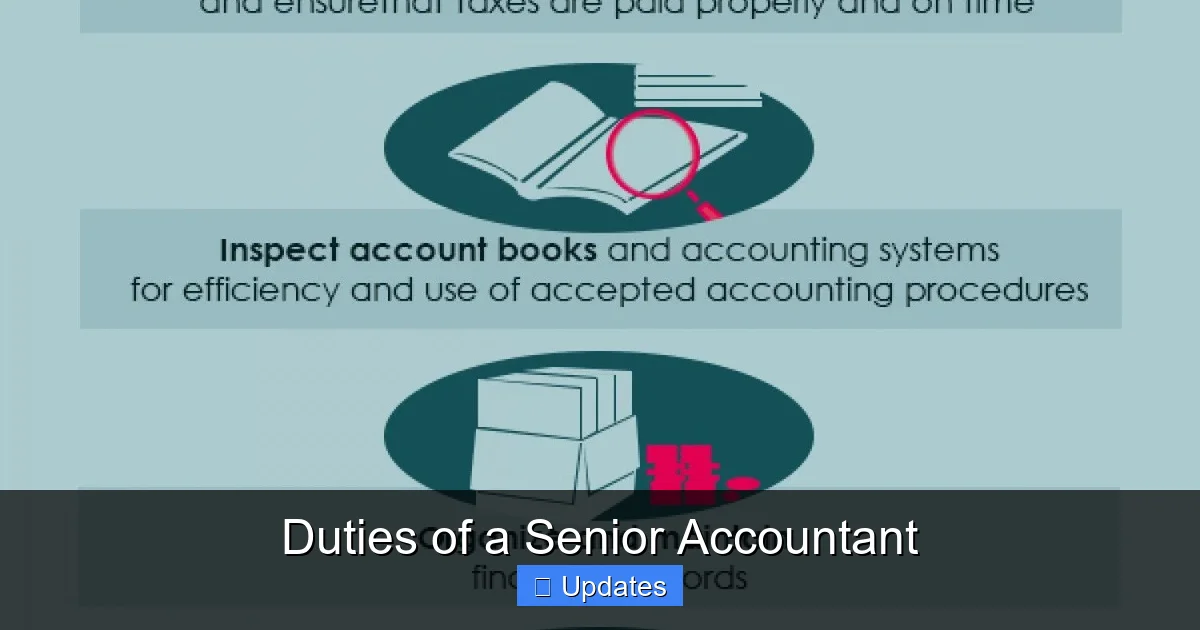
Visual guide about Duties of a Senior Accountant
Image source: i.pinimg.com
1. Financial Statement Preparation and Review
One of the most critical duties of a senior accountant is preparing and reviewing financial statements. These include the balance sheet, income statement, cash flow statement, and statement of retained earnings. Accuracy here isn’t optional—it’s the foundation of trust in financial reporting.
For example, imagine your company just closed its books for Q3. As a senior accountant, you’d gather data from various departments, reconcile accounts, and compile the numbers into official reports. You’d also check for discrepancies, ensure proper accruals and deferrals, and confirm that everything aligns with Generally Accepted Accounting Principles (GAAP) or International Financial Reporting Standards (IFRS), depending on your location and industry.
But it doesn’t stop there. You’d also analyze these statements to identify trends—like rising expenses or declining profitability—and flag them for management. This kind of insight turns raw data into actionable intelligence.
2. Supervising Junior Accounting Staff
Leadership begins with supervision. As a senior accountant, you’re often responsible for overseeing the work of junior accountants, bookkeepers, and clerks. This includes assigning tasks, setting deadlines, and reviewing completed work for accuracy and completeness.
Let’s say a new hire just processed a batch of vendor invoices. You’d spot-check their work, provide feedback on any errors, and explain best practices—like proper coding or approval workflows. Over time, you’ll help them grow into confident professionals who can handle more complex responsibilities.
This mentorship also extends to training. You might lead monthly sessions on new accounting software updates, tax law changes, or internal control procedures. By investing in your team’s development, you boost morale, reduce errors, and build a stronger department overall.
3. Ensuring Compliance and Supporting Audits
Regulatory compliance is non-negotiable. Senior accountants must ensure that all financial records meet legal and industry standards. This means staying updated on tax regulations, financial disclosure rules, and internal audit requirements.
During an external audit—say, from a CPA firm—you’ll act as the main point of contact. You’ll organize documentation, respond to auditor inquiries, and address any findings. For instance, if the auditors question a depreciation method used for equipment, you’ll defend the choice with supporting schedules and policy documents.
Internal audits are just as important. You might lead quarterly reviews of expense reports or bank reconciliations to catch irregularities early. These proactive measures protect the company from fraud, fines, and reputational damage.
4. Managing Month-End and Year-End Close Processes
The month-end close is like a well-orchestrated dance. As a senior accountant, you coordinate timelines, assign responsibilities, and monitor progress across teams. Tasks typically include posting adjusting entries, closing temporary accounts, and generating final reports.
For example, at the end of March, you’d ensure that prepaid insurance is amortized, accrued salaries are recorded, and revenue is recognized per contract terms. Delays here can snowball—late reports affect forecasting, payroll, and investor communications.
Year-end closes add another layer of complexity. You’ll prepare for audits, finalize annual budgets, and submit tax filings. Having a detailed checklist and clear roles minimizes stress and keeps everything on track.
5. Analyzing Financial Data and Supporting Decision-Making
Senior accountants don’t just report numbers—they interpret them. You’ll dive into financial ratios, cost variances, and performance metrics to uncover opportunities or risks.
Imagine the marketing team wants to launch a new campaign. As a trusted advisor, you’d model the potential ROI using historical data and budget constraints. Or, if production costs spiked unexpectedly, you’d trace the issue back to supplier contracts or inventory waste.
This analytical work supports strategic planning. Whether it’s evaluating a merger, expanding into a new market, or cutting overhead, your insights help leaders make informed choices backed by solid data.
Advanced Responsibilities and Strategic Contributions
Beyond the routine tasks, senior accountants often take on advanced responsibilities that elevate their role from operational to strategic. These duties reflect growing experience, leadership ability, and a deeper understanding of business dynamics.
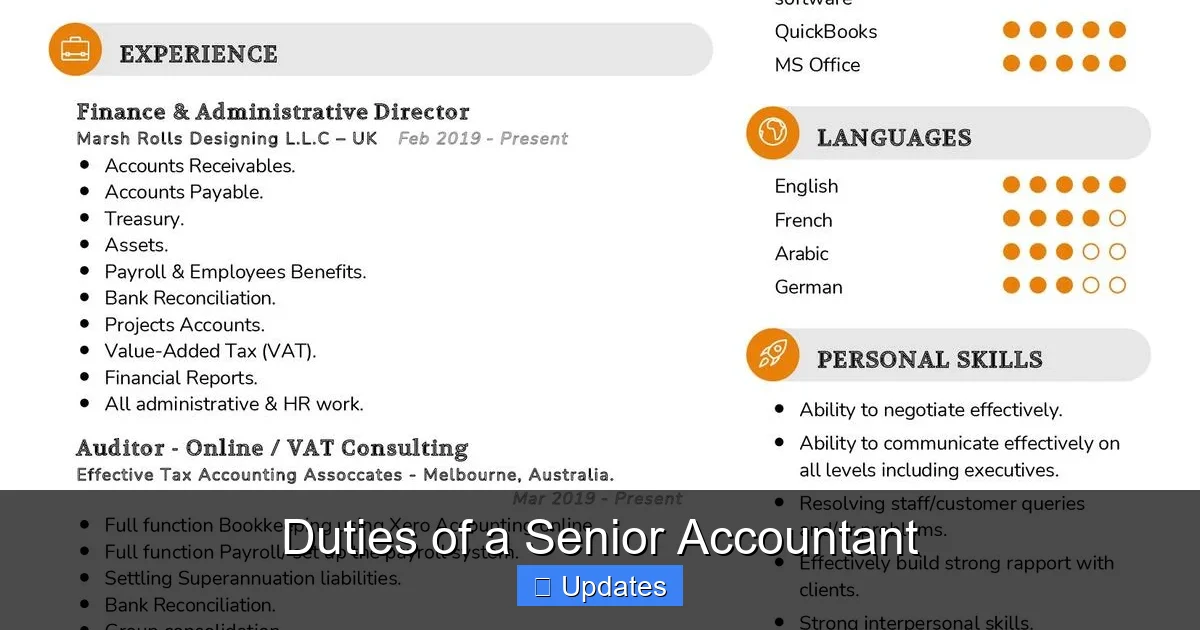
Visual guide about Duties of a Senior Accountant
Image source: resumekraft.com
1. Budgeting and Forecasting Support
You may collaborate with department heads to create annual budgets or quarterly forecasts. This involves gathering input, projecting revenues and expenses, and building scenarios for different economic conditions.
For instance, if sales are expected to grow 10% next year, you’d estimate the corresponding increase in logistics and staffing costs. Then, you’d compare actual performance against projections and explain variances in monthly review meetings.
This forward-looking approach helps organizations plan ahead, allocate resources wisely, and avoid cash shortfalls.
2. Implementing Accounting Policies and Procedures
As your experience grows, you’ll help shape the company’s accounting framework. This includes drafting or updating policies on revenue recognition, expense approvals, and asset valuation.
Suppose the company recently adopted ASC 606 for revenue recognition. You’d train your team on the new rules, revise internal forms, and document processes to ensure consistency. Clear procedures reduce confusion and improve compliance.
3. Leading System Upgrades and Automation Projects
Technology transforms accounting faster than ever. Senior accountants often lead initiatives to upgrade ERP systems, automate reconciliations, or integrate cloud-based tools.
For example, you might pilot a new AI-powered tool for invoice processing. After testing it with a small dataset, you’d present findings to IT and recommend full deployment. Automating repetitive tasks frees up time for higher-value work like analysis and planning.
4. Serving as a Liaison Between Departments
Accounting doesn’t exist in a vacuum. You’ll frequently collaborate with HR, procurement, IT, and operations to ensure financial data flows smoothly across functions.
When HR rolls out a new benefits package, you’ll calculate the cost impact on payroll and communicate it to finance. Similarly, when IT decommissions old servers, you’ll verify proper write-offs and disposal records.
This cross-functional coordination prevents silos and promotes transparency.
5. Advising on Tax Strategy and Planning
While CPAs handle tax filing, senior accountants often contribute to tax planning. You’ll identify deductions, evaluate tax credits, and advise on structuring deals to minimize liabilities—within legal boundaries.
For example, if the company considers purchasing equipment, you’d assess whether accelerated depreciation would benefit cash flow. Or, if expanding internationally, you’d research transfer pricing rules to avoid double taxation.
These efforts can save thousands—or even millions—in taxes over time.
Skills and Qualifications Required
To excel as a senior accountant, you need more than just technical know-how. The role demands a blend of hard and soft skills, along with relevant credentials.
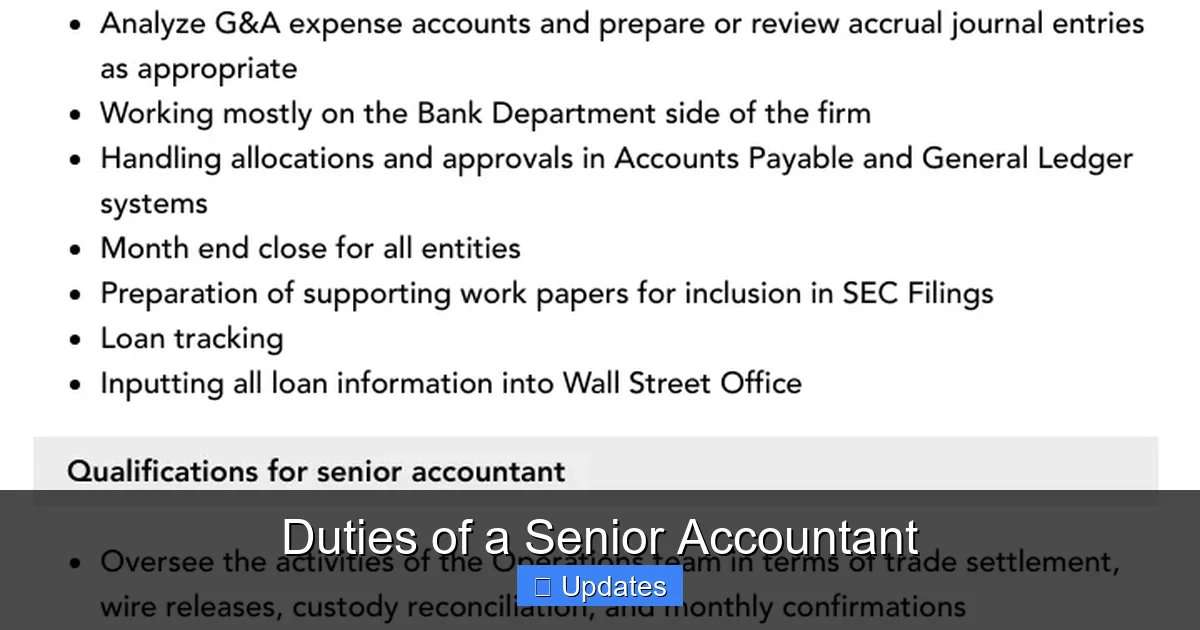
Visual guide about Duties of a Senior Accountant
Image source: asset.velvetjobs.com
Technical Proficiency
You should be fluent in accounting software like QuickBooks, SAP, Oracle, or NetSuite. Experience with Excel is essential—especially advanced functions like pivot tables, VLOOKUP, and macros. Knowledge of GAAP/IFRS, tax codes, and financial regulations is non-negotiable.
Leadership and Communication
You must coach others without micromanaging. Strong verbal and written communication lets you explain complex topics clearly—whether writing a memo or presenting to executives. Active listening helps you understand team concerns and stakeholder needs.
Problem-Solving and Attention to Detail
Accounting is detail-oriented by nature. You’ll spot anomalies in thousands of entries and resolve them quickly. Logical thinking allows you to troubleshoot issues like missing invoices or misclassified expenses.
Time Management and Organization
Juggling multiple projects requires excellent prioritization. Using tools like calendars, task lists, and project management apps helps you stay on top of deadlines during busy periods like tax season.
Professional Certifications
While not always required, certifications enhance credibility. Options include:
- CMA (Certified Management Accountant) – Focuses on strategic financial management.
- CPA (Certified Public Accountant) – Covers auditing, taxation, and general accounting principles.
- ACCA (Association of Chartered Certified Accountants) – Popular internationally, especially outside the U.S.
Many employers prefer or require at least one of these. They signal deep expertise and commitment to the profession.
Career Path and Advancement Opportunities
The journey to becoming a senior accountant usually starts with an entry-level role—like staff accountant or junior accountant. With 4–7 years of experience, strong performance, and sometimes additional education, you’ll qualify for promotion.
From there, paths diverge. Some senior accountants move into controller positions, overseeing entire accounting departments. Others shift toward financial analyst or FP&A (Financial Planning & Analysis) roles, focusing more on forecasting and strategy. A few transition into auditing or consulting, either within firms or as independent advisors.
Alternatively, you might specialize—becoming a forensic accountant, sustainability reporting expert, or ERP implementation consultant. The key is continuous learning and seeking stretch assignments that expand your skill set.
If you’re aiming high, consider pursuing an MBA later in your career. It opens doors to CFO roles and other executive positions in finance.
Practical Tips for Excelling as a Senior Accountant
Here are some actionable strategies to help you thrive in this demanding yet rewarding role:
- Document Everything: Keep detailed records of policies, procedures, and decisions. This protects you and your team during audits or disputes.
- Stay Curious: Follow industry news, attend webinars, and join professional groups like AICPA or local accounting associations.
- Automate Repetitive Tasks: Use scripts, templates, or software bots to reduce manual work and minimize human error.
- Build Relationships: Get to know colleagues in other departments. Understanding their goals makes collaboration smoother.
- Seek Feedback: Regularly ask managers and peers for input on your performance and areas for improvement.
Conclusion
The duties of a senior accountant go far beyond number-crunching. This role is a cornerstone of financial integrity, operational efficiency, and strategic insight. By mastering technical skills, nurturing talent, and communicating effectively, you become a vital asset to any organization.
Whether you’re already in the role or aspiring to reach it, embracing these responsibilities with diligence and curiosity will set you apart. The path may require extra study, certification, or patience—but the rewards are real. Not only do you gain respect and influence, but you also contribute directly to the success and stability of your company.
So if you’re ready to step up, lead with confidence, and make a lasting impact—this is your moment. The world of senior accounting is waiting.
Frequently Asked Questions
What are the main responsibilities of a senior accountant?
A senior accountant oversees financial reporting, supervises junior staff, ensures compliance, manages month-end closes, analyzes financial data, and supports audits. They bridge technical expertise with leadership and strategic input.
How does a senior accountant differ from a staff accountant?
A senior accountant has more responsibility, including mentoring junior staff, reviewing work, leading projects, and contributing to financial strategy. Staff accountants focus more on routine tasks under supervision.
Do senior accountants need to be certified?
Not always, but certifications like CPA, CMA, or ACCA are highly valued. They demonstrate advanced knowledge and can improve job prospects and credibility.
Can a senior accountant work remotely?
Yes, many senior accountant roles offer remote or hybrid options, especially in larger companies. However, some tasks—like audits or system implementations—may require on-site presence.
What industries employ senior accountants?
Senior accountants work in virtually every sector: public accounting firms, corporations (manufacturing, tech, healthcare), government agencies, nonprofits, and consulting firms.
Is leadership experience required for a senior accountant role?
Yes, typically. Leadership is key—managing projects, guiding junior staff, and collaborating across departments are core parts of the job. Prior supervisory experience strengthens your application.