
Walking Cane Grip Explained: Types & Proper Fit


Emergency SOS Phone

Toilet Seat Bidet Attachment

Lightweight Vacuum Cleaner
Quick Answer
A walking cane grip is the handle you hold to control the cane and transfer some weight through your hand. Its shape, width, material, and position affect palm pressure, wrist comfort, and control. The right grip feels secure without squeezing hard, allows a relaxed wrist, and sits at wrist-crease height when the cane is correctly adjusted.
A cane can have the right height and a sturdy tip yet still feel uncomfortable because of its handle. A narrow grip may concentrate pressure in the palm, while a contour that does not match your hand can make the wrist twist. Those details become especially noticeable when you use a cane throughout the day.
What Does a Walking Cane Grip Actually Do?
The grip provides the contact point between your hand and the walking aid. It lets you steer and place the cane, maintain a dependable hold, and press downward when your walking pattern requires partial support.
Its most important job is not simply to feel soft. A useful handle distributes pressure across an appropriate area of the hand without forcing the fingers, thumb, or wrist into an awkward position. The shaft and tip must still provide the support that your condition requires.
The Main Walking Cane Grip Types Explained
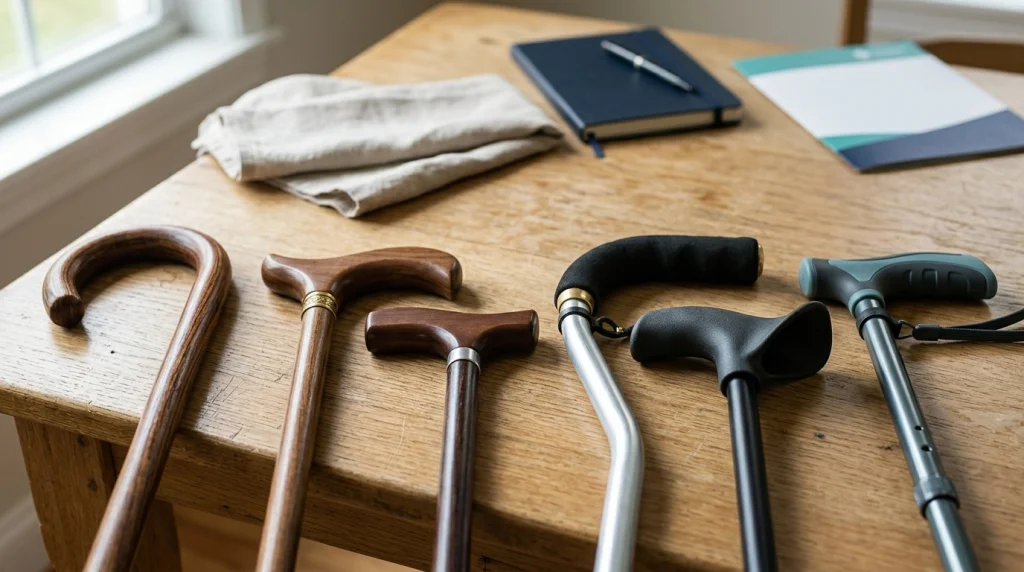
Handle names are not perfectly standardized across manufacturers, but the following designs describe the common shapes you will encounter.
Crook or Tourist Handle
This traditional curved handle resembles a hook. You can often hang it over an arm or a convenient edge when the cane is not in use, although a hanging cane can still fall or become a trip hazard.
The rounded curve may suit occasional light support. However, the actual area available to rest your palm can be limited, and some users find it harder to keep their wrist aligned when pressing down. It is not automatically the best option for painful hands.
Derby Handle
A derby grip extends horizontally from the shaft and usually curves downward at its end. It offers a distinct surface for the palm and is commonly found on traditional wooden and adjustable canes.
Fritz Handle
The Fritz resembles a streamlined derby, generally with a tapered shape and less pronounced hooked end. It can provide a comfortable alternative for people who find a curved handle difficult to grasp, including some users with arthritis.
Offset Handle
On an offset cane, the upper shaft bends so the handgrip sits more directly over the cane’s main support line. That alignment can make downward pressure easier to manage than on a conventional curved handle.
Offset handles are often paired with foam grips and adjustable aluminum shafts. The offset design describes the relationship between handle and shaft, not necessarily how soft or wide the hand-contact surface is. For an example of this configuration, see the NOVA offset cane review.
Palm or Anatomical Grip
A palm grip is sculpted to support particular areas of the hand. Many versions are made for either the left or right hand, so ordering the correct orientation is essential.
The contours may distribute pressure more comfortably for someone who dislikes a straight handle. But a pronounced mold only helps when it matches the user’s hand size and natural position. An incorrect fit can create new pressure points.
Soft Ergonomic Grip
Foam, rubber, gel-like coverings, and other molded surfaces can reduce the harsh feeling of a rigid handle. Softness alone does not guarantee control. A very thick, slippery, or compressible grip can be difficult to hold securely.
Which Grip Type Fits Different Hand Needs?
The table summarizes useful starting points, not prescriptions. Personal fit and your required level of support still determine the right choice.
| Your main concern | Grip worth evaluating | What to check |
|---|---|---|
| Painful finger joints | Larger ergonomic, Fritz, or palm grip | Can you hold it without tight finger squeezing? |
| Palm pressure | Broader or contoured handle | Does pressure spread comfortably across your palm? |
| Frequent downward support | Properly fitted offset design | Does your hand align over the support shaft? |
| Occasional light use | Derby or crook | Is the grip secure and comfortable for your usage? |
| Sweaty or slippery hands | Textured, cleanable handle | Does it remain secure without excessive gripping force? |
How to Check Whether Your Cane Grip Fits Correctly
Grip comfort cannot be assessed independently from cane height. Follow this simple sequence on a level, nonslip surface, with another person nearby if your balance is uncertain.
- Wear your regular walking shoes. Stand as upright as comfortably possible and let your arms rest naturally at your sides.
- Check wrist height. The top of the cane handle should be approximately level with the crease of your wrist when the tip is on the floor.
- Hold the grip normally. Your elbow should remain slightly bent, commonly around 15–30 degrees, without raising your shoulder or bending sideways.
- Check hand contact. Your palm should rest securely with no sharp ridge, hard seam, or localized pressure on a painful joint.
- Take a few controlled steps. Notice whether you have to squeeze unusually hard, twist your wrist, or shift your hand to keep control.
- Reassess after normal use. Discomfort that appears only after several minutes can reveal a fit issue that a brief hold does not.
The Mayo Clinic cane-fitting guidance recommends a comfortable grip and advises evaluation when hand numbness or pain develops. A physical therapist can also assess cane height, handle design, and walking technique together.
Practical Tip
When trying two handles, keep cane height and walking conditions as similar as possible. Otherwise a height difference may be mistaken for a grip improvement.
Why Does a Cane Grip Cause Hand or Wrist Pain?
Several problems can create similar symptoms. A thin handle may require more finger flexion than you can comfortably manage. A hard edge can concentrate pressure in one part of the palm, while a cane set too high or low can change your wrist and shoulder position.
Technique matters too. If you lean heavily on the handle or place the cane far ahead of your body, you may create greater strain than expected. For a painful or weak leg, the cane is generally held in the opposite hand and advanced with the affected leg, unless your clinician has instructed otherwise.
According to MedlinePlus cane-use guidance, the cane should be comfortably fitted, and people needing more support than a cane offers may require another walking aid.
Do not ignore new numbness, tingling, persistent pain, or weakness. These are reasons to have your grip, technique, and any relevant hand symptoms evaluated. A grip change is not a substitute for assessing an underlying medical problem.
How Grip Material Changes the Feel
Material changes the feel of a handle, but no single material is best for everyone. Shape and dimensions often matter just as much.
- Foam: Light and cushioned, but it can compress, become dirty, or deteriorate with use.
- Rubber or molded polymer: Often provides texture and a firm, grippy surface; some finishes are easier to wipe clean.
- Gel-like padding: Can soften contact, although excessive movement or bulk may make control less predictable.
- Wood: Firm and traditional-looking, with comfort dependent on carving, finish, and handle width.
- Rigid plastic: Usually straightforward to clean, but an unsuitable shape may feel harsh against the palm.
Common Grip Mistakes That Reduce Comfort or Control
- Choosing by appearance alone: A beautiful curved handle can still place pressure in the wrong area of your hand.
- Buying the wrong handed grip: Anatomical handles may require a left-hand or right-hand version.
- Making a handle too bulky: A sleeve or replacement covering that increases diameter may improve cushioning but make grasping harder.
- Gripping harder to compensate for instability: The real issue may be cane height, a worn tip, the wrong base, or inadequate overall support.
- Ignoring the tip: A perfect handle cannot correct poor traction from a worn rubber foot.
- Using a poorly fitted fixed-height cane: Some wooden models require shortening rather than simple push-button adjustment.
If you use a wooden cane, the wooden cane fitting example shows why handle design and permanent shaft length need to be considered together.
Safety Reminder
Do not assume that replacing or padding a grip increases the cane’s weight capacity. Use only compatible parts and follow the manufacturer’s instructions. If the handle is loose, cracked, or rotates unexpectedly, stop using the cane until it is assessed or repaired.
When Should You Change the Grip—or the Entire Cane?

Consider a different handle if you can otherwise walk safely with the cane but repeatedly experience localized palm discomfort, an awkward wrist position, or difficulty wrapping your fingers around the grip. If the manufacturer supports a compatible replacement handle, a grip change may be an option.
Consider reassessing the entire cane if you feel unsteady despite correct technique, rely on it for more weight than recommended, cannot keep its tip planted, or struggle to manage the handle because your hands are weak. In those circumstances, a softer grip alone will not address the main problem.
The distinction is especially important after a fall, a new injury, or a change in mobility. Ask a physical or occupational therapist to assess the support you need rather than repeatedly adjusting accessories on an unsuitable device.
A Simple Grip-Selection Checklist
Before settling on a cane handle, confirm five things: your palm has enough comfortable contact area; your fingers do not have to clamp down excessively; your wrist remains relatively neutral; the cane is correctly sized; and the handle stays secure during the walking tasks you actually perform.
Check the manufacturer-stated weight capacity, shaft adjustment, tip condition, and the intended left/right orientation where relevant. For a new cane, testing it under professional supervision is worthwhile if you have a history of falls or an uncertain walking pattern.
Related Product Category
Ergonomic Walking Canes With Contoured Grips
Compare handle shape, grip width, handedness, and adjustable height rather than selecting a cane for padding alone.
Affiliate disclosure: As an Amazon Associate, this site may earn from qualifying purchases.
Frequently Asked Questions
Is a thicker cane grip always better for arthritis?
No. A wider grip may help some people who struggle to bend painful finger joints, but excessive thickness can make holding the handle less secure. Comfort, hand size, and control matter more than diameter alone.
What is the difference between an offset grip and an ergonomic grip?
Offset describes how the handle lines up with the cane shaft. Ergonomic describes how the hand-contact area is designed to feel or fit. One cane can have both an offset shaft and an ergonomic grip.
Can you put a foam cover over an existing cane handle?
Only if the cover is compatible and remains firmly attached without slipping or changing your grip unsafely. An improvised sleeve can alter handle thickness and control. Follow the cane manufacturer’s guidance.
Are left-handed and right-handed cane grips different?
Some are. Anatomical or palm-shaped grips may be made specifically for one hand, while many straight, derby, and offset handles are usable with either hand. Check the individual product design.
Should you squeeze a walking cane handle tightly?
Hold it firmly enough to keep control, but avoid unnecessary squeezing. If a secure hold requires considerable effort, the grip shape, size, material, or overall cane suitability may need reassessment.
Does a cushioned grip make a cane safer on slippery floors?
No. Cushioning affects your hand contact, not floor traction. Cane-tip condition, surface conditions, correct placement, and adequate balance support remain essential.
Final Thoughts
The best walking cane grip is not necessarily the softest or most expensive. It is the one that fits your hand, supports a comfortable wrist position, and lets you control a properly sized cane reliably. If pain, numbness, weakness, or instability continues, get the full walking aid and your technique checked instead of focusing on the handle alone.
