
Walking Cane Shaft Explained: Materials, Types, and How It Works


Memory Foam Seat Cushion

Page Magnifier Sheet

Smart Doorbell Camera
Quick Answer
A walking cane shaft is the long structural section between the handle and the ground tip, or ferrule. It transfers pressure from your hand toward the ground, while its material and construction affect weight, stiffness, adjustability, and durability. A properly fitted cane also matters for safe use, as explained in this MedlinePlus cane-use guide.
What matters most in a cane shaft?
- Material: Wood, aluminum, carbon fiber, and other materials each feel and behave differently.
- Construction: A shaft can be fixed, telescoping, folding, or built from several connected sections.
- Rigidity: The shaft should remain stable during normal use without unwanted flex or looseness.
- Correct length: Proper shaft length helps position the handle where your arm can use the cane comfortably.
- Rated capacity: Always follow the manufacturer’s stated user-weight limit rather than judging strength by material alone.
- Condition: Cracks, dents, loose joints, or failed adjustment locks can make a shaft unsafe.
Simple rule
- Choose the shaft for the support, fit, portability, and durability you need rather than appearance alone.
If you’ve ever looked closely at a walking cane, the handle usually gets most of the attention. I think the shaft deserves just as much attention because it forms the structural backbone of the cane.
The shaft determines how the cane feels to lift, how it stores, how its height changes, and how solid it feels when the tip contacts the floor. This guide explains those details without burying them under engineering jargon.
In This Guide
- What is a walking cane shaft?
- What does a cane shaft do when you walk?
- Which walking cane shaft material is best?
- Fixed, adjustable, or folding shaft: what is the difference?
- How strong should a walking cane shaft be?
- How does shaft length affect cane fit?
- How do you inspect and maintain a cane shaft?
- How should you choose a cane shaft?
- Frequently asked questions
What is a walking cane shaft?
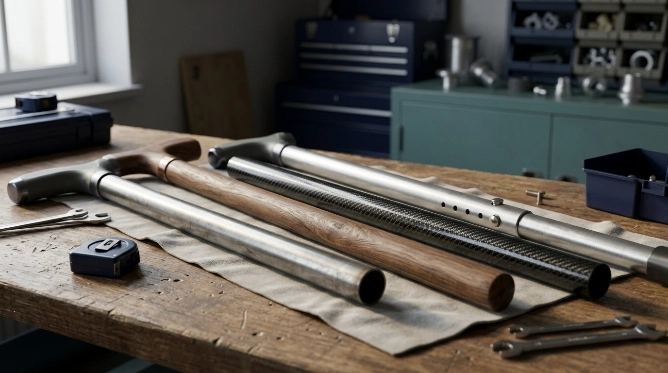
A walking cane shaft is the structural section connecting the cane’s handle to its lower tip. On a traditional wooden cane, it may be one solid piece, while modern mobility canes often use hollow metal or composite tubing.
Simple definition: The shaft is the cane’s main supporting body. It carries forces between your hand and the cane tip while maintaining the cane’s usable length and alignment.
A basic cane can be understood as four connected areas. Each one contributes something different to the finished walking aid.
- Handle: The part held by your hand.
- Collar or connection: The area where some handles meet the shaft.
- Shaft: The long supporting body of the cane.
- Ferrule or tip: The lower component that contacts the walking surface.
Some designs blur these boundaries. A wooden crook cane, for example, may form the curved handle and shaft from one continuous piece of material.
An adjustable cane is different. Its shaft normally contains overlapping sections, adjustment holes, a locking button, and sometimes a tightening collar.
The shaft is more than a decorative stick
It is easy to think of the shaft as nothing more than the space between the handle and tip. Structurally, however, it is the route through which forces travel while the cane is being used.
Its stiffness, connections, length, and condition therefore influence how stable the entire cane feels. A beautiful handle cannot compensate for a damaged or loose shaft.
What does a cane shaft do when you walk?
The shaft transfers force from the handle toward the ground while keeping the handle and tip properly separated. It must do this repeatedly without developing excessive bending, looseness, or structural damage.
- Transfers load: Hand pressure travels through the shaft toward the floor.
- Maintains alignment: It keeps the handle positioned above the tip.
- Sets cane height: Its usable length largely determines handle position.
- Influences feedback: Shaft stiffness and material affect how ground contact feels through your hand.
- Controls portability: Folding and telescoping shafts make a cane easier to store or transport.
Cane loading can place meaningful demands on the upper body. Research on cane-assisted walking has found that increasing dependence on a cane can increase mechanical work at the shoulder and elbow, although individual biomechanics vary considerably.
You can read the published cane biomechanics research on PubMed for more detail. This is one reason cane fit and technique should not be treated as minor details.
Clinician note: If you need substantial weight-bearing support, have worsening weakness, or feel unsafe with a cane, ask a physical therapist or healthcare professional whether a cane is the appropriate mobility aid.
Why shaft stiffness matters
A shaft normally needs enough rigidity to feel predictable when the cane contacts the ground. Excessive flex, movement between sections, or a loose locking mechanism can make that contact feel less stable.
Stiffness should not be confused with maximum user weight. Two shafts made from the same material can have different capacities because diameter, wall thickness, joints, manufacturing, and design also matter.
Section Takeaway: The shaft acts as the cane’s structural bridge between your hand and the floor. Material matters, but construction and condition matter just as much.
Which walking cane shaft material is best?
There isn’t one shaft material that is best for everyone. Wood suits traditional fixed canes, aluminum works especially well for adjustable designs, and carbon fiber can reduce weight in premium designs.
| Material | Usual construction | Weight feel | Adjustability | Main attraction |
|---|---|---|---|---|
| Wood | Usually solid | Moderate | Usually fixed | Traditional feel and appearance |
| Aluminum | Usually hollow tubing | Light | Commonly adjustable | Practicality and easy height adjustment |
| Carbon fiber composite | Composite tube | Very light | Depends on design | High stiffness-to-weight potential |
| Steel | Metal tubing | Heavier | Design dependent | Strong, substantial construction |
Wooden cane shafts
Wood gives a cane a traditional appearance and usually feels substantial rather than clinical. Oak, ash, beech, maple, and other hardwoods may be used depending on the maker.
A fixed wooden shaft also avoids telescoping hardware. The tradeoff is that correct sizing becomes especially important because most wooden shafts cannot be shortened or lengthened repeatedly.
Aluminum cane shafts
Aluminum is well suited to hollow tubular construction. That makes it practical for adjustable shafts with overlapping sections and push-button height settings.
Its biggest everyday advantage is flexibility of fit. If you’re still finding the right cane height, an adjustable aluminum design can be easier to work with than a fixed wooden shaft.
Carbon fiber shafts
Carbon fiber composites offer high stiffness at low weight. That can appeal to someone who frequently lifts, carries, or travels with a cane.
Construction quality still matters. Carbon fiber should never be treated as automatically stronger or safer than every aluminum or wooden cane.
Does shaft weight and rigidity change how a cane feels?
Yes. Research on long mobility canes for people with visual impairment has shown that shaft weight and flexibility can change tactile feedback and hazard-detection performance.
Those long canes serve a different purpose from support canes, so their findings should not be transferred directly. Still, the shaft-material study indexed by PubMed demonstrates that weight and rigidity are functional design properties, not merely cosmetic details.
Section Takeaway: Pick a material for the complete cane design, not because one material sounds more advanced. Weight, fit, joints, capacity, and intended use belong in the same decision.
Fixed, adjustable, or folding shaft: what is the difference?
A fixed shaft prioritizes simplicity, an adjustable shaft prioritizes fit flexibility, and a folding shaft prioritizes portability. Each construction solves a different problem.
| Shaft type | Height adjustment | Connections | Best-known advantage | What to inspect |
|---|---|---|---|---|
| Fixed | Usually none | Few | Simple, solid construction | Cracks, bends, handle joint |
| Telescoping | Yes | Sliding shaft interface | Easy fitting | Button, holes, collar, looseness |
| Folding | Sometimes | Multiple segment joints | Compact storage | Every joint and internal cord |
Fixed shafts
I like the mechanical simplicity of a fixed shaft. There are fewer moving connections to check, although that does not make the cane maintenance-free.
A fixed cane must be the correct length. Cutting a wooden shaft too short cannot be undone without changing components.
Telescoping shafts
A telescoping shaft has one section that slides inside another. A spring-loaded button usually engages a selected adjustment hole, while some designs add a collar to reduce movement.
Check that the button fully projects through its hole before walking. A partly engaged adjustment mechanism should never be treated as secure.
Folding shafts
Folding canes separate into connected segments so the shaft becomes shorter for storage. Many use internal elastic cord to keep the sections together and help guide assembly.
Convenience comes with extra inspection points. Every connection should seat completely before the cane is loaded.
How strong should a walking cane shaft be?
A walking cane shaft should meet the manufacturer’s stated capacity for its intended user and remain structurally sound during normal use. There is no responsible universal weight limit that can be assigned from shaft material alone.
Two aluminum canes may have different capacities. Their tubing diameter, wall thickness, geometry, fasteners, joints, and overall engineering can differ.
- User-weight rating: Stay within the manufacturer’s specified limit.
- Intended use: A light balance cane and a heavy-duty support cane may be engineered differently.
- Joint design: Connections can be as important as the main tube.
- Damage history: A hard impact can change the safety of an otherwise strong shaft.
- Side loading: Canes are normally designed around their intended walking orientation, not as pry bars or lifting tools.
Why diameter alone does not tell you strength
A thick-looking shaft is not automatically stronger. Hollow metal tubing can achieve useful stiffness with less mass, while solid wood behaves differently because its internal structure is completely different.
Wall thickness matters in a hollow tube, but consumers usually cannot judge it visually. That’s why the actual product rating matters more than comparing outside diameter in a photograph.
Watch the joints, not only the middle
When I compare cane construction, one of the first places I look is where parts meet. Adjustment holes, folding joints, handle connections, and lower fittings deserve more attention than an undamaged section in the middle.
Movement, clicking, cracking, or a connection that no longer seats normally deserves investigation. Stop using the cane if you suspect structural failure.
Section Takeaway: Never estimate safe capacity from material, thickness, or appearance. Use the manufacturer’s rating and treat unusual shaft damage or joint movement seriously.
How does shaft length affect cane fit?
Shaft length determines where the cane handle sits relative to your hand and body. A cane that is significantly too long or short can change posture and make normal cane movement awkward.
Mayo Clinic’s cane-fitting guidance says the top of the cane should generally align with the wrist crease while the arm hangs naturally. It also describes a comfortable elbow bend of roughly 15 to 30 degrees while holding the cane.
What happens if the shaft is too long?
A cane that is too tall may force you to lift the shoulder or work harder to move the cane. It can also make placement feel awkward.
What happens if the shaft is too short?
A short cane can encourage leaning toward one side or reaching downward. That can undermine the comfortable posture you wanted from the mobility aid.
- Stand naturally: Wear the shoes you normally walk in.
- Relax your arm: Let it hang beside your body.
- Check wrist position: Compare the handle position with the wrist crease.
- Check elbow bend: Your elbow should remain comfortably flexed rather than locked or sharply bent.
- Test safely: Make sure an adjustable shaft locks fully after changing height.
Clinician note: Body proportions, posture, diagnosis, and walking pattern can change ideal fitting. A physical therapist can assess cane height and technique for your individual needs.
How do you inspect and maintain a cane shaft?
Inspect the shaft regularly enough that gradual wear does not surprise you. I would give extra attention after a fall, hard impact, airline trip, or any event where the cane was crushed or dropped heavily.
For a wooden shaft
- Look for cracks running with or across the grain.
- Check for splitting near the handle and ferrule.
- Watch for serious warping or unexpected movement.
- Keep the finish reasonably protected from prolonged moisture.
For an aluminum shaft
- Look for dents, bends, and creases in the tube.
- Check adjustment holes for deformation.
- Confirm the spring button moves freely and locks fully.
- Tighten the stabilizing collar if the manufacturer’s instructions call for it.
For a folding or carbon fiber shaft
- Check every folding connection before use.
- Look for cracks, deep abrasion, or separation around composite surfaces.
- Make sure sections fit together completely.
- Stop using the cane if the shaft develops unexplained flex, movement, or damage.
Don’t forget the ferrule just because this guide focuses on shafts. A sound shaft still depends on a serviceable tip for reliable ground contact.
MedlinePlus recommends checking cane tips regularly and replacing worn tips. That small inspection belongs in the same routine as checking the shaft.
How should you choose a cane shaft?
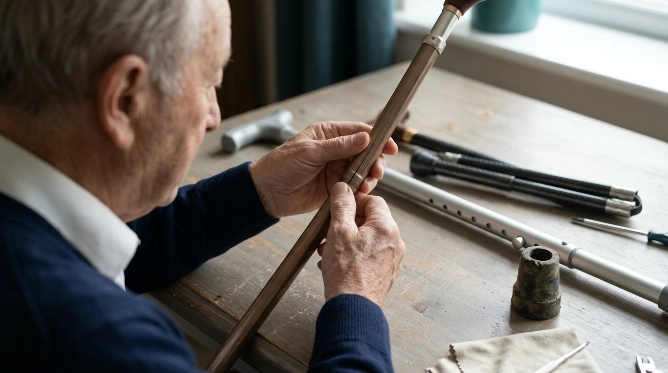
Choose a shaft by starting with your mobility needs, then working through fit, weight, adjustability, portability, and rated capacity. Material should support those requirements rather than become the entire decision.
- Decide how much support you need. A healthcare professional can help if balance or weakness is significant.
- Choose fixed or adjustable length. Adjustable designs are useful when you’re unsure of final sizing.
- Consider carrying weight. A lighter shaft may matter if you lift the cane frequently.
- Think about storage. Folding designs can fit more easily into bags, vehicles, or luggage.
- Check the capacity. Use the manufacturer’s stated user-weight rating.
- Inspect the locking design. Adjustment and folding mechanisms should feel positive and secure.
- Check replacement parts. Tips and other wear components should be obtainable when needed.
Which shaft would I consider first?
For someone who has never used a cane and is still finding the correct height, a quality adjustable shaft offers useful flexibility. It lets you change the setting without permanently cutting the cane.
A fixed wooden shaft makes more sense when exact sizing is already known and traditional appearance matters. A lightweight composite design may appeal more to someone who prioritizes low carrying weight.
One buying mistake to avoid: Don’t choose a cane solely because its shaft material sounds premium. A properly fitted, well-built cane with an appropriate rating is more useful than an expensive material in the wrong size or design.
As of 2026, cane buyers can choose from more shaft constructions than the traditional single-piece stick. That makes it even more important to compare the whole device rather than one specification.
Section Takeaway: Start with fit and intended support. Then choose the shaft material and construction that make that correctly fitted cane practical for your daily routine.
Frequently asked questions
Is the shaft the same thing as the entire walking cane?
No. The shaft is the long structural body of the cane, while the complete cane also includes a handle and ground-contact tip or ferrule.
Can a walking cane shaft be replaced?
It depends on the design. Some modular or custom canes allow component replacement, while many mass-market mobility canes are intended to be replaced as a complete unit if the structural shaft becomes damaged.
Is a wooden cane shaft stronger than aluminum?
You cannot determine that from material alone. Strength and safe user capacity also depend on dimensions, construction, joints, manufacturing quality, and the manufacturer’s tested or stated rating.
Why does my adjustable cane shaft rattle?
A small amount of movement may come from overlapping adjustable sections, but a new or worsening rattle should be investigated. Check that the adjustment button is fully engaged and any locking collar is secured according to the manufacturer’s instructions.
Can I drill another adjustment hole into a metal cane shaft?
Don’t modify a load-bearing cane shaft unless the manufacturer specifically permits that change. Drilling, cutting, heating, or reshaping a shaft can alter its structural behavior and may void its rated capacity or warranty.
Can a bent aluminum cane shaft be straightened?
A bent mobility cane should normally be treated as structurally damaged rather than casually bent back into shape. Contact the manufacturer or a mobility professional about replacement instead of relying on a home repair.
How often should I check the cane shaft?
A quick visual and hands-on check before regular use is sensible, especially around adjustment points and folding joints. Inspect it more carefully after a fall, hard impact, or whenever the cane starts feeling different.
The bottom line on walking cane shafts
The shaft is one of the most important structural parts of a walking cane. It determines much of the cane’s length, weight, rigidity, adjustability, and portability.
Wood offers simplicity and traditional character, aluminum makes adjustable construction practical, and carbon fiber can reduce weight. None should be chosen without also considering fit, rated capacity, joints, and overall condition.
If you rely on a cane for balance or physical support, treat unexplained bending, cracking, looseness, or locking problems as safety issues. When your mobility needs are changing, a physical therapist or healthcare professional can also help confirm whether your cane and its setup still suit you.