
What Does a Walking Cane Do?


Bathtub Transfer Bench
Electric Mobility Scooter

Electric Food Chopper
Quick Answer
A walking cane gives you an extra point of contact with the ground. It can improve stability, support a mildly weak or painful leg, and make everyday walking feel more controlled. A properly fitted cane is most useful when you need a little help rather than full weight-bearing support; Mayo Clinic’s cane guidance also stresses correct fit and safe technique.
What a cane can do
- Improve stability: It gives your body another contact point while you step, turn, or pause.
- Share some load: Your arm can take part of the pressure that would otherwise pass through a sore or weaker leg.
- Support confidence: A predictable support point can make short walks and daily errands feel less uncertain.
- Help with timing: Moving the cane with the weaker leg can create a steadier walking rhythm.
- Assist on steps: Used correctly with a handrail, a cane can add support on curbs and stairs.
One important limit
- If you need heavy support, have frequent falls, or cannot walk safely with a cane, ask a clinician or physical therapist whether a walker or another aid is more appropriate.
I think of a cane as a small tool with a surprisingly important job. It should make walking more controlled without forcing you to lean, reach, or change your posture unnaturally.
As of 2026, the basic advice has not changed: fit matters, technique matters, and the right aid depends on how much support you need. This guide explains what a cane does, what it does not do, and how to use one more safely.
In This Guide
- What does a walking cane actually do?
- How does a cane help balance and reduce pressure?
- Who may benefit from using a cane?
- What type of walking cane should you use?
- How tall should a walking cane be?
- Which hand should hold the cane?
- How do you use a cane on stairs and curbs?
- When is a cane not enough?
- Frequently asked questions
- Final takeaway
What does a walking cane actually do?
A walking cane is a mobility aid that adds one extra support point between your body and the ground. It can help you steady yourself, move with better control, and reduce some demand on a mildly painful or weak lower limb.
That sounds simple, but three different jobs are happening at once.
- Balance support: The cane gives you a wider functional base while walking and standing.
- Partial unloading: You can press through the handle to shift some force through your arm instead of one leg.
- Movement cue: The cane can help organize the timing of your steps when one side feels weaker or less reliable.
A cane is not meant to carry all your body weight
A standard cane is usually for light to moderate assistance, not for replacing the support of both legs. If you must lean heavily on it every step, the device may be too limited for your needs.
Section Takeaway: A cane mainly adds stability, modest support, and walking rhythm. It is not a substitute for a stronger mobility aid when you need substantial weight-bearing help.
How does a cane help balance and reduce pressure?

A cane helps balance by giving your body another stable contact point. It may also reduce how much force a sore or weaker leg must handle during part of the walking cycle.
- During standing: The cane gives you a nearby point to steady against.
- During stepping: It can support the weaker side as that leg moves or accepts weight.
- During turning: It can help you slow the movement and avoid rushing through the pivot.
- During fatigue: It provides a consistent support point when your legs feel less reliable.
Why the opposite hand matters
Holding the cane opposite the weaker or painful leg lets the cane and affected leg move together. That pattern can help you stay more upright and share some of the demand across your body.
For example, if your right knee is the problem, you would usually hold the cane in your left hand. You then move the left-hand cane forward with the right leg.
Health note: For individualized advice, speak with a doctor, physical therapist, or occupational therapist if balance, pain, or weakness is new or worsening.
Section Takeaway: A cane can support balance and reduce some lower-limb demand, but it works as part of your whole balance system. Persistent instability needs professional assessment.
Who may benefit from using a cane?
A cane may suit someone who can still walk independently but needs a small amount of extra stability or support. The National Institute on Aging advises using an assistive device when needed and having it properly sized for safe use.
You may be a reasonable cane user if one side feels mildly painful, weak, stiff, or less dependable, yet you can still stand and walk without major assistance.
Common situations where a cane may help
- Mild balance difficulty: You feel steadier with one hand supported.
- One-sided leg discomfort: A hip, knee, ankle, or foot is sore enough to change your walking.
- Short-term recovery: You are progressing after an injury or procedure and your clinician allows partial support.
- Reduced endurance: Your walking remains safe, but fatigue makes you less steady near the end of an outing.
- Uneven confidence: Curbs, crowded spaces, or unfamiliar surfaces make you hesitate.
Who should be cautious about relying on a cane?
A cane may be too little support if you regularly grab furniture, need another person to steady you, or cannot keep the cane planted securely. Significant weakness on both sides can also make a one-handed aid a poor match.
The National Institute on Aging’s fall-prevention guidance recommends correct sizing and notes that a physical or occupational therapist can help choose and teach safe use of mobility aids.
- Seek help if you have repeated falls or near-falls.
- Seek help if dizziness or faintness is new.
- Seek help if you suddenly develop weakness or numbness.
- Seek help if pain makes you place heavy body weight through the cane.
Health note: A cane should match your medical and mobility needs. New neurological symptoms, sudden weakness, severe pain, or a fall with injury warrants prompt medical evaluation.
What type of walking cane should you use?
The best cane is not automatically the one with the widest base or most features. It is the one that gives enough support without becoming awkward to place, lift, or carry.
| Cane type | Base | Typical support level | Best suited for | Main tradeoff |
|---|---|---|---|---|
| Single-point cane | One tip | Light support | Mild balance or one-sided discomfort | Less stable than a multi-point base |
| Quad cane | Four feet | More stationary support | People who benefit from a wider base | Heavier and slower to reposition |
| Folding cane | Usually one tip | Similar to its non-folding equivalent | Travel and occasional use | Joints must lock securely |
| Hiking or walking stick | One outdoor tip | Terrain aid, not always medical support | Trails, hills, and recreational walking | May not be designed as a clinical mobility aid |
How tall should a walking cane be?
A correctly fitted cane should let you stand upright with relaxed shoulders and a slight elbow bend. Mayo Clinic suggests roughly 15 to 30 degrees of elbow bend, with the handle near the wrist crease when your arm hangs at your side.
A simple fit check
- Put on the shoes you normally wear for walking.
- Stand as upright as you comfortably can.
- Let your arms rest naturally at your sides.
- Adjust the cane handle to about the crease of your wrist.
- Grip the handle and confirm that your elbow stays slightly bent.
Section Takeaway: Set the handle near wrist-crease height and keep a slight elbow bend. If you have to shrug, lean, or reach, recheck the fit.
Which hand should hold the cane?
In most one-sided problems, hold the cane in the hand opposite the weaker or painful leg. MedlinePlus gives the same guidance and recommends moving the cane forward with the weaker leg.
If your right leg is affected, hold the cane in your left hand. If your left leg is affected, use your right hand.
How to walk with a cane
- Stand tall with the cane beside your stronger side.
- Move the cane forward a short, comfortable distance.
- Move the weaker or painful leg forward with the cane.
- Press through the cane only as much as needed.
- Step through with the stronger leg.
- Repeat at a controlled pace.
The MedlinePlus cane-use instructions also advise looking forward rather than down at your feet. Turning slowly is safer than twisting quickly on the weaker leg.
Should you ever use the cane on the same side?
There are individual exceptions, especially when a clinician is addressing a specific movement pattern, hand limitation, or injury. Do not change sides simply because one hand feels more natural if the cane was prescribed for a particular problem.
If both legs are weak or painful, one cane may not offer enough support. A therapist can assess whether a walker, crutches, or another device is more suitable.
Health note: If you have had surgery, follow your surgeon’s or therapist’s weight-bearing instructions. General cane technique should never override a specific rehabilitation plan.
How do you use a cane on stairs and curbs?
Use a handrail whenever one is available. The usual sequence is strong leg first going up, weaker leg first going down.
Going up a curb or step
- Stand close to the step.
- Keep the cane planted securely.
- Step up with your stronger leg first.
- Bring the weaker leg and cane up to the same level.
- Pause before continuing.
Going down a curb or step
- Place the cane on the lower level first.
- Move the weaker leg down next.
- Bring the stronger leg down last.
- Pause if you need to reset your balance.
On a staircase, move one step at a time until the pattern feels automatic. Do not rush because someone is waiting behind you.
Section Takeaway: Use the rail when possible, lead up with the stronger leg, and lead down with the cane and weaker leg. Slow, deliberate steps matter more than speed.
When is a cane not enough?
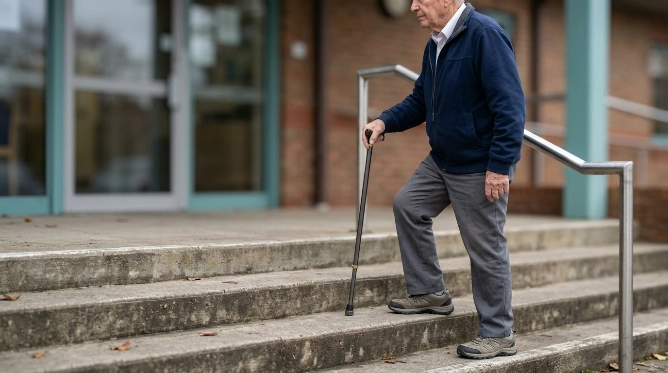
A cane is not enough when you need more support than one hand and one ground point can safely provide. Frequent falls, major balance loss, or heavy leaning are strong reasons to reassess the device.
CDC fall-prevention guidance emphasizes that falls have multiple risk factors, including walking difficulty, lower-body weakness, medicines, vision problems, footwear, and home hazards. A cane can help with mobility, but it cannot correct every risk.
Signs you may need a different mobility aid
- You put a large share of your body weight through the cane.
- You stumble even when the cane is correctly placed.
- You cannot walk safely while carrying the cane.
- You need furniture, walls, or another person as a second support.
- You have repeated falls or near-falls.
- You cannot keep the cane tip flat and secure.
Check the cane itself
A worn rubber tip reduces traction. MedlinePlus recommends checking cane tips and replacing them when they are worn.
- Tip: Look for smooth tread, cracking, hardening, or uneven wear.
- Height button: Confirm that adjustable sections lock fully.
- Folding joints: Make sure each segment seats securely before walking.
- Handle: Replace or repair a grip that twists, tears, or becomes slippery.
Make the environment safer too
A good cane cannot cancel out a loose rug, wet floor, dark hallway, or poorly fitting shoe. The CDC’s older-adult fall-prevention resources recommend addressing home hazards and other fall risks alongside mobility support.
Use nonslip footwear, keep walking paths clear, and leave one hand available for a railing when possible. A shoulder bag or small backpack can keep your hands freer than carrying loose items.
Health note: Tell a healthcare professional about falls, repeated near-falls, new dizziness, or sudden mobility changes. Those problems may need assessment beyond choosing a different cane.
Section Takeaway: A cane helps only when the person, device, and environment work together. If you still feel unsafe, reassess the mobility aid instead of forcing the cane to do more than it can.
Frequently asked questions
Does a walking cane prevent falls?
A cane can improve stability when it is the right device, correctly fitted, and used properly. It cannot guarantee that you will not fall because vision, strength, medications, surfaces, footwear, and balance disorders can also affect fall risk.
Does a cane help with knee pain?
It can reduce some demand on a painful knee when used in the opposite hand. If knee pain is severe, worsening, or changes your walking substantially, ask a clinician whether a cane is enough support.
Can I use a cane just for balance?
Yes. Some people use a cane mainly for mild balance support rather than pain or weakness. The cane should still be fitted to your height and placed securely with each step.
Is a quad cane better than a regular cane?
Not always. A quad cane has a broader base and may feel steadier during pauses, while a single-point cane is lighter and often easier to move naturally. The better choice depends on how much support you need.
Can a walking stick do the same job as a medical cane?
Sometimes for light recreational support, but not necessarily for a medical mobility need. Hiking sticks may be designed for terrain and rhythm rather than precise height, grip, base, and weight-bearing requirements.
How do I know if my cane is the right height?
With your arm resting by your side, the handle should sit around your wrist crease. When you grip it, your elbow should stay slightly bent and your shoulder should remain relaxed.
When should I switch from a cane to a walker?
Consider an assessment if you need heavy support, have trouble on both sides, fall repeatedly, or still feel unsafe with a cane. A walker offers a larger support base, but it also needs correct fitting and technique.
Final takeaway
A walking cane does more than give you something to lean on. Used correctly, it can add stability, share some load with a weaker or painful leg, and help make everyday walking more controlled.
The key is matching the cane to your actual needs. Set the height correctly, use the opposite hand for a one-sided problem, keep the tip in good condition, and ask for professional guidance when one cane no longer feels like enough.
If your goal is to keep enjoying walks, errands, travel, gardening, or other hobbies, the best cane is the one that supports safe movement without getting in your way. Proper fit and technique matter more than extra features.