
Senior Track and Field Records


Adjustable Walker with Wheels

Audiobook Player

Spill-Proof Travel Mug
Senior track and field records celebrate the incredible athleticism of older adults who continue to push physical limits well into their golden years. These milestones highlight not just speed and strength, but also discipline, resilience, and lifelong commitment to fitness. Whether you’re a competitor or a fan, these achievements inspire us all to redefine what’s possible with dedication and proper training.
The world of athletics is often seen as a young person’s game—fast-paced, physically demanding, and dominated by athletes in their teens and twenties. But that’s changing fast. Every year, more and more people are proving that age is just a number when it comes to physical performance. In fact, senior track and field records are being shattered regularly by dedicated individuals who refuse to let biology define their potential. From sprinting to long-distance running, jumping to throwing, men and women over 60 are setting new standards that challenge our assumptions about aging and ability.
These aren’t just numbers on a scoreboard—they’re stories of perseverance, discipline, and passion. Athletes in their seventies, eighties, and even nineties are competing at the highest levels, inspiring both younger generations and their peers. And while some may assume these seniors are simply maintaining fitness, many are actually pushing boundaries and rewriting what’s possible after decades of life experience.
In this article, we’ll explore the fascinating world of senior track and field records, from how they’re measured to the incredible people behind them. We’ll look at the science of aging and performance, share tips for safe and effective training, and celebrate the growing movement of masters-level athletes who prove that greatness has no expiration date.
Whether you’re a senior looking to get back into shape or someone who simply admires human endurance, there’s something deeply motivating about seeing someone in their late sixties run faster than they did at 25. Let’s dive into why these records matter—and how you might be inspired to join the ranks.
Key Takeaways
- Senior track and field records are officially recognized performances by athletes aged 60 and above across various events.
- The World Masters Athletics (WMA) governs international competitions and maintains updated global records for seniors.
- Aging doesn’t mean slowing down—many seniors compete at elite levels with smart training and recovery.
- Records in sprints, jumps, throws, and distance events continue to fall as techniques improve and participation grows.
- These achievements promote healthy aging, community engagement, and intergenerational inspiration.
- Training strategies for seniors emphasize injury prevention, nutrition, and periodized workouts.
- Local and national masters programs offer opportunities for seniors to test their limits safely and competitively.
📑 Table of Contents
- What Are Senior Track and Field Records?
- How Are Senior Track and Field Records Measured?
- Notable Senior Track and Field Records
- Training Strategies for Senior Athletes
- Health Benefits of Competitive Athletics in Later Life
- Getting Started: How Seniors Can Enter Competitions
- The Future of Senior Track and Field Records
What Are Senior Track and Field Records?
When we talk about senior track and field records, we’re referring to official best times, distances, or heights achieved by athletes aged 60 and older. These records are organized by age group—60–64, 65–69, 70–74, and so on—to ensure fair competition among peers of similar physical development and hormonal profiles. The World Masters Athletics (WMA) oversees global recognition of these records, though many countries have their own national organizations tracking performance locally.
Unlike Olympic or collegiate records, which are based on chronological age, masters athletics uses age-grading systems to compare performances across different generations. This means a 70-year-old sprinter can be evaluated fairly against a 60-year-old, even if their raw times differ significantly. It’s a system designed to reward improvement and consistency rather than just peak performance.
Events include everything from the 100-meter dash to the hammer throw, high jump to marathon. There are also combined events like the decathlon and heptathlon adapted for masters athletes. Women and men compete separately, with some categories including non-binary participants in certain meets.
These records aren’t just symbolic—they represent real progress. Each new record reflects better coaching, improved understanding of physiology, and increased accessibility to training resources. They also serve as benchmarks for personal goals: many seniors set out not to beat others, but to beat their own past selves.
For example, a 78-year-old woman might aim to shave two seconds off her 400-meter time from five years ago. That kind of personal triumph is just as meaningful as breaking a world record—and often more relatable.
How Are Senior Track and Field Records Measured?

Visual guide about Senior Track and Field Records
Image source: mywordsearch.s3.amazonaws.com
Measuring senior track and field records follows strict guidelines to ensure fairness and accuracy. All competitions must be sanctioned by recognized bodies like the WMA or USA Track & Field (USATF). Officials verify athlete eligibility through birth certificates or government IDs, confirming age at the time of competition.
Timing is done using electronic starting blocks and photo finishes, especially critical in close races. Wind readings are recorded for sprints and jumps; a tailwind over 2.0 meters per second invalidates world records. Officials also measure takeoff points, landing zones, and equipment dimensions precisely.
For field events, judges use calibrated tools—measuring tapes, laser rangefinders, and certified shot put balls. Every attempt is documented with video evidence in case of disputes.
Age-group divisions follow a standard system:
– 60–64 (Masters I)
– 65–69 (Masters II)
– 70–74 (Masters III)
– 75–79 (Masters IV), etc.
This ensures athletes compete against those within a reasonable physiological window. It also allows for long-term tracking of performance trends—like how average sprint times change between the 60s and 80s.
Some federations allow “over-age” categories where athletes aged 60+ can compete in lower brackets if they meet specific criteria. This encourages participation without compromising safety or fairness.
Ultimately, the goal is simple: capture true performance under controlled conditions. When a 63-year-old sets a new 100m record of 13.8 seconds in a certified meet, it becomes an official milestone—recognized globally and celebrated by the community.
Notable Senior Track and Field Records

Visual guide about Senior Track and Field Records
Image source: static.wixstatic.com
Over the past decade, several senior track and field records have captured global attention. One standout is the women’s 60-meter dash record held by Marjorie Jackson-Nelson, an Australian legend who competed into her late 80s. At 84 years old, she ran the 60m in just 11.23 seconds—a time that would rank highly among junior competitors today.
In distance running, George Hood remains a towering figure. The American ultramarathoner completed the 100-mile race in under 13 hours at age 81, setting multiple age-group world records. His story shows that endurance isn’t limited by years—just by mindset and preparation.
On the field, Alida van der Merwe, a South African shot putter, threw over 12 meters in her 90s, astonishing sports scientists and fans alike. Her technique, built over decades of practice, allowed her to maintain power despite natural declines in muscle mass.
Even in combined events, seniors are making waves. The men’s 65–69 decathlon record stands at 6,842 points, set by John Kiviat in 2022. He trained rigorously, focusing on recovery and mobility, proving that versatility across disciplines is still achievable late in life.
These records aren’t isolated incidents—they reflect a broader trend. More seniors are entering competitions, supported by coaches, medical professionals, and supportive communities. As awareness grows, so does the pool of talent willing to test limits.
It’s also worth noting that records are constantly evolving. What was once considered impossible becomes routine. A 70-year-old who runs 4:30 in the mile today might see that time drop below 4:00 tomorrow with focused training.
Training Strategies for Senior Athletes
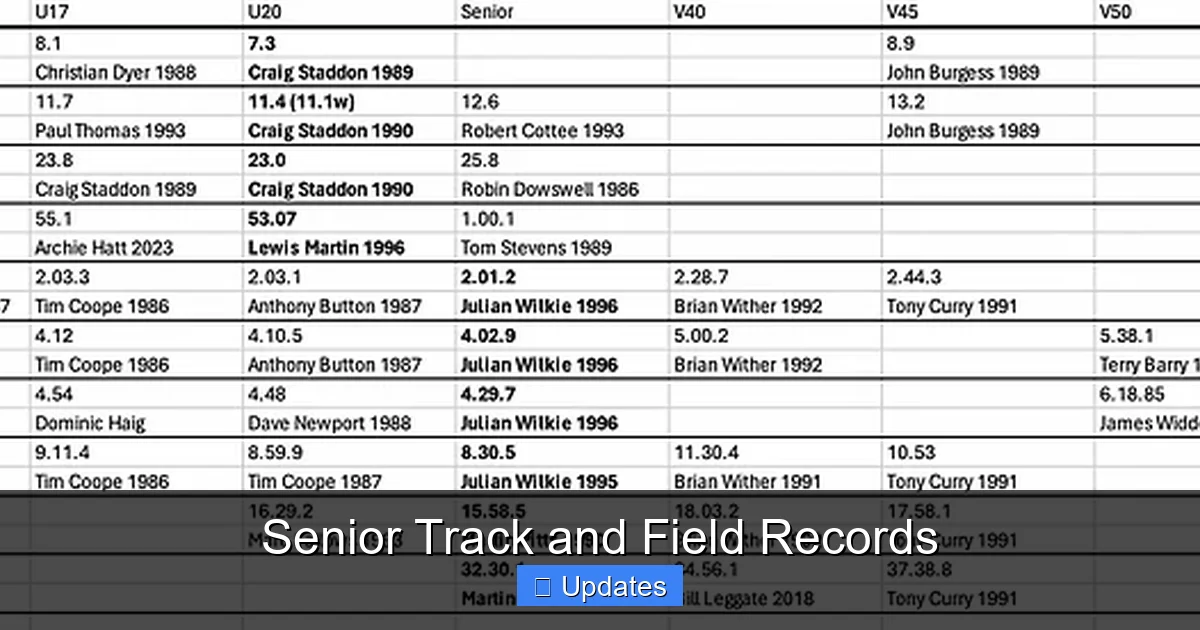
Visual guide about Senior Track and Field Records
Image source: static.wixstatic.com
Staying competitive in your 60s, 70s, or beyond requires smart training. Unlike youth athletes, seniors benefit from approaches that prioritize longevity over intensity. Here’s what top-performing masters athletes do differently:
Focus on Consistency Over Intensity
Instead of pushing hard every session, many seniors adopt low-to-moderate intensity training most days. Think brisk walks, easy runs, or light resistance work three to five times weekly. This builds aerobic base without taxing joints or tendons.
Incorporate Strength and Mobility Work
Muscle loss accelerates after 65, but strength training can slow—or even reverse—that decline. Exercises like squats, lunges, and planks help maintain power for sprinting and jumping. Pair these with dynamic stretching and foam rolling to support flexibility and reduce stiffness.
Practice Periodization
Divide training into phases: build endurance first, then add speed work, followed by taper weeks before competition. This mimics youth programs but adapts volume and load based on recovery capacity.
Prioritize Recovery
Sleep, hydration, and nutrition are non-negotiable. Seniors need slightly more protein (1.2–1.6g per kg of body weight daily) and anti-inflammatory foods like berries, leafy greens, and fatty fish. Supplements like vitamin D and omega-3s support bone and joint health.
Work With Specialists
Find a coach experienced in masters athletics. They’ll design workouts that respect your history—whether you were a college runner or just started later in life. Physical therapists can also address chronic issues like arthritis or prior injuries.
For example, a 68-year-old former sprinter might focus on short bursts of acceleration rather than full-speed repeats. Meanwhile, a beginner in their 70s could start with interval walking before progressing to jogging.
Remember: progression should feel sustainable. If a workout causes soreness lasting more than 48 hours, scale back. Pain is your body’s warning system—listen carefully.
Health Benefits of Competitive Athletics in Later Life
Competing in track and field isn’t just about records—it’s about quality of life. Research shows regular physical activity after 60 improves nearly every aspect of health:
– Reduced risk of heart disease by up to 40%
– Improved insulin sensitivity and blood sugar control
– Stronger bones, lowering osteoporosis risk
– Better balance, reducing fall-related fractures
– Enhanced cognitive function and mood stability
Social connection is another key benefit. Joining a masters team or local club combats isolation—a major concern for older adults. Training together builds camaraderie and accountability.
Mental resilience also grows. Setting and achieving goals boosts self-esteem. Overcoming fatigue or pain teaches grit. Many seniors report feeling “younger” mentally than their peers who sit at home.
And yes—competing adds excitement. There’s nothing like crossing the finish line knowing you gave it your all. Even if you don’t win gold, the pride of showing up counts.
Getting Started: How Seniors Can Enter Competitions
You don’t need to be a former Olympian to compete. Most masters programs welcome newcomers. Here’s how to begin:
Find a Local Club
Search online for “masters track and field [your city]” or visit your state’s USATF website. Clubs provide coaching, meet schedules, and often cover entry fees for first-timers.
Register for a Meet
Start small—maybe a 5K fun run or local track event. Wear proper shoes, bring water, and arrive early. Volunteers will guide you through check-in and warm-ups.
Understand the Rules
Each event has rules: lane assignments, false start penalties, wind limits. Ask a coach or veteran athlete for clarification. Safety always comes first.
Prepare Physically
Begin with cross-training: cycling, swimming, or elliptical work builds fitness without impact. Gradually introduce running or field drills based on your comfort level.
Many seniors find joy in “benchmarking”—racing against past performances rather than others. For instance, aiming to run 10 minutes flat in the 5K instead of comparing yourself to elite runners.
Don’t forget to document your journey! Taking photos during training or posting updates online creates motivation and shares inspiration with others.
The Future of Senior Track and Field Records
As life expectancy rises and attitudes toward aging shift, expect more breakthroughs. Medical advances in gerontology, wearable tech for monitoring recovery, and AI-driven training apps will further empower seniors.
More women will compete—especially in endurance events where representation has historically lagged. Global participation will grow as developing nations invest in masters programs.
Technology will also play a role. Virtual races and hybrid meets could become common, allowing remote competitors to log times accurately. Biometric sensors might predict optimal training loads before injuries occur.
But the core will remain human: passion, curiosity, and the drive to move forward. Every new record—whether in the 100m or discus—is a vote for possibility.
Imagine a future where 90-year-olds routinely complete marathons. Where schools teach kids that greatness isn’t tied to youth. That’s the legacy we’re building now, one lap, one throw, one step at a time.
—
In closing, senior track and field records are more than statistics—they’re symbols of what humanity can achieve when we choose to keep moving. Whether you’re 60 or 90, the track awaits. And who knows? Maybe you’ll be the next name etched into history.
For more inspiration on staying active and engaged in later life, check out our guides on Senior Health And Fitness Day 2025 and Fisher Senior Care And Rehab. And if you’re planning a celebration of your own accomplishments, don’t miss creative ideas for Cap And Gown Senior Picture Ideas that honor your journey!
Frequently Asked Questions
Are senior track and field records recognized internationally?
Yes, the World Masters Athletics organization officially recognizes records set by athletes aged 60 and over in sanctioned competitions worldwide. These records are categorized by age group and event type.
Can I compete in senior track events if I’m in my early 60s?
Absolutely. Most masters programs accept athletes starting at age 60. You’ll compete in the 60–64 age bracket and can begin training immediately with proper guidance.
Do I need previous competitive experience to join?
No prior experience is required. Many clubs welcome beginners and provide coaching tailored to individual fitness levels and goals.
How often are senior track and field records updated?
Records are verified and updated continuously through national and international sanctioning bodies. New marks are added as they’re officially ratified at recognized meets.
What safety precautions should seniors take before starting training?
Consult your doctor before beginning any exercise program, especially if you have chronic conditions. Focus on gradual progression, wear supportive footwear, and listen to your body to avoid overuse injuries.
Where can I find upcoming senior track and field meets?
Check websites like USATF.org or your local park district for event listings. Many colleges and universities host open masters meets throughout the year.